2027 Chevrolet Blazer EV Maintains Pricing Despite NACS Integration and Upgrades
The 2027 Chevrolet Blazer EV will maintain its current pricing structure, a strategic decision that positions the electric SUV competitively despite integrating a North American Charging Standard (NACS) port and other unspecified enhancements.
✨ This content was summarized and interpreted by AI; it may contain errors — please verify accuracy with the original sources. Learn more
Listen to this story
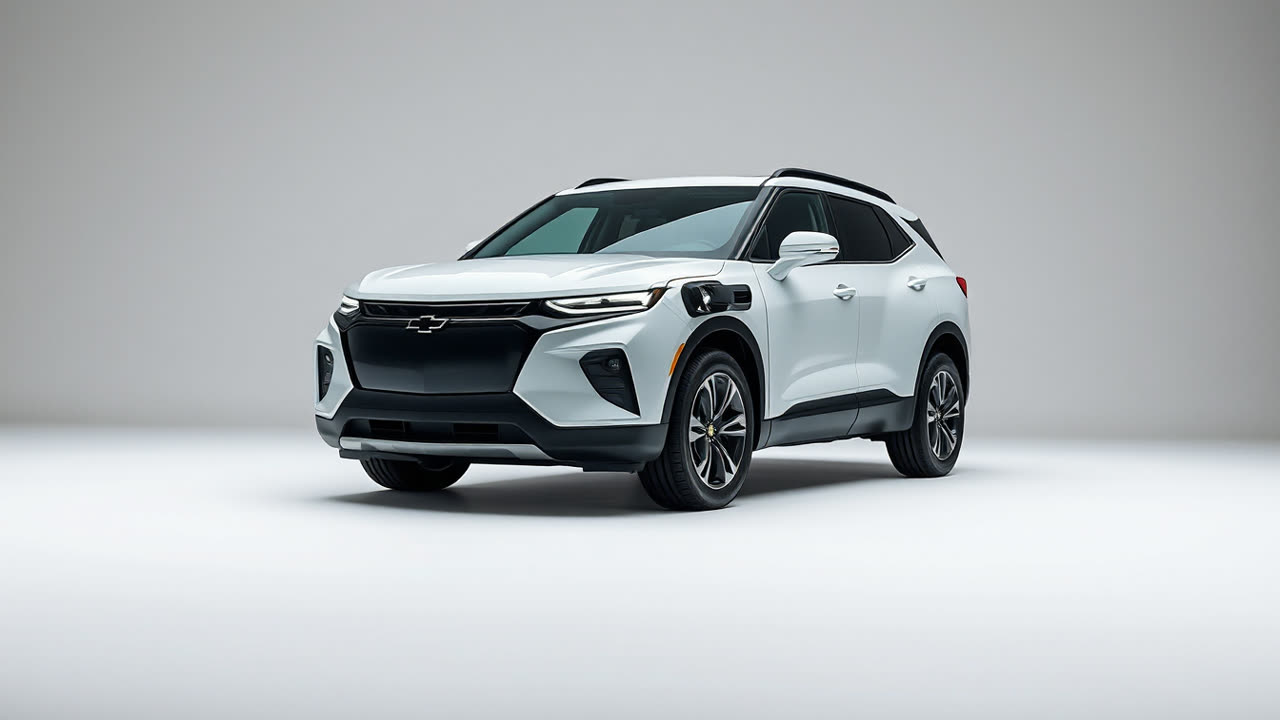
The 2027 Chevrolet Blazer EV will maintain its current pricing structure, a strategic decision that positions the electric SUV competitively despite integrating a North American Charging Standard (NACS) port and other unspecified enhancements. This move, confirmed by General Motors, underscores a broader industry pivot towards standardizing charging infrastructure while simultaneously navigating a fiercely contested EV market where pricing power is increasingly critical. The outgoing 2026 Blazer EV, which the 2027 model directly succeeds, currently starts at an MSRP of $50,195 for the 2LT trim, with the RS trim at $54,595, and the performance-oriented SS variant commanding $65,995. Maintaining these price points for an upgraded model delivers tangible value to consumers, effectively offering more for the same investment and signaling GM's commitment to bolstering its EV lineup's appeal without succumbing to inflationary pressures or passing on the costs of new technology.
This pricing stability for the 2027 Blazer EV is a significant development, primarily because of the NACS integration. The adoption of NACS, championed by Tesla and now widely embraced across the industry, promises to simplify the charging experience for GM owners by providing access to Tesla's extensive Supercharger network, which boasts over 15,000 individual chargers across North America. This expanded charging access directly addresses a perennial pain point for prospective EV buyers: range anxiety and the perceived inadequacy of non-Tesla charging infrastructure. For the user, it means greater convenience, reduced charging times at compatible stations, and significantly improved long-distance travel capabilities. For the industry, it solidifies NACS as the de facto standard, accelerating the transition away from the Combined Charging System (CCS) and potentially streamlining future EV infrastructure investments. GM's decision to include the NACS port as standard for 2027 models, rather than offering it as an option or requiring an adapter, also signals confidence in the long-term viability and dominance of the NACS ecosystem.
Beyond the charging standard, the unspecified "additional features" for the 2027 Blazer EV are critical to maintaining its competitive edge. Given the 2024 and 2025 model year Blazer EVs faced initial software glitches and production delays, forcing a temporary halt in sales and a re-evaluation of its infotainment system, these upgrades likely include significant software refinements, enhanced driver-assistance technologies, or even subtle interior material improvements. Addressing these early-production hiccups and refining the user experience is paramount for GM to rebuild consumer trust and ensure the Blazer EV lives up to the promise of its Ultium platform. The Ultium architecture, designed for flexibility and scalability, underpins GM's next generation of EVs, promising impressive range, fast charging, and robust performance across various vehicle segments. The Blazer EV, with its estimated range of up to 324 miles for the 2LT and RS AWD models and 279 miles for the SS performance variant, already offers competitive metrics against rivals like the Tesla Model Y Long Range, which provides an estimated 330 miles of range and starts at approximately $47,490. The Ford Mustang Mach-E, another key competitor, offers up to 320 miles of range and starts around $49,995, positioning the Blazer EV squarely in the heart of this competitive segment. By holding prices steady while adding value, GM is directly challenging these rivals, particularly Tesla, which has aggressively cut prices in recent years to maintain market share.
Looking ahead, GM's strategy with the 2027 Blazer EV suggests a nuanced approach to the evolving EV landscape. Rather than engaging in a direct price war that could erode margins, the company appears focused on enhancing the value proposition through feature upgrades and charging convenience, leveraging the NACS transition as a significant selling point. This could set a precedent for other legacy automakers as they integrate NACS into their upcoming models. Furthermore, the stabilization of pricing for a key EV model hints at a maturing market where consumers expect consistent value and a seamless charging experience. The success of the 2027 Blazer EV will be a crucial barometer for GM's broader Ultium strategy and its ability to compete effectively against established EV players and emerging contenders. As battery technology continues to advance and manufacturing efficiencies improve, future iterations of the Blazer EV or other Ultium-based vehicles could see further range enhancements or even more aggressive pricing strategies, but for now, the focus is clearly on delivering more for the same.