24-Carat Gold Mini PC Costs $1.7 Million, Redefining Luxury Tech
An unnamed "chrysophile" commissioned a custom mini PC with a pure 24-carat gold passive chassis for an estimated $1.7 million, weighing nearly 29 pounds and claiming up to 50% faster heat transfer.
✨ This content was summarized and interpreted by AI; it may contain errors — please verify accuracy with the original sources. Learn more
Listen to this story
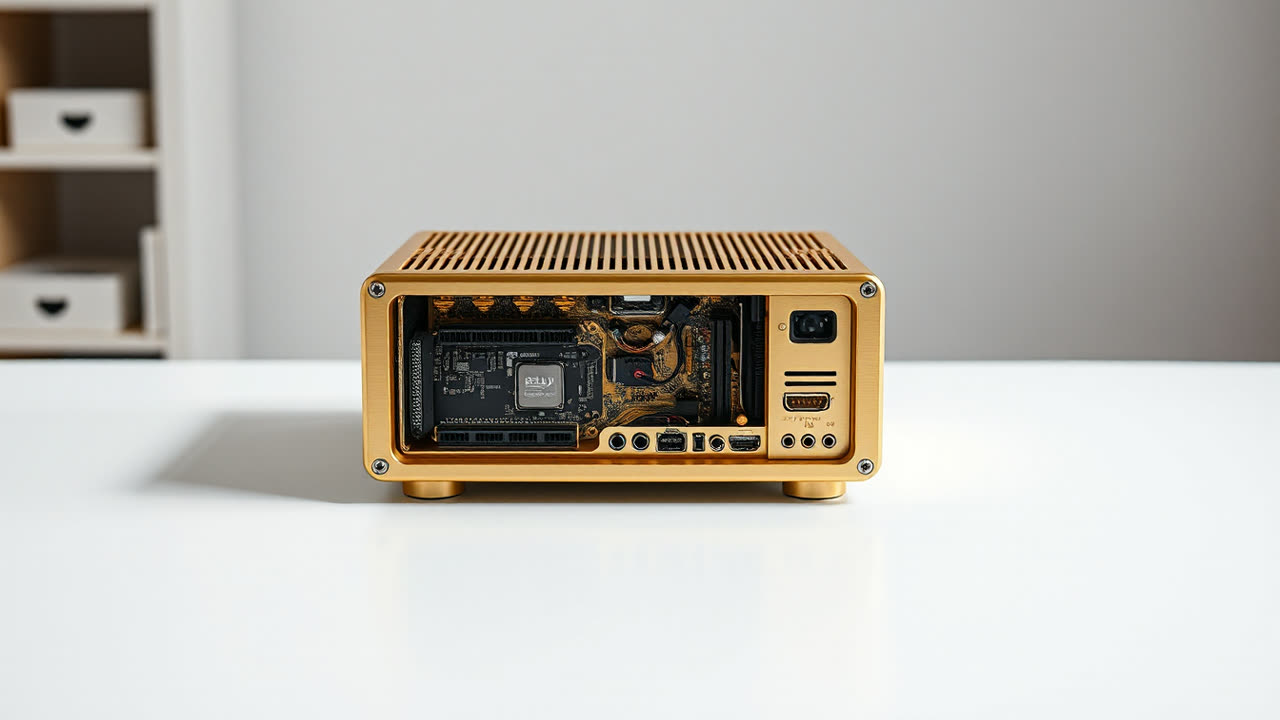
A custom mini PC, featuring a pure 24-carat gold passive chassis, has been commissioned for an estimated $1.7 million, weighing nearly 29 pounds and purportedly offering up to 50% faster heat transfer than conventional materials. This extraordinary bespoke creation, ordered by an unnamed "chrysophile," represents an unprecedented convergence of extreme luxury and niche computing, pushing the boundaries of what constitutes high-end hardware, albeit with a profound reordering of priorities where material value dwarfs practical performance metrics.
The core news underscores a fascinating paradox: while the mini PC leverages gold for its chassis to aid in heat dissipation, gold is not, from an engineering standpoint, the optimal material for thermal conductivity. Copper, for instance, boasts a thermal conductivity of approximately 401 W/(m·K), while pure gold registers around 310 W/(m·K). Silver, another precious metal, surpasses both at roughly 429 W/(m·K). Even common aluminum, often used in PC cases and heatsinks, offers a respectable 205 W/(m·K), making the choice of gold less about peak thermal efficiency and more about unparalleled opulence. The claimed "up to 50% faster heat transfer" is likely a relative comparison to standard, less optimized passive cooling solutions, rather than a direct comparison against more thermally efficient, yet less precious, metals like copper or silver. The sheer mass of 29 pounds (around 13.15 kg) of 24-carat gold, a soft metal, further suggests that structural integrity and aesthetic presentation are paramount, potentially requiring a substantial internal support structure, adding to the complexity and cost.
This commission matters significantly not for its technological breakthrough, but for what it reveals about the ultra-luxury market and the evolving definition of "premium" in consumer electronics. For the average user, the concept is ludicrous; a high-performance passive cooling system built from copper or aluminum would cost a tiny fraction of $1.7 million and likely perform as well, if not better, thermally. However, for the individual capable of commissioning such an item, the utility is not in raw computational power per dollar, nor even in maximizing thermal efficiency, but in exclusivity, craftsmanship, and the sheer material value of the object. It transforms a functional piece of technology into a tangible asset and a statement piece, akin to haute couture or bespoke supercars. This signals a market where the inherent value of the materials and the artisanal effort involved far outweigh the functional performance characteristics typically prioritized in tech reviews.
From an industry perspective, this bespoke mini PC highlights a tiny, yet potent, segment of demand for hyper-customized, ultra-premium electronics. While the mainstream PC market continues its relentless pursuit of performance-per-dollar, miniaturization, and energy efficiency, this gold PC points to a nascent or perhaps always-present, but rarely publicized, desire among the ultra-wealthy for technological artifacts that serve as luxury goods first and computing devices second. It challenges manufacturers to consider how far they might extend their offerings into bespoke, material-rich designs, beyond mere aesthetic customization with standard finishes. This could inspire niche builders to explore more exotic materials and artisanal techniques, not for mass production, but for exclusive commissions, potentially creating a new sub-segment of "art PCs" or "investment-grade electronics."
Comparing this gold mini PC to existing rivals or prior generations of luxury tech reveals its unique position. While there have been limited edition PCs adorned with precious metals or gemstones, such as certain custom-built gaming rigs that might incorporate gold plating or diamond-encrusted elements, none have approached this scale of material integration where the entire passive chassis is pure 24-carat gold, driving the cost into the multi-million-dollar range almost solely due to the raw material. Most high-end passive cooling solutions rely on meticulously engineered aluminum fins, copper heat pipes, and large surface areas to dissipate heat silently, often found in fanless workstations or audiophile-grade media centers, which typically cost thousands, not millions. The prior generation of "luxury" PCs often focused on extreme performance, intricate custom liquid cooling loops, or designer aesthetics, but rarely on such an extravagant use of precious metals as a primary structural and thermal component.
Looking ahead, while this specific gold mini PC is likely an outlier rather than a trendsetter for mainstream computing, its existence could subtly influence the high-end custom PC market. We may see more emphasis on unique, limited-run commissions that prioritize artisanal craftsmanship and exotic materials, even if those materials are not always the most practical from a pure engineering standpoint. This could push the boundaries of luxury tech into an era where devices are not just tools, but also objects of art and investment. The challenge for future custom builders will be to balance the allure of rare materials with a genuine, even if secondary, commitment to technological excellence, ensuring that such creations remain more than just expensive paperweights. The true innovation here is not in thermal management, but in the audacious redefinition of a personal computer as a statement of extreme wealth and personal aesthetic.