49ers Coach's Tesla Autopilot Crash Raises Alarms Over Driver Distraction and ADAS Safety
San Francisco 49ers coach Kyle Shanahan's admission that his Tesla Model S was on Autopilot during a July 14 crash while he was distracted by a dropped phone reignites critical questions about driver attentiveness and the limitations of semi-autonomous technology.
✨ This content was summarized and interpreted by AI; it may contain errors — please verify accuracy with the original sources. Learn more
Listen to this story
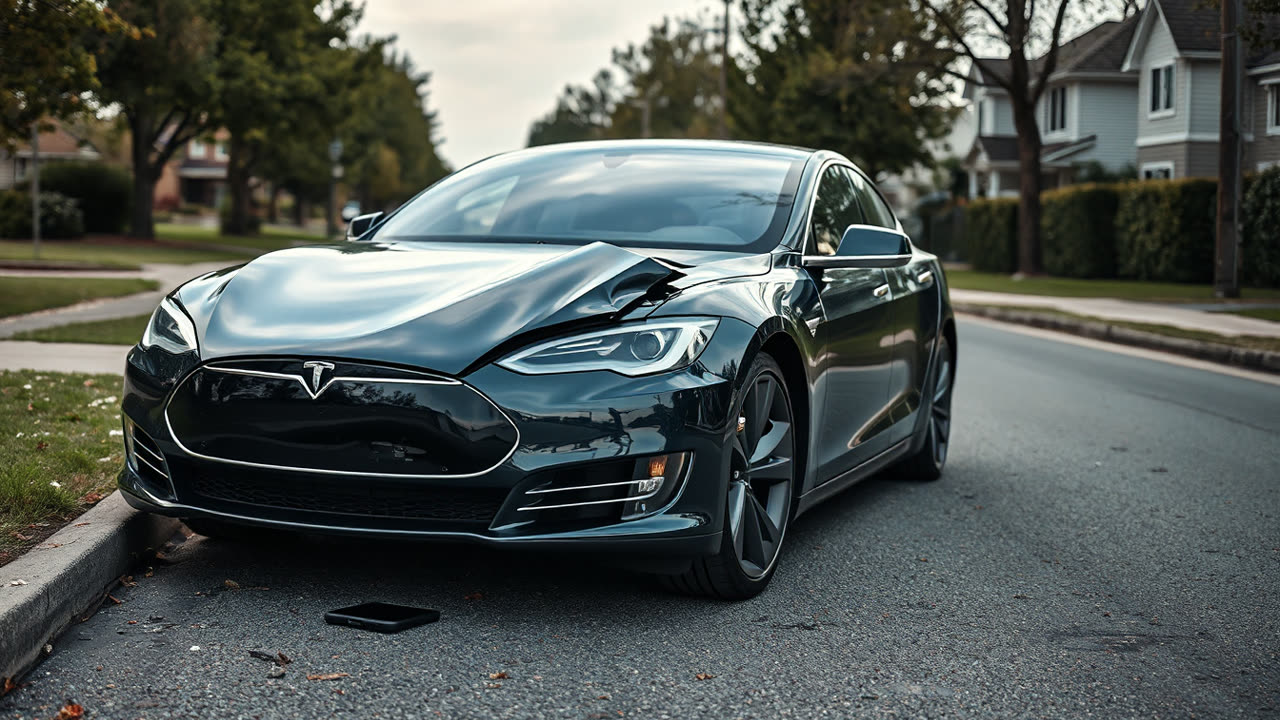
The recent revelation by San Francisco 49ers coach Kyle Shanahan that his Tesla Model S was on Autopilot during a July 14 crash in Palo Alto, California, adds a significant new dimension to the ongoing public and regulatory debate surrounding advanced driver-assistance systems (ADAS). While Shanahan, who sustained a broken nose and hand, fractured ribs, and a concussion requiring 40 stitches, has consistently taken responsibility for the accident, his admission that he was reaching for a dropped phone when the car veered into oncoming traffic raises critical questions about driver attentiveness and the limitations of current semi-autonomous technology. The collision, which involved a 2025 Mercedes-Benz GLC 300, initially saw the California Highway Patrol attribute fault to the other driver, a clerical error later corrected by Palo Alto Police, confirming Shanahan as the at-fault party. Shanahan, who has used Autopilot for nine years, stated he was unsure if the system malfunctioned or if he inadvertently disengaged it while distracted, emphasizing that "it is always your fault, whether you're on autopilot or not. You can't take your eyes off the road".
This incident matters immensely because it perfectly encapsulates the complex, often contradictory, relationship between human drivers and increasingly sophisticated ADAS. Tesla's Autopilot, a Level 2 ADAS, provides features like Traffic-Aware Cruise Control and Autosteer, assisting with speed, distance, and lane-keeping. It is distinct from the more advanced (and more expensive) Full Self-Driving (FSD) package, which includes functionalities like Navigate on Autopilot, Auto Lane Change, and Traffic Light and Stop Sign Control, designed for more extensive autonomous driving experiences, even on city streets. Both systems, however, explicitly require active driver supervision, a fact Tesla emphasizes in its owner's manuals and on its website. Yet, the allure of automation often leads to driver complacency, a dangerous gap between technological capability and human behavior. Shanahan's own uncertainty regarding a malfunction versus accidental disengagement highlights this very problem.
The crash reignites scrutiny on Tesla's safety claims and the broader ADAS industry. Tesla's Q3 2025 Vehicle Safety Report stated one crash was recorded every 6.36 million miles driven with Autopilot engaged, a figure Tesla claims is approximately nine times lower than the national average of one crash every 702,000 miles. However, this comparison has been criticized for methodological differences in data collection and reporting, and the 2025 figure represents a slight *deterioration* from Q3 2024's 7+ million miles per accident. The National Highway Traffic Safety Administration (NHTSA) has expressed concerns about Autopilot and FSD, having opened numerous investigations and even initiated a general recall in December 2023 for all Autopilot-equipped vehicles, resolved via an over-the-air software update. In March 2026, NHTSA escalated its probe into 3.2 million Tesla vehicles with FSD, citing concerns that the camera-based system may fail to detect or warn drivers in poor visibility conditions and has been linked to nine incidents, including one fatal crash. This ongoing regulatory oversight underscores the inherent challenges in ensuring safety as these systems become more prevalent.
Compared to rivals, Tesla's vision-only approach, relying solely on cameras and neural networks, stands in contrast to systems like Ford BlueCruise and GM Super Cruise, which utilize a combination of cameras, radar, and high-definition maps. Ford's BlueCruise, rated the top active driving assistance system by Consumer Reports in 2023, enables hands-free driving on over 130,000 miles of mapped highways, while GM's Super Cruise covers more than 400,000 miles. These systems also incorporate driver-facing cameras to monitor alertness, a feature Tesla only formally accepted as necessary in 2024 when FSD was renamed "Full Self-Driving (Supervised)". Mercedes-Benz has pushed further with Drive Pilot, the first SAE Level 3 system approved for U.S. highways, signifying a significant shift in liability from driver to manufacturer under specific operational conditions. The distinction between Level 2 ADAS (like Autopilot) and Level 3 systems is crucial, as Level 3 allows for "eyes-off" driving in certain scenarios, with the OEM becoming liable for incidents.
The industry is at a critical juncture. The fragmentation of state-level regulations in the U.S. for autonomous vehicles, with over 43 states enacting varying laws as of June 2026, presents a complex landscape for development and deployment. There is growing momentum for national standards, with bills like the Autonomous Vehicle Acceleration Act of 2025 introduced in Congress to establish unified safety, cybersecurity, and insurance standards. NHTSA, under the second Trump Administration, has signaled interest in providing regulatory certainty while also emphasizing public trust and safety perceptions. The public perception of autonomous vehicles remains fragile; while some studies suggest AVs are perceived as less risky than human-driven vehicles, fatal accidents significantly decrease public trust, especially among those with limited prior knowledge of the technology.
Moving forward, the focus will intensify on robust driver monitoring systems, clearer communication of system limitations, and a standardized regulatory framework. The shift from "computing power competition" to "algorithm-hardware collaborative optimization" among ADAS suppliers, particularly in regions like China, indicates a maturing industry. The commercial opportunity for ADAS is projected to grow significantly, with McKinsey estimating the proportion of new vehicles equipped with ADAS or automated-driving technology could rise from approximately 36% in 2025 to nearly 70% by 2035. However, achieving widespread acceptance and truly safer roads will depend on manufacturers and regulators working in concert to bridge the "perception gap" where rare tragedies disproportionately influence public opinion, even as the technology demonstrates safety improvements in many scenarios. Shanahan's accident serves as a stark reminder that even with advanced systems, the human element—distraction, complacency, and the critical need for supervision—remains the most unpredictable variable on the road to full autonomy.