AGI AI828 SSD Review: A Near-Last Resort Budget Drive
The AGI AI828 SSD offers PCIe Gen4 speeds at a budget price, but its DRAM-less QLC design results in significantly subpar performance and high power consumption, making it a questionable choice for most users.
✨ This content was summarized and interpreted by AI; it may contain errors — please verify accuracy with the original sources. Learn more
Listen to this story
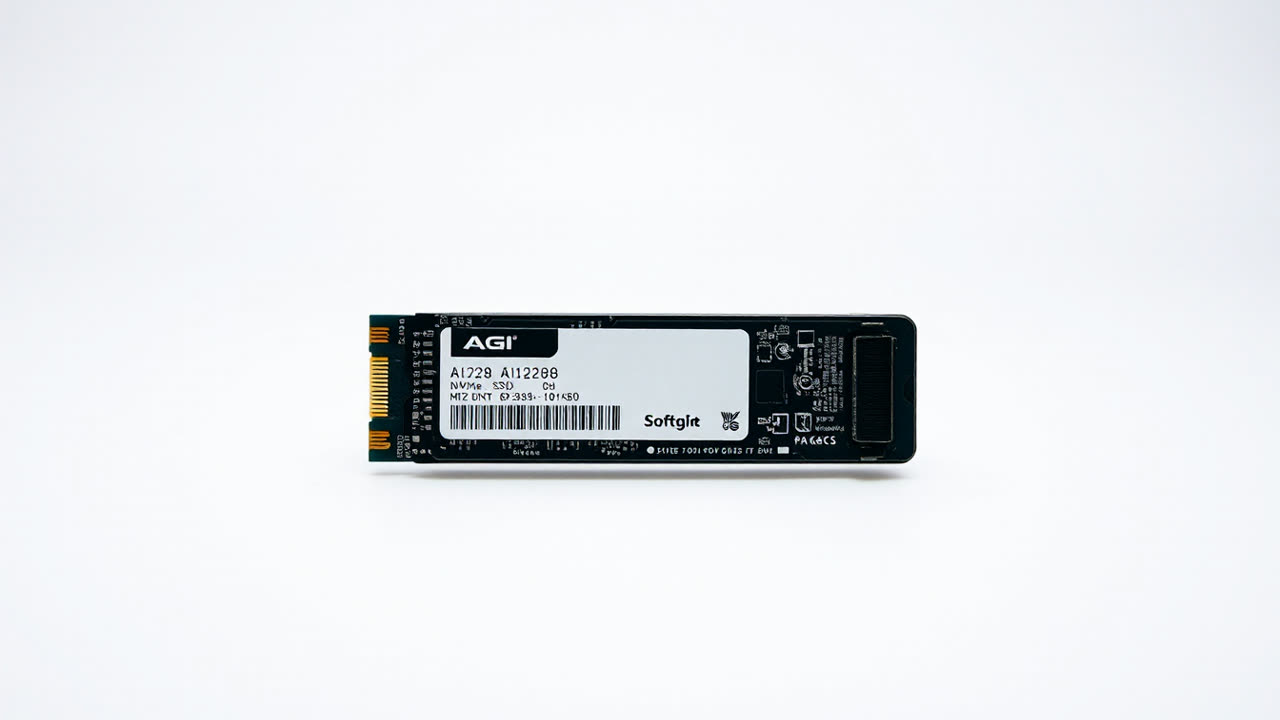
The AGI AI828 SSD emerges as a stark reminder of the compromises inherent in the budget storage segment, positioning itself as a "near-last resort" option due to its demonstrably subpar performance and significant power inefficiency. Priced aggressively, particularly for its PCIe Gen4 interface, the drive leverages a DRAM-less design and QLC NAND, a combination that often underperforms against its TLC counterparts, especially under sustained loads. While a 1TB model can be found for around $60, a price point that initially seems attractive for Gen4, its real-world benchmarks reveal sequential read speeds peaking at approximately 3,500 MB/s and writes around 2,800 MB/s, figures more akin to high-end PCIe Gen3 drives than competitive Gen4 offerings. More critically, its random I/O performance, crucial for system responsiveness, lags considerably, with 4K random read speeds hovering just above 50 MB/s and writes around 150 MB/s, falling significantly short of even entry-level Gen4 expectations.
The "why it matters" for users is multifaceted. For the absolute budget-conscious user building a secondary gaming rig or a basic office PC where storage is not a bottleneck, the AGI AI828 might just barely suffice as a boot drive or for storing less demanding applications and files. However, for anyone engaging in tasks requiring frequent data transfers, large file handling, or demanding applications, the performance bottlenecks will be palpable. The lack of a DRAM cache, a common cost-cutting measure, means the drive relies on a portion of the system's RAM for its mapping table, leading to increased latency and a dramatic drop in write speeds once its small SLC cache is exhausted. This can translate to frustratingly slow file copies, extended application loading times, and a general sluggishness that undermines the perceived speed benefits of an NVMe interface. Furthermore, its power efficiency is a notable concern, consuming up to 6.3 watts during peak operation, which is considerably higher than many contemporary Gen4 drives that often stay below 5 watts, making it a less ideal choice for laptops where battery life is paramount.
In the broader industry context, the AGI AI828 exemplifies the race to the bottom in the budget SSD market, a segment increasingly flooded with drives that prioritize price over performance and longevity. Historically, budget drives often meant sacrificing peak speeds or endurance. However, the current trend with drives like the AI828 demonstrates a willingness to compromise on fundamental performance metrics and even power efficiency to hit aggressive price points. This contrasts sharply with leading budget PCIe Gen4 drives such as the Crucial P3 Plus or the Solidigm P41 Plus, which, while also using QLC NAND and often DRAM-less designs, typically offer superior controllers and optimized firmware resulting in significantly better sustained performance and often better power efficiency for a slightly higher, but often justifiable, cost. Even older, high-end PCIe Gen3 drives like the Samsung 970 EVO Plus, which can now be found at competitive prices, would largely outperform the AGI AI828 in real-world scenarios, particularly in random I/O and sustained writes.
Looking ahead, the trajectory of budget SSDs is likely to continue pushing the boundaries of cost reduction, but with an increasing emphasis on smart engineering to mitigate the drawbacks seen in drives like the AGI AI828. Manufacturers will undoubtedly refine QLC NAND technology, improving endurance and performance, while controller innovation will focus on more efficient DRAM-less algorithms and sophisticated SLC caching mechanisms. We may see a clearer segmentation emerge: ultra-budget drives for basic storage, and "value" drives that offer a more balanced performance-to-price ratio. However, the long-term viability of drives that offer such a stark compromise in performance and power efficiency hinges on whether the market will tolerate these trade-offs. As PCIe Gen5 SSDs begin to enter the mainstream, driving down the cost of Gen4 components further, it’s plausible that even entry-level Gen4 drives will offer a baseline performance far exceeding the AGI AI828 without significant price hikes. The expectation for future budget drives will be to provide a more compelling balance, making products like the AI828 a historical footnote of an era where cutting corners went a step too far.