AI-Assisted BIOS Unlock: Claude Code Bypasses HP's RSA-2048 Security, Reveals Hidden Settings
A Redditor leveraged Anthropic's Claude Code to reverse engineer and modify an HP laptop's BIOS, defeating robust RSA-2048 signature checks and uncovering 55 previously inaccessible settings.
✨ This content was summarized and interpreted by AI; it may contain errors — please verify accuracy with the original sources. Learn more
Listen to this story
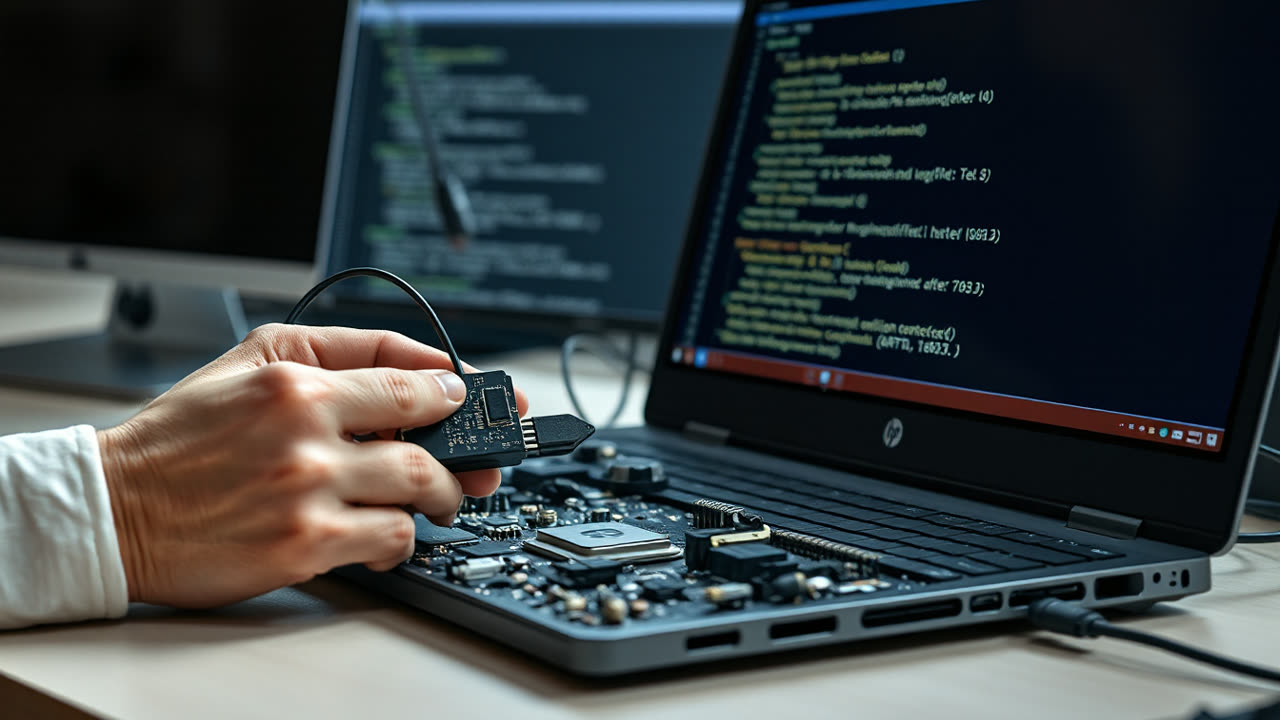
A Redditor recently demonstrated the unprecedented capability of AI, specifically Claude Code, in assisting with the complex process of unlocking and modifying an HP laptop's BIOS, bypassing robust RSA-2048 signature checks and revealing 55 previously hidden settings. This notable achievement, performed by "Reddit_2049" on an HP 15-dw1036ne laptop running BIOS version F.68, highlights a significant shift in the landscape of hardware security and AI's role within it. The process involved an intricate dance of reverse engineering and patching, where Claude Code proved instrumental in guiding the user through the identification of byte-level modifications necessary to circumvent the BIOS's stringent security protocols.
The core technical feat centered on defeating the RSA-2048 DXE-FV signature check, a critical security measure designed to prevent unauthorized firmware modifications. HP, like other major manufacturers, employs sophisticated hardware-based security, such as HP Sure Start, which utilizes a dedicated Endpoint Security Controller (HP ESC) and a 2048-bit HP RSA public key embedded in read-only memory to validate BIOS integrity before execution. This system is designed to detect any modification, often triggering a "BIOS Corruption Detected" message, and can even self-heal from a "golden copy" of the BIOS. However, with Claude Code's assistance, Reddit_2049 managed to pinpoint the exact location of the `RsaVerifyCore` call tail and alter a `JNZ` (jump if not zero) instruction to a `JMP` (unconditional jump) (0x75 to 0xEB), effectively forcing a successful return for the signature verification. This was achieved by leveraging a suite of reverse engineering tools including UEFITool, UEFIExtract, UEFIFind, Ghidra (integrated with GhidrAssistMCP), Unicorn Engine, and Capstone, all guided by Claude Code's analysis to generate a Python script for applying the patches. The final step involved flashing the modified BIOS using a hardware chip flasher, such as a CH341A.
This event holds profound implications for both users and the tech industry. For individual users, particularly those who acquire BIOS-locked laptops at bargain prices due to operational restrictions, this breakthrough offers a pathway to unlock full control over their hardware, potentially preventing e-waste. The ability to access 55 hidden setup fields and four advanced BIOS tabs (Advanced, Power, Debug, Boot) could enable performance optimizations, detailed hardware configurations, or even the re-enabling of legacy features like S3 Suspend over Modern Standby, which some users prefer. However, this newfound power comes with significant risks; modifying the BIOS without expert knowledge can easily "brick" a device, rendering it unusable, a risk that even the Redditor's workflow cautioned against for certain settings. The ease with which AI can now assist in such sensitive modifications raises concerns about the potential for malicious actors to exploit these capabilities, creating a new vector for firmware-level attacks.
From an industry perspective, this incident is a stark reminder of the evolving cybersecurity landscape. For hardware manufacturers like HP, it underscores the continuous challenge of securing the foundational firmware against increasingly sophisticated threats. Even advanced, hardware-rooted security measures designed to be tamper-proof may now be vulnerable to AI-assisted reverse engineering and exploitation. This necessitates an urgent re-evaluation of existing firmware security paradigms. For AI developers, particularly Anthropic, this showcases the immense, and sometimes unsettling, power of their models like Claude Code. While beneficial for legitimate reverse engineering and unlocking, it also highlights the "dual-use" nature of advanced AI, which can be weaponized for malicious purposes. Previous reports have already detailed how Claude's agentic capabilities and vulnerabilities in its ecosystem could lead to remote code execution, API key exfiltration, and even autonomous vulnerability discovery across major operating systems.
Historically, BIOS modding was a niche activity, requiring deep expertise in assembly language, intimate knowledge of specific hardware architectures, and painstaking manual effort to disassemble and analyze firmware binaries. Early BIOS versions, initially proprietary to IBM PCs in 1981, eventually transitioned from ROM to flash memory, enabling updates but also introducing risks like BIOS rootkits. Modern systems have largely moved to UEFI (Unified Extensible Firmware Interface), a successor to BIOS that offers enhanced features and security, including Secure Boot, which cryptographically verifies the integrity of boot components. Manufacturers like HP have further fortified this with proprietary solutions like Sure Start, acting as a hardware-based Root of Trust to prevent unauthorized modifications. This AI-assisted bypass represents a significant leap from previous methods, which often involved less sophisticated key combinations or direct memory access tools. The comparison to rival AI models is also pertinent, as other large language models like ChatGPT have been shown capable of assisting in the creation of "hardware Trojans," indicating a broader trend of AI lowering the barrier for hardware-level exploits.
Looking ahead, this event is a potent indicator of an impending "AI arms race" in cybersecurity. The ability of AI to rapidly analyze complex codebases and identify subtle vulnerabilities will inevitably lead to more frequent and sophisticated hardware and firmware exploits. Manufacturers will be compelled to integrate AI more deeply into their defensive strategies, utilizing it for real-time threat detection, predictive maintenance, and the development of quantum-resistant security protocols. The rise of AI PCs with dedicated Neural Processing Units (NPUs) is already being touted for its potential to enhance on-device security by offloading AI workloads for threat detection and biometric authentication. However, this also means that the focus of security will shift beyond traditional software flaws to securing the AI models themselves, their inputs, and their agentic workflows. The ethical implications of such powerful, dual-use AI tools will also necessitate increased regulatory scrutiny and the establishment of robust ethical guidelines to prevent widespread misuse in areas ranging from individual device compromise to broader national security threats posed by AI-enabled bioterrorism. The battle for control over fundamental system integrity is officially entering an AI-driven era.