AI Tool Reconstructs Visuals Directly from Human Brain Scans
A novel AI tool has achieved an unprecedented feat, reconstructing visual imagery directly from human brain scans with remarkable precision, effectively allowing a machine to "see" what a person is perceiving.
✨ This content was summarized and interpreted by AI; it may contain errors — please verify accuracy with the original sources. Learn more
Listen to this story
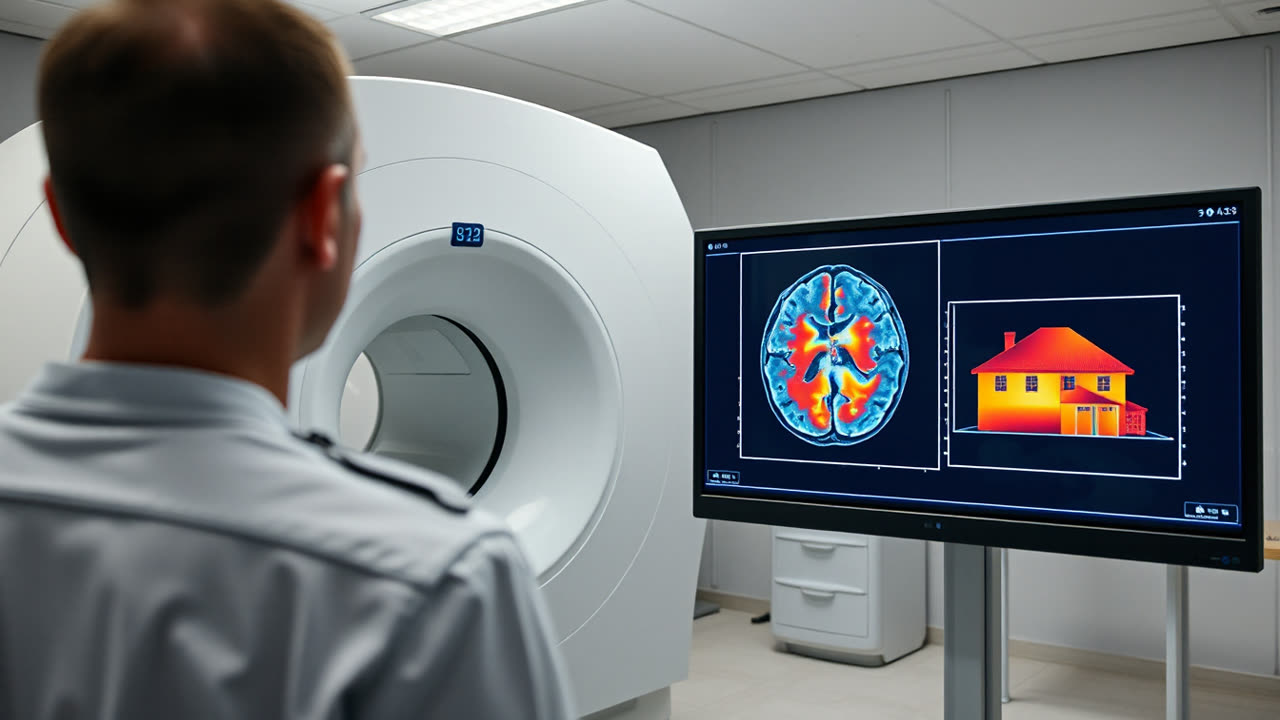
A novel AI tool has achieved an unprecedented feat, reconstructing visual imagery directly from human brain scans with remarkable precision, effectively allowing a machine to "see" what a person is perceiving. This breakthrough, building on years of research in neural decoding, leverages advanced deep diffusion models and functional magnetic resonance imaging (fMRI) data to synthesize images semantically and visually similar to the original stimuli. Researchers at Princeton University, for instance, have demonstrated real-time reconstruction within approximately 15 seconds, a significant acceleration over previous methods that took hours or even days. Similarly, a recent study from Radboud University in the Netherlands, evolving from their 2022 work, now claims near-perfect accuracy in converting brain activity into photographic images by allowing AI to focus on specific brain regions. The technology also exhibits a bidirectional capability, predicting a person's brain activity based on what they are looking at, offering a deeper understanding of visual encoding.
This development carries profound implications for both users and the broader technology industry. For individuals, the immediate horizon suggests transformative applications in assistive technologies. Envision a future where individuals with locked-in syndrome could communicate more richly, or where prosthetic devices are controlled with unparalleled intuitive thought. The potential for restoring vision to those with precortical vision loss, bypassing damaged optical pathways through cortical Brain-Computer Interfaces (BCIs), is particularly compelling, with ongoing trials investigating systems like Blindsight® by Neuralink and the PRIMA subretinal implant. Furthermore, the ability to externalize subjective experiences could revolutionize dream research, mental imagery studies, and even offer new avenues for psychological assessment by materializing internal perceptions.
However, the "mind-reading" moniker itself immediately triggers substantial ethical dilemmas. The prospect of machines accessing and reconstructing private visual thoughts raises critical questions about mental privacy, consent, and the potential for misuse. If a machine can reconstruct what someone is seeing, could it eventually reconstruct what someone is *imagining* or *remembering*? This necessitates robust ethical frameworks and regulatory oversight, discussions for which are already underway by international bodies like UNESCO. The distinction between medical necessity and potential surveillance becomes increasingly blurred, demanding careful consideration as the technology matures.
Historically, brain decoding has been a challenging frontier in computational neuroscience, with earlier attempts yielding blurry or semantically ambiguous reconstructions. Initial approaches struggled to map complex fMRI signals directly to pixels, resulting in limited resolution and fidelity. The current generation of AI tools marks a significant departure, primarily due to the integration of deep generative models, especially latent diffusion models like Stable Diffusion. Researchers from Osaka University, for example, demonstrated in 2023 how Stable Diffusion could reconstruct high-resolution images from brain activity without extensive training or fine-tuning of the generative model itself. This contrasts sharply with prior methods that often required vast, specific datasets and intensive model training for even modest results. The current advancements achieve superior semantic fidelity by mapping BOLD signals onto the latent space of pre-trained classifiers, which then condition generative models to synthesize images. This "semantic-first" approach allows the AI to grasp the conceptual content of the visual stimulus, rather than just raw pixel data, leading to more meaningful and accurate reconstructions.
Looking ahead, the trajectory of this technology points towards continued refinement in resolution, speed, and semantic accuracy. Expect to see further breakthroughs in decoding not just static images but dynamic visual experiences, such as videos, as demonstrated by University College London researchers who reconstructed 10-second video clips from mouse brain activity. The integration with other AI-driven neuroimaging applications, such as AI models that can diagnose neurological conditions like brain tumors and predict dementia risk with high accuracy from MRI scans, suggests a synergistic future where AI enhances both our understanding and treatment of the brain. The commercialization of Brain-Computer Interfaces, a market projected to exceed $6 billion by 2030, will likely focus first on medical applications where clear needs exist, such as communication and motor control for disabled individuals. However, the challenges of high costs, limited patient populations, and complex regulatory pathways remain significant hurdles for broad market adoption. As research progresses, the ability to decode and encode brain activity with increasing precision will not only unlock new therapeutic possibilities but also force society to confront fundamental questions about the nature of thought, privacy, and what it means to be human in an increasingly interconnected neural landscape.