Alibaba Unveils Zhenwu V900, Claims 'Most Powerful AI Chip in China'
Alibaba has unveiled its Zhenwu V900 AI accelerator, claiming it to be "the most powerful AI chip in China" with three times the performance of its predecessor and 216GB of memory, marking a pivotal step in China's domestic AI hardware independence amid escalating U.S. export controls and setting the stage for its 10-trillion-parameter Qwen large language model.
✨ This content was summarized and interpreted by AI; it may contain errors — please verify accuracy with the original sources. Learn more
Listen to this story
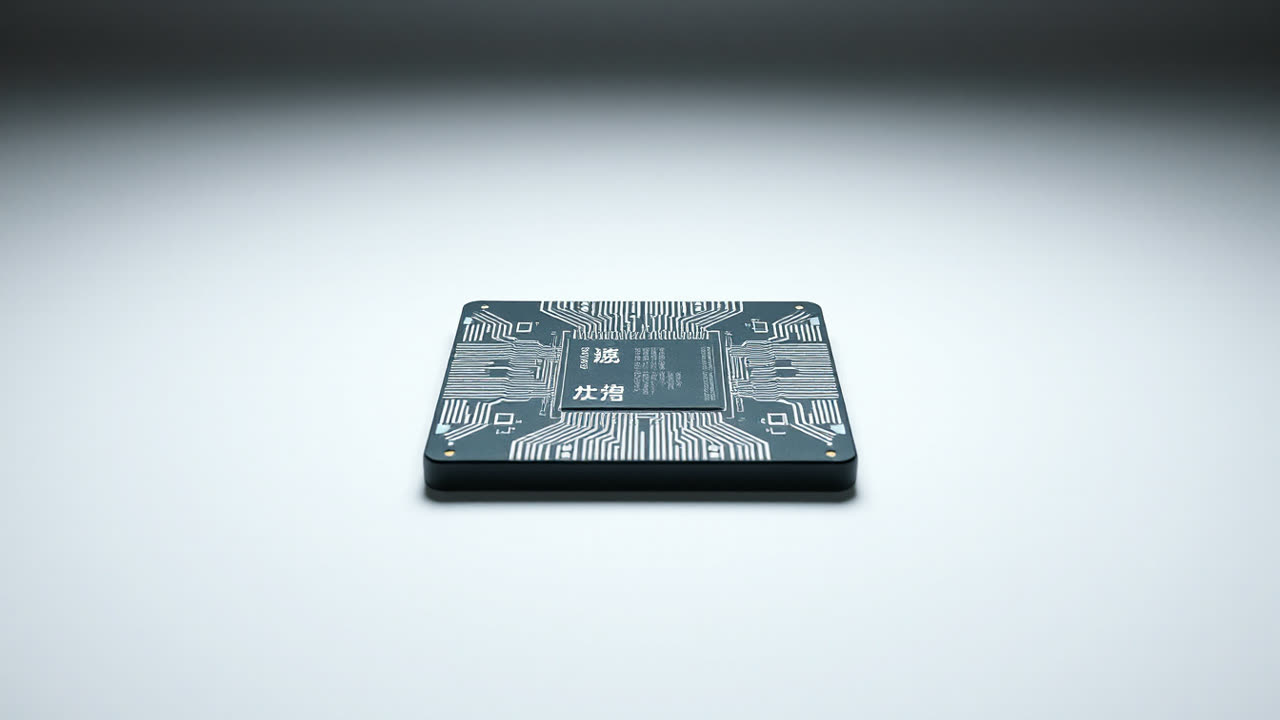
Alibaba has unveiled the Zhenwu V900 AI accelerator, claiming it to be "the most powerful AI chip in China," boasting a performance three times that of its predecessor, the M890, and integrating a substantial 216GB of memory. This ambitious new chip is engineered to power Alibaba's forthcoming 10-trillion-parameter Qwen large language model, signaling a significant escalation in China's domestic AI hardware capabilities and Alibaba's strategic independence in the face of escalating geopolitical tech tensions. The V900 supports a massive supercluster architecture capable of integrating 500,000 chips, a scale that underscores Alibaba's intent to build hyperscale AI infrastructure comparable to leading global players.
The introduction of the Zhenwu V900 marks a pivotal moment for China's AI industry, directly addressing the critical need for advanced domestic hardware to circumvent U.S. export controls that have severely restricted access to state-of-the-art AI accelerators from companies like NVIDIA. By developing a homegrown solution, Alibaba aims to secure its position as a dominant force in cloud AI services within China, offering its substantial internal computing power to external clients through Alibaba Cloud. This move not only fortifies Alibaba's own AI development pipeline, particularly for its Qwen large language model series, but also offers a viable alternative to other Chinese enterprises grappling with the scarcity and high cost of imported chips, thereby fostering a more self-reliant AI ecosystem within the country. The claimed performance leap of three times over the M890, coupled with 216GB of memory, positions the V900 to handle the increasingly complex and memory-intensive demands of advanced generative AI models, which are crucial for applications ranging from natural language processing to scientific research and autonomous systems.
Comparing the Zhenwu V900 to its predecessor, the M890, highlights a rapid maturation in Alibaba's chip design capabilities. While specific architectural details of the M890 are less publicly detailed, the V900's claimed triple performance increase and significantly larger memory footprint—double that of NVIDIA's H100 SXM, which offers 128GB—demonstrate a focused effort to meet the memory bandwidth and computational demands of cutting-edge AI workloads. Against international rivals, particularly NVIDIA's H100, the V900's "most powerful" claim within China must be contextualized. While direct, independent benchmarks are typically unavailable for new Chinese accelerators, the V900's memory capacity suggests an architecture optimized for large model inference and training, areas where NVIDIA has historically dominated. Domestically, the V900 enters a competitive landscape alongside Huawei's Ascend 910B, which has seen increasing adoption in Chinese data centers following U.S. sanctions. While Huawei's Ascend series has been lauded for its performance and ecosystem, the V900's specific focus on Alibaba's cloud infrastructure and its Qwen model provides a distinct, vertically integrated advantage.
The strategic implications extend beyond raw performance. The V900 represents a significant investment in China's "new infrastructure" initiative, which prioritizes domestic technological self-sufficiency. For Alibaba Cloud users, the availability of such powerful domestic accelerators could translate into more competitive pricing and reduced latency for AI services, fostering innovation across various industries within China. The ability to deploy a 10-trillion-parameter model like Qwen, supported by a 500,000-chip supercluster, would place Alibaba at the forefront of global AI capabilities, potentially rivaling models from Google, OpenAI, and Meta in scale and complexity. This scale is crucial for developing truly general-purpose AI systems that can understand and generate human-like text, images, and other forms of data with unprecedented sophistication.
Looking ahead, the Zhenwu V900's success will be measured not only by its raw performance but also by its ecosystem development. Alibaba will need to cultivate robust software tools, frameworks, and developer support to maximize the chip's utility and encourage widespread adoption beyond its internal operations. The challenge remains for Chinese chip developers to not only match the raw power of international leaders but also to build the comprehensive software stacks and developer communities that have been critical to the success of platforms like NVIDIA's CUDA. Further iterations of the Zhenwu series are highly probable, as the race for AI supremacy accelerates, likely focusing on even greater energy efficiency, enhanced interconnectivity, and specialized architectures for multimodal AI. This domestic innovation push is not merely about technological advancement; it's about establishing digital sovereignty and securing a leadership position in the global AI landscape, with Alibaba's Zhenwu V900 serving as a potent symbol of this ambition.