Amazon Prime Air Targets 500 U.S. Cities by 2026
Amazon's Prime Air is poised for a monumental expansion, targeting drone delivery services for nearly 500 U.S. cities and towns by the close of 2026.
✨ This content was summarized and interpreted by AI; it may contain errors — please verify accuracy with the original sources. Learn more
Listen to this story
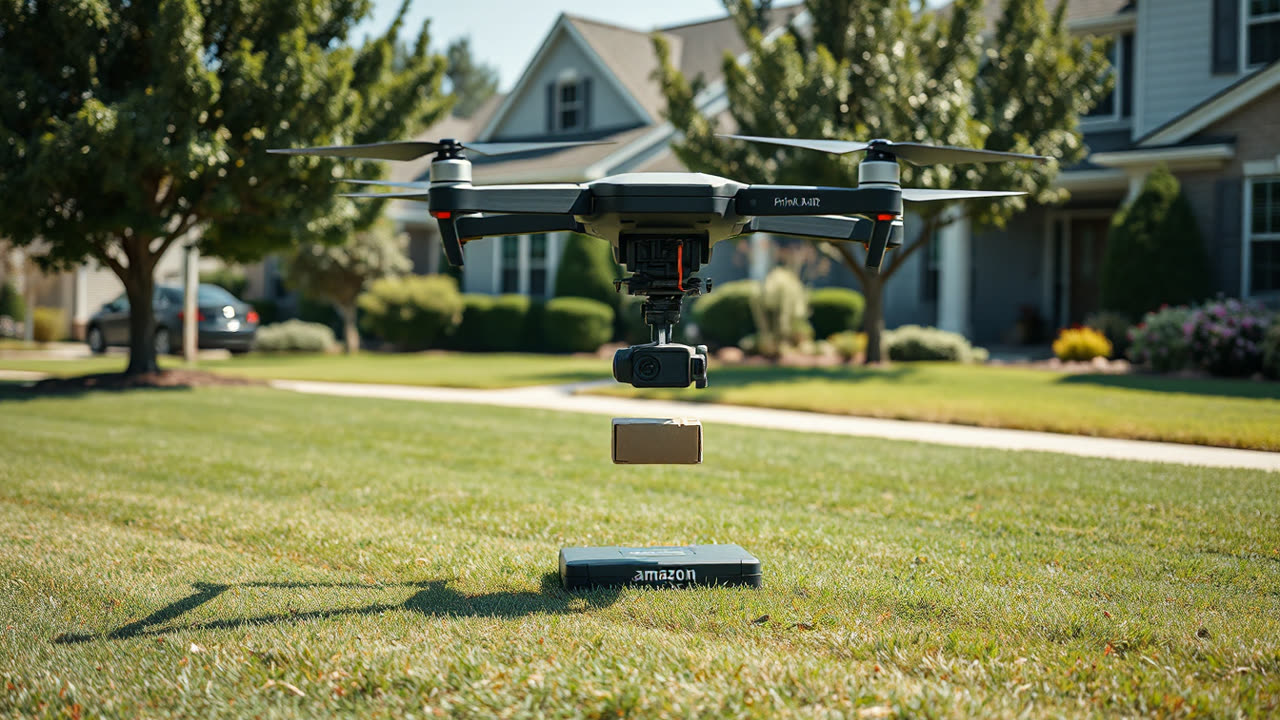
Amazon's Prime Air is poised for a monumental expansion, targeting drone delivery services for nearly 500 U.S. cities and towns by the close of 2026. This ambitious plan represents a sixfold increase from its current footprint of 11 operational sites across 10 U.S. metro areas, aiming to bring ultrafast delivery to tens of millions of customers. The aggressive rollout, spearheaded by the company's advanced MK30 drone, signals a pivotal moment for last-mile logistics, yet it simultaneously ushers in a complex set of trade-offs for American residents and the broader industry.
This expansion is more than just a logistical upgrade; it's a fundamental redefinition of consumer expectations and urban infrastructure. For users, the allure of receiving packages weighing up to five pounds—encompassing millions of groceries, electronics, cosmetics, and medications—in as little as 30 minutes is undeniable. Amazon Prime members can often access this service for free on orders over $50, with a modest $3 fee for smaller orders, while non-Prime members face a $5 charge. This unparalleled speed and convenience could become a new benchmark, compelling traditional delivery services to accelerate their own offerings. However, this convenience comes with inherent trade-offs. Concerns about noise pollution, privacy, and safety are central to public acceptance. While Amazon's MK30 drone boasts a 50% reduction in perceived sound compared to its predecessors through custom-designed propellers, the cumulative effect of hundreds or thousands of drones traversing suburban skies remains an open question for residents. Privacy advocates also raise questions about onboard cameras and sensors, even as Amazon asserts they are solely for navigation and obstacle avoidance, not surveillance. The potential for accidents, though mitigated by sophisticated "Detect-and-Avoid" systems, inherently introduces a new layer of risk into residential areas.
The industry impact of Amazon's move is profound, poised to reshape the competitive landscape and employment market. The global drone delivery service market, valued at an estimated $1.51 billion in 2024, is projected to surge to $18.26 billion by 2032, demonstrating a compound annual growth rate of 31.3%. This growth is driven by substantial cost reductions; drone delivery can slash last-mile costs by 40-60%, reducing per-package expenses to as low as $1-2 compared to the $8-12 for traditional truck deliveries. These efficiencies stem from reduced fuel, labor, and vehicle maintenance costs, making drone operations at least 70% cheaper than van services. This economic advantage will undoubtedly pressure competitors to either innovate or risk being left behind.
Amazon's current drone, the MK30, is a fully electric aircraft with a maximum takeoff weight of 83.2 pounds, capable of operating within a 7.5-mile range, covering an area of approximately 174 square miles per delivery center. It can also fly in light rain, a crucial improvement for reliability. This advanced capability positions Prime Air ahead of earlier drone models and in direct competition with rivals. Alphabet's Wing, for instance, in partnership with Walmart, is also aggressively expanding, aiming for 270+ stores by 2027 to serve over 40 million Americans in areas like Dallas-Fort Worth, Greater Houston, and Metro Atlanta, with plans for new markets including the San Francisco Bay Area, Philadelphia, and Phoenix. Wing's drones offer similar capabilities, delivering packages up to 5 pounds within a 6-mile radius at speeds up to 60 mph, often within 30 minutes. Zipline, another significant player, has partnered with Uber Eats, with initial deployments expected in Dallas and Houston this year, targeting an ambitious one million drone deliveries per day by the end of 2029, often achieving deliveries in as little as 5-10 minutes. Zipline also recently launched its first U.S. healthcare home delivery service with Cleveland Clinic in July 2026.
The regulatory environment is simultaneously evolving to support this burgeoning industry. The Federal Aviation Administration (FAA) has granted Amazon authorization for Beyond Visual Line of Sight (BVLOS) operations without requiring visual observers, a critical step for scalable networks. Further regulatory clarity is anticipated with the FAA's proposed Part 108 rules, expected by early-to-mid 2026, which aim to standardize BVLOS operations without the need for individual waivers, replacing traditional remote pilot roles with Operations Supervisors and Flight Coordinators. This shift from case-by-case approvals to a more standardized framework is essential for widespread adoption and efficient expansion.
Looking ahead, the widespread integration of drone delivery will necessitate significant advancements in air traffic management systems, such as Unmanned Aircraft System Traffic Management (UTM), to ensure safety and deconfliction in low-altitude airspace. The economic implications extend to job displacement in traditional delivery sectors, with some studies suggesting drones could displace $127 billion worth of labor and services across multiple industries. However, the technology also promises to create new roles in drone design, maintenance, operation, and data analysis. Environmentally, electric drones offer a greener alternative, significantly reducing greenhouse gas emissions and alleviating urban traffic congestion, particularly for small, lightweight packages and when powered by clean electricity grids. As Amazon and its rivals push the boundaries of autonomous aerial logistics, the coming years will reveal the true balance between unprecedented convenience and the societal adjustments required for a sky filled with buzzing delivery vehicles.