Amazon Prime Air to Expand Drone Delivery to Nearly 500 US Cities by 2026
Amazon's Prime Air service is set for a massive sixfold expansion, aiming to bring ultrafast drone delivery to tens of millions of customers across nearly 500 U.S. towns and cities by the end of 2026.
✨ This content was summarized and interpreted by AI; it may contain errors — please verify accuracy with the original sources. Learn more
Listen to this story
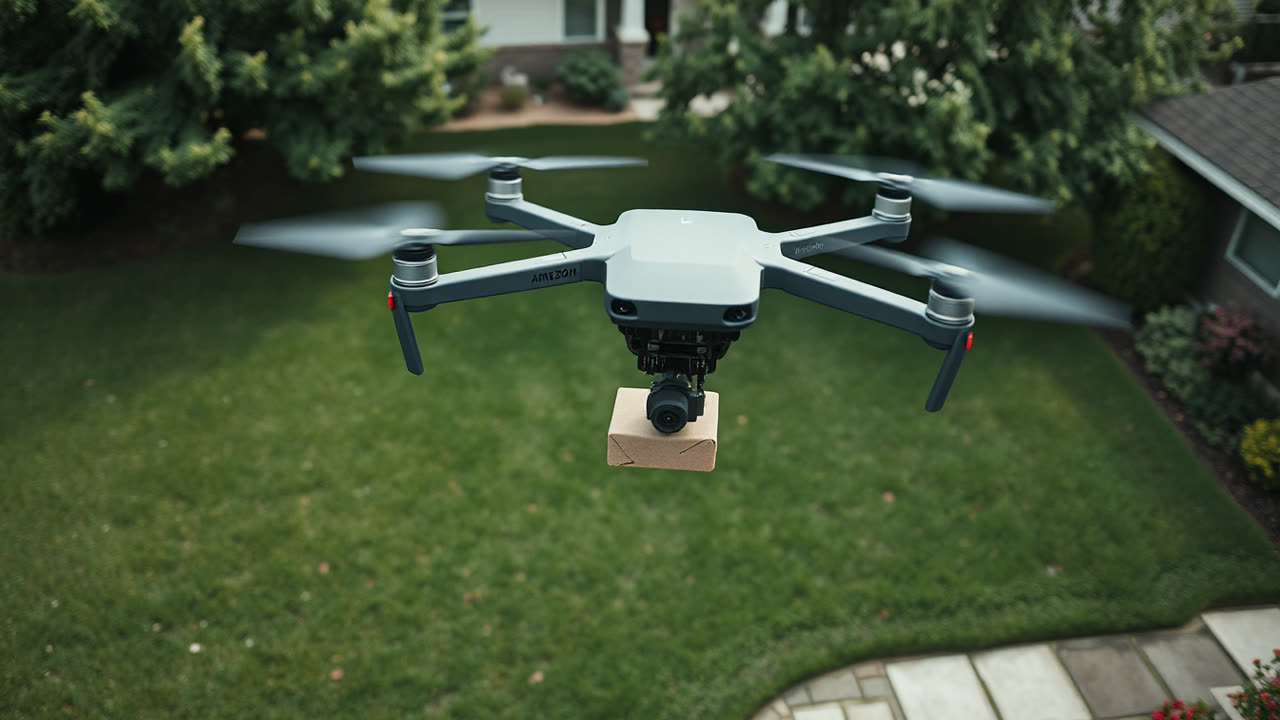
Amazon Prime Air is dramatically scaling its drone delivery service, with plans to serve nearly 500 towns and cities across the United States by the close of 2026, marking a sixfold expansion of its current footprint and bringing ultrafast delivery options to tens of millions of customers. This aggressive rollout includes imminent launches in the Chicago and Atlanta metro areas, alongside Syracuse, Cleveland, and Boise, Idaho, significantly broadening the reach of a service that has already completed hundreds of thousands of deliveries this year. Customers in eligible areas can expect millions of items, from groceries and electronics to cosmetics and medications, to arrive in as fast as 30 minutes, though most orders currently take around 60 minutes. This service is free for Prime members on orders over $50, with a $2.99 fee for smaller Prime orders and a $4.99 fee for non-members.
The significance of this expansion transcends mere convenience; it represents a pivotal moment in the evolution of last-mile logistics, pushing drone delivery from a nascent novelty to a foundational component of modern e-commerce. Amazon's commitment to reaching communities with its custom-built MK30 drones underscores a strategic shift towards bypassing traditional road-based congestion, promising reduced delivery times and a lower environmental footprint. The fully electric MK30 drone, weighing 83 pounds, can carry packages up to 5 pounds within a 7.5-mile radius, cruising at speeds exceeding 70 mph at altitudes above 200 feet. Its advanced "Detect-and-Avoid" system, which enables autonomous monitoring of airspace and real-time safety decisions, coupled with its ability to operate in light rain and its quieter design, addresses critical safety and public acceptance concerns that have historically hampered drone adoption. This technological maturity, combined with Amazon's existing network of 11 operational sites across 10 U.S. metro areas, each covering approximately 175 square miles, provides a scalable infrastructure for rapid deployment.
Amazon's aggressive move comes amidst a fiercely competitive landscape, with rivals like Alphabet's Wing and Zipline also making substantial strides. Wing, in partnership with Walmart, is rapidly expanding its network, aiming to serve over 40 million Americans from more than 270 locations by 2027. Wing's drones, capable of carrying up to 2.5 pounds at 60 mph, have already completed over one million commercial deliveries, demonstrating efficiency with a single pilot overseeing up to 32 drones. Zipline, initially known for medical supply deliveries, has surpassed 2 million commercial deliveries globally and recently partnered with Uber Eats, targeting an ambitious one million drone deliveries daily by the end of 2029, offering delivery times as short as 5-10 minutes. Walmart itself has completed over one million drone deliveries, achieving an average delivery time of 23 minutes, with its fastest recorded at 4 minutes and 44 seconds. While Amazon's Prime Air boasts a wider selection of items than some competitors and a broader target footprint, the race for market dominance in drone delivery is clearly intensifying, with each player leveraging different strengths, from Amazon's integrated e-commerce ecosystem to Zipline's rapid-fire delivery model and Wing's strategic retail partnerships.
The regulatory environment, long a bottleneck, is also evolving to facilitate this growth. Amazon operates under the Federal Aviation Administration's (FAA) Part 135 air carrier certification, with authorization for Beyond Visual Line of Sight (BVLOS) operations, a crucial enabler for scaling delivery networks. Further clarity is anticipated with the expected finalization of new FAA Part 108 and Part 146 regulations in early-to-mid 2026, which promise to standardize BVLOS operations without requiring individual waivers for each flight, thereby significantly streamlining future expansion. These regulatory advancements, coupled with the proven safety records of major operators, are transforming drone delivery from experimental trials into a legitimate and scalable air logistics system.
Looking ahead, the trajectory for drone delivery is one of exponential growth and increasing integration into daily life. The global drone logistics and transportation market is projected to reach $15.49 billion by 2033, growing from $4.40 billion in 2026, with e-commerce applications driving the largest share. Gartner predicts that over one million drones will be carrying out retail deliveries in 2026, a massive leap from 20,000 today. This growth will be fueled by continued technological advancements in payload capacity, flight range, battery efficiency, and AI-driven navigation, which will allow drones to carry heavier items, cover greater distances, and operate with even higher autonomy. However, challenges remain, particularly around public acceptance regarding noise and privacy, as well as the need for robust infrastructure development including dedicated landing pads and charging stations. As regulatory frameworks mature and public familiarity increases, drone delivery is poised to fundamentally reshape consumer expectations for speed and convenience, ultimately redefining the economics and environmental impact of the last mile in logistics.