AMD Launches Budget Ryzen 5 CPUs to Counter Soaring Memory Prices
AMD has introduced the Ryzen 5 5500F and Ryzen 5 7500 processors, aiming to provide more affordable entry points to its AM4 and AM5 platforms amid a dramatic surge in DDR4 and DDR5 memory costs.
✨ This content was summarized and interpreted by AI; it may contain errors — please verify accuracy with the original sources. Learn more
Listen to this story
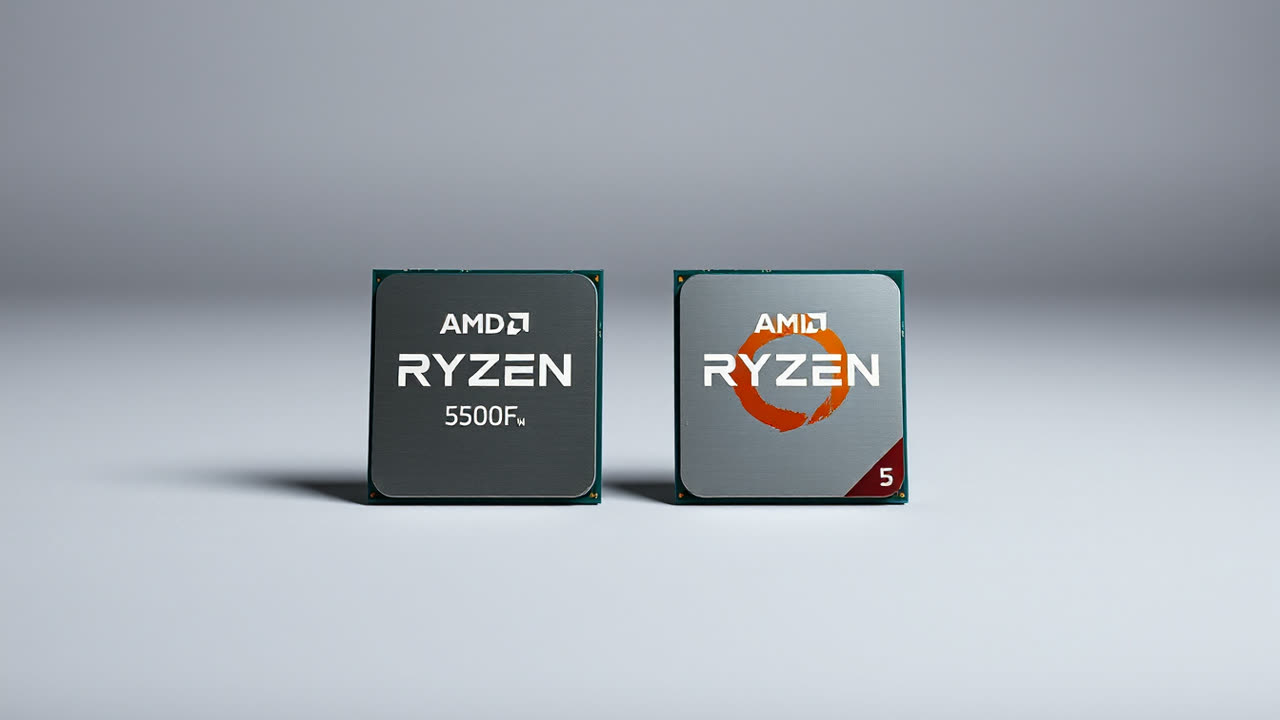
AMD has officially launched two new budget-focused processors, the Ryzen 5 5500F and Ryzen 5 7500, aiming to provide more accessible entry points into both its enduring AM4 and contemporary AM5 platforms amidst dramatically rising memory prices. The Ryzen 5 5500F, priced at $99 in the US and £87.98 in the UK, targets the AM4 socket with six Zen 3 cores, boasting a 3.0 GHz base clock and a 4.4 GHz boost clock. This new Zen 3 offering features 16MB of L3 cache and a 65W TDP, supporting DDR4 memory and PCIe 3.0. Meanwhile, the Ryzen 5 7500, designed for the AM5 socket, features six Zen 4 cores with a 3.7 GHz base clock and a 5.0 GHz boost clock, along with 32MB of L3 cache and a 65W TDP. Crucially, unlike its "F" designated counterpart, the Ryzen 5 7500 includes a small integrated Radeon RDNA 2 graphics unit, making it a viable option for systems without a discrete GPU.
This dual release strategically addresses a PC building market grappling with severe component inflation, particularly in the memory sector. DDR4 RAM prices have "climbed dramatically," with 16GB kits reaching approximately $76.90, representing a staggering 2,300% year-over-year increase, sometimes making DDR4 more expensive than DDR5. Concurrently, DDR5 prices have "exploded," with 32GB (2x16GB) kits that cost $100-$200 in October 2025 now starting at $350. This volatile memory landscape has made the total cost of a new PC, especially an AM5-based one requiring DDR5, a significant barrier, with a basic AM5 platform upgrade potentially costing around $800 on the lower end when factoring in a new motherboard and DDR5 RAM. AMD's introduction of these budget CPUs, particularly the AM4-compatible 5500F, offers a lifeline to value-conscious builders by providing performance upgrades within a more affordable, established ecosystem.
The Ryzen 5 5500F extends the longevity of the decade-old AM4 platform, which remains the "undisputed budget king" due to its mature, cost-effective motherboards and DDR4 compatibility. While its 16MB L3 cache and PCIe 3.0 support are limitations compared to higher-tier AM4 chips like the Ryzen 5 5600 (32MB L3, PCIe 4.0), its £87.98 / $99 price point makes it an attractive upgrade for users on older Zen or even Intel platforms, allowing them to allocate more budget towards a GPU. However, in gaming, the Ryzen 5 5500 (which the 5500F builds upon) has historically lagged behind Intel's Core i3-12100F, which often provides better gaming value despite fewer cores, primarily due to higher single-core performance and superior cache architecture for gaming. The slightly higher boost clock of the 5500F may narrow this gap, but its 16MB L3 cache remains a potential bottleneck in cache-sensitive titles.
The Ryzen 5 7500's entry into the AM5 lineup is more perplexing. While it theoretically lowers the entry cost for Zen 4 and the future-proof AM5 platform with DDR5 and PCIe 5.0, its initial UK price of £167.99 is problematic. At this price, it faces stiff internal competition from AMD's own, faster Ryzen 5 7600X (£149.99) and the newer Zen 5 Ryzen 5 9600X (£161.99), both of which offer superior performance for a comparable or even lower cost. This positioning makes the Ryzen 5 7500 appear to offer "very little value" at launch, despite the inclusion of integrated graphics, which are typically minimal (two RDNA 2 CUs) and not intended for serious gaming. The Ryzen 5 7500F, launched earlier at an MSRP of $179 and often found for less (around $116 in some markets), offers nearly identical CPU performance to the 7500 (non-F) but without the iGPU, and has proven to be highly competitive in gaming against Intel's 13th-gen Core i5s, often outperforming the i5-13500 and i5-13400. The price differential for the integrated graphics on the 7500 (non-F) seems disproportionately high, especially when more powerful alternatives exist within AMD's own stack.
Looking ahead, AMD's strategy appears to be a dual-pronged approach: extending the life and value of AM4 for extreme budget builds and providing a more "affordable" (though currently questionable in value) entry to AM5. The persistent high cost of DDR5 memory will likely continue to make AM4 a compelling option for a significant portion of the market, particularly for 1080p gaming where platform costs can heavily influence the overall build budget. Intel, too, is focusing on budget options, with chips like the Core i3-14100F ($90-$100) and Core Ultra 5 225F ($150-$170) providing strong competition in the sub-$200 segment, some supporting both DDR4 and DDR5, offering builders flexibility. The success of AMD's new offerings will hinge not just on their raw performance, but critically on how their market prices settle, especially for the Ryzen 5 7500, which currently struggles to justify its cost against more capable Zen 4 and Zen 5 siblings. The ongoing memory crisis underscores the importance of such budget-conscious CPU releases, but effective pricing remains paramount for genuine market impact.