AMD's EPYC 'Venice' CPUs Challenge Nvidia's Vera with Record Performance Claims
AMD's new EPYC 'Venice' CPUs enter the high-performance computing arena, with the 256-core flagship claiming to more than double Nvidia Vera's performance and a 96-core variant showing a 20% per-core speed advantage.
✨ This content was summarized and interpreted by AI; it may contain errors — please verify accuracy with the original sources. Learn more
Listen to this story
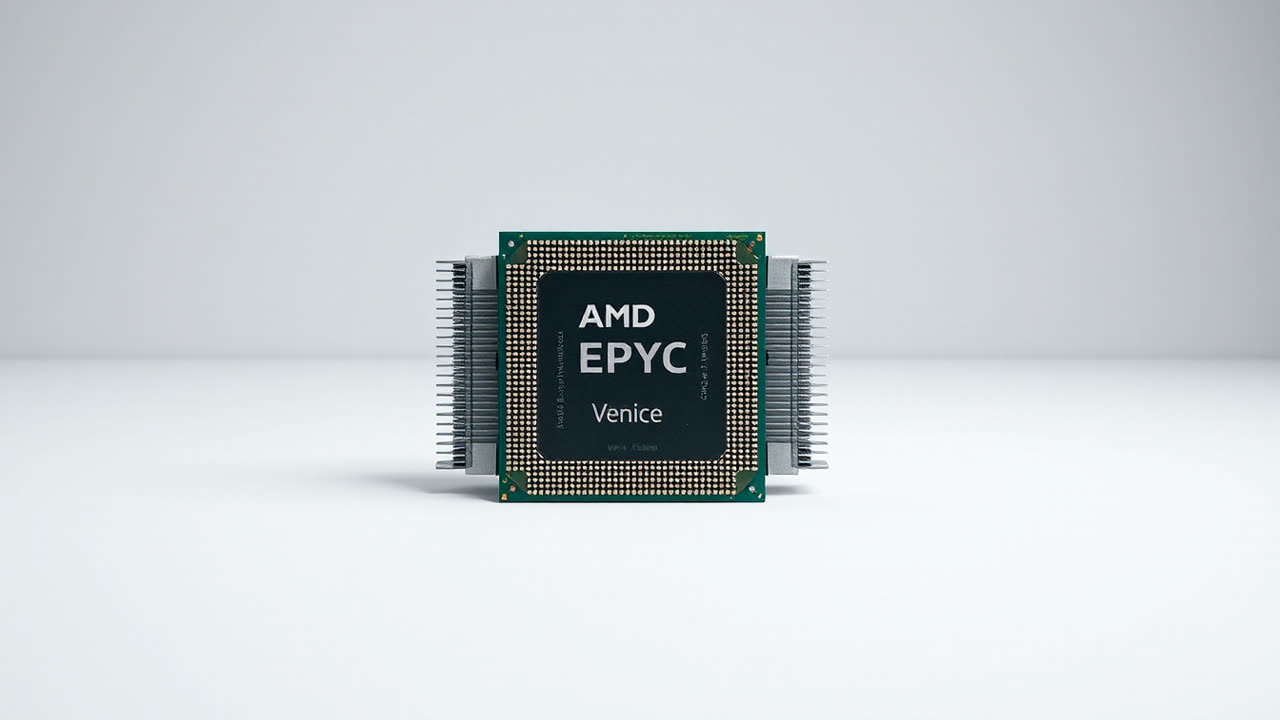
AMD's EPYC 'Venice' CPUs have made an audacious entrance into the high-performance computing arena, with the company claiming its flagship 256-core chip more than doubles the performance of Nvidia's Vera, while a 96-core 'Venice' variant demonstrates a 20% per-core speed advantage over its rival. This direct challenge, underscored by official benchmarks, signals a significant escalation in the battle for data center dominance, shifting the competitive landscape beyond traditional CPU-GPU distinctions towards integrated, high-density processing.
The introduction of 'Venice' represents AMD's most aggressive push yet into the burgeoning market for highly parallelized, general-purpose server processors, directly confronting Nvidia's increasingly broad portfolio that now includes its own server CPUs like Vera. These benchmarks, released in late 2026, position 'Venice' as a formidable contender for workloads ranging from AI inference and data analytics to scientific simulations, where raw core count and memory bandwidth are paramount. The 256-core configuration, likely leveraging an advanced chiplet design, pushes the boundaries of what's feasible in a single socket, offering unprecedented computational density for hyperscalers and enterprises grappling with ever-growing data volumes.
This move matters immensely for several reasons. For users, particularly large cloud providers and research institutions, 'Venice' promises a potential step-change in efficiency and cost-effectiveness. Doubling performance in specific benchmarks, or achieving superior per-core metrics, translates directly into fewer physical servers needed to accomplish the same computational tasks, reducing power consumption, cooling requirements, and physical footprint. This could accelerate the adoption of software-defined infrastructure and enable more ambitious workloads that were previously bottlenecked by processing capacity. Furthermore, AMD's continued innovation in core density and inter-core communication, likely building upon advancements seen in prior EPYC generations like 'Genoa' and 'Bergamo', suggests a mature and scalable architecture capable of handling diverse, demanding applications.
For the industry, AMD's aggressive posture with 'Venice' intensifies the multi-front war for data center silicon. Nvidia, traditionally dominant in GPU acceleration, has been strategically expanding its CPU offerings with products like Vera, aiming to provide comprehensive, integrated solutions. AMD's 'Venice' benchmarks directly challenge this full-stack ambition, forcing Nvidia to either accelerate its own CPU roadmap or more tightly integrate its GPUs with third-party CPUs to maintain its competitive edge. Intel, the long-standing incumbent in the server CPU market with its Xeon processors, also faces renewed pressure. While Intel has made strides with its latest Xeon generations, the sheer core count and advertised performance efficiency of 'Venice' could prompt a re-evaluation of its roadmap, particularly concerning multi-chip module (MCM) designs and specialized accelerators.
Comparing 'Venice' to its predecessors, AMD's EPYC line has consistently pushed core counts and memory bandwidth since its inception. The 'Genoa' series, for instance, offered up to 96 cores based on the Zen 4 architecture, delivering significant performance gains over prior generations in 2022. 'Bergamo', with its focus on cloud-native workloads, further optimized core density and efficiency. 'Venice' appears to be a natural evolution, scaling core counts dramatically while refining the underlying architecture for even greater parallelism and efficiency. Against Nvidia's Vera, which is designed to complement its GPU ecosystem, 'Venice' appears to be positioning itself as a powerful, standalone CPU solution capable of handling a broader spectrum of general-purpose and specialized compute tasks without necessarily requiring an accompanying accelerator for certain workloads. This differentiation could be critical in markets where CPU-centric processing remains dominant or preferred.
Looking ahead, the 'Venice' launch sets the stage for a period of intense innovation and competition. AMD's clear intent to target Nvidia's CPU efforts suggests a future where the lines between traditional CPU and accelerator companies continue to blur. We can anticipate Nvidia responding with either enhanced versions of Vera, potentially featuring tighter integration with its latest GPU architectures, or by emphasizing workloads where its holistic platform approach offers superior performance. Intel, not to be counted out, will likely accelerate its own high-core-count Xeon development and potentially explore more aggressive integration of its own accelerators (like Gaudi for AI) with its server CPUs. The immediate impact will be felt in competitive bidding for hyperscale contracts, where even marginal performance or efficiency gains can translate into billions in savings. Furthermore, this intense competition will likely benefit end-users, driving down costs and accelerating the development of more powerful and efficient server hardware across the board, ultimately pushing the boundaries of what's possible in cloud computing and enterprise data centers.