AMD Unleashes 256-Core EPYC 'Venice' Processor
AMD's new EPYC 9006 'Venice' series, featuring a flagship 256-core CPU, fundamentally redefines high-performance computing and data center efficiency with unprecedented core density and Zen 6 architecture.
✨ This content was summarized and interpreted by AI; it may contain errors — please verify accuracy with the original sources. Learn more
Listen to this story
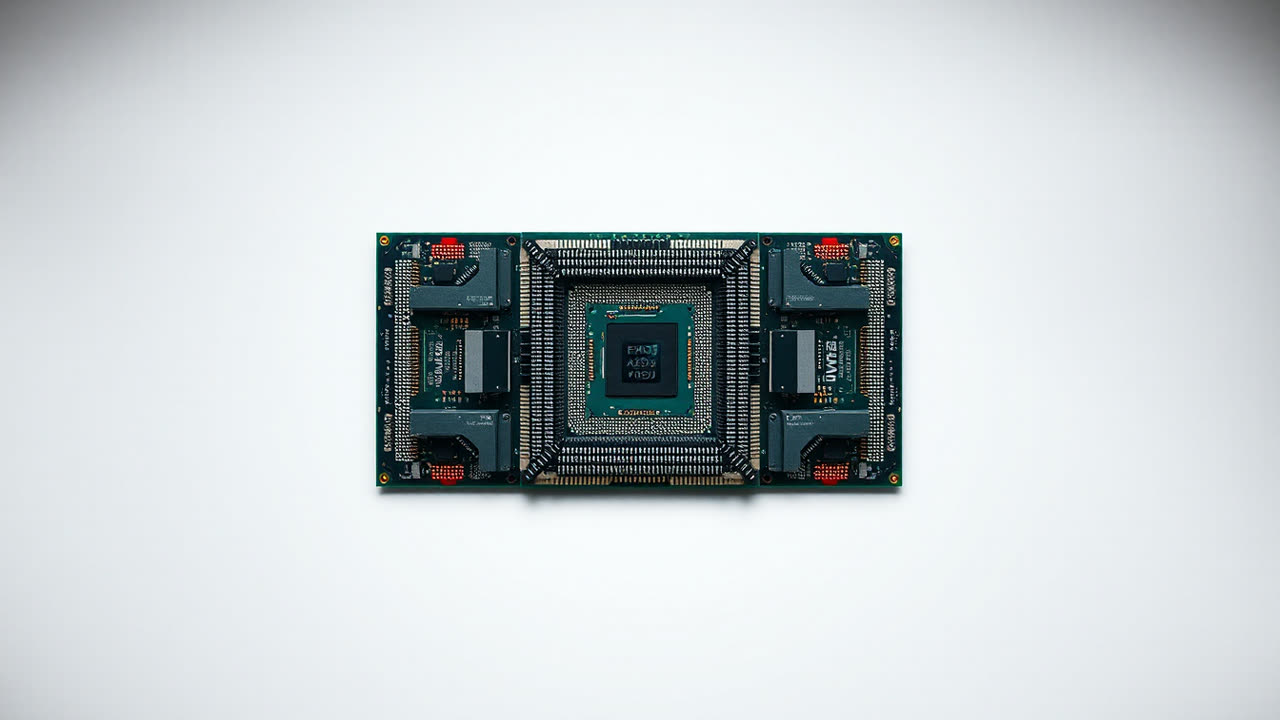
AMD has unleashed its 6th Generation EPYC 9006 "Venice" series, headlined by a monstrous 256-core processor priced at nearly $15,000, fundamentally reshaping the landscape of high-performance computing and data center infrastructure. This flagship SKU, alongside a comprehensive lineup ranging from $700, ushers in an era of unprecedented core density and computational power, built upon the advanced Zen 6 architecture. The EPYC 9006 series, with its multi-chiplet design, promises to deliver significant gains in per-socket performance and efficiency, catering to the most demanding workloads from virtualization to AI inference and training.
The core of the "Venice" series' impact lies in its sheer scalability and architectural refinements. The 256-core variant, likely a quad-die configuration, pushes the boundaries of what a single CPU socket can achieve, enabling data centers to consolidate workloads, reduce server footprints, and potentially lower operational costs. Each Zen 6 core is expected to deliver substantial IPC (instructions per cycle) improvements over previous generations, leveraging advancements in cache hierarchies and execution units. The processors also feature enhanced memory support, likely moving beyond DDR5-6000 to even higher speeds and capacities, and an expanded PCIe 6.0 lane count, providing critical bandwidth for next-generation accelerators and high-speed networking. This level of integration and performance directly addresses the escalating demands of hyperscalers and enterprises grappling with data explosion and complex AI models that thrive on massive parallel processing capabilities.
This release profoundly matters for several reasons, impacting both users and the industry. For enterprise users and cloud providers, "Venice" offers an opportunity for unprecedented workload consolidation. A single 256-core processor can potentially host hundreds of virtual machines or handle massive databases with fewer physical servers, leading to significant reductions in power consumption, cooling requirements, and rack space. This translates directly into a lower Total Cost of Ownership (TCO), a critical metric for large-scale deployments. Furthermore, the immense core count is a boon for AI and machine learning workloads, where parallel processing is paramount. While dedicated AI accelerators still dominate deep learning training, "Venice" can handle substantial inference tasks and smaller-scale training models more efficiently, reducing the need for specialized hardware in certain scenarios. The enhanced I/O capabilities also mean faster data ingress and egress, crucial for data-intensive applications.
From an industry perspective, "Venice" intensifies the already fierce competition with Intel's Xeon platform. AMD's consistent strategy of pushing core counts and leveraging its chiplet architecture has allowed it to gain significant market share in the server segment over the past few years. With the EPYC 9006 series, AMD appears to be further solidifying its leadership in core density, forcing Intel to accelerate its own roadmap, which by late 2026 would likely feature successors to its Sierra Forest (E-core) and Granite Rapids (P-core) families. While Intel has been focusing on a mix of performance and efficiency cores, AMD's "Venice" demonstrates a potent combination of high-performance cores at an extreme scale, posing a direct challenge to Intel's offerings in raw throughput and virtualization density. The pricing strategy, from sub-$1,000 entry-level SKUs to the nearly $15,000 flagship, ensures AMD can compete across various segments of the server market, from edge computing to high-end data centers.
Comparing "Venice" to its predecessors, the generational leap from Zen 4 (Genoa/Bergamo) to Zen 6 is substantial. While Genoa introduced up to 96 cores and Bergamo pushed to 128 cores per socket, "Venice" nearly doubles that maximum, showcasing AMD's aggressive scaling capabilities. This progression isn't merely about more cores; it's about more efficient cores, improved interconnects, and a more robust platform that supports the latest memory and I/O standards. Against rivals, "Venice" sets a new benchmark for single-socket core count, a metric where AMD has consistently held an advantage. Intel's current generation Xeon processors, while offering competitive performance in specific workloads and a mature ecosystem, typically feature lower core counts per socket, with their highest core-count offerings often relying on multi-socket configurations or efficiency-core designs. The "Venice" series further differentiates AMD by offering a compelling performance-per-watt proposition, a critical factor for environmentally conscious and cost-sensitive data center operators.
Looking ahead, the introduction of the EPYC 9006 "Venice" series signals a continued trajectory towards extreme core density and specialized compute in the server market. We can expect to see further optimization of software and operating systems to fully leverage these high core counts, as well as advancements in cooling technologies to manage the thermal output of such powerful processors. AMD's success with "Venice" will likely encourage further innovation in chiplet designs, potentially paving the way for even more heterogeneous architectures that integrate specialized accelerators directly on the CPU package. The relentless pursuit of performance and efficiency will undoubtedly shape the next generation of data centers, with AMD firmly positioned at the forefront of this evolution, continually pushing the boundaries of what's possible within a single server socket.