Anthropic Redesigns Claude Code Projects with Persistent AI-Coordinated Cloud Sessions
Anthropic's new Claude Code Projects beta introduces always-on parallel cloud sessions, transforming AI coding assistance into a persistent, collaborative partnership that continues even after a user closes their laptop.
✨ This content was summarized and interpreted by AI; it may contain errors — please verify accuracy with the original sources. Learn more
Listen to this story
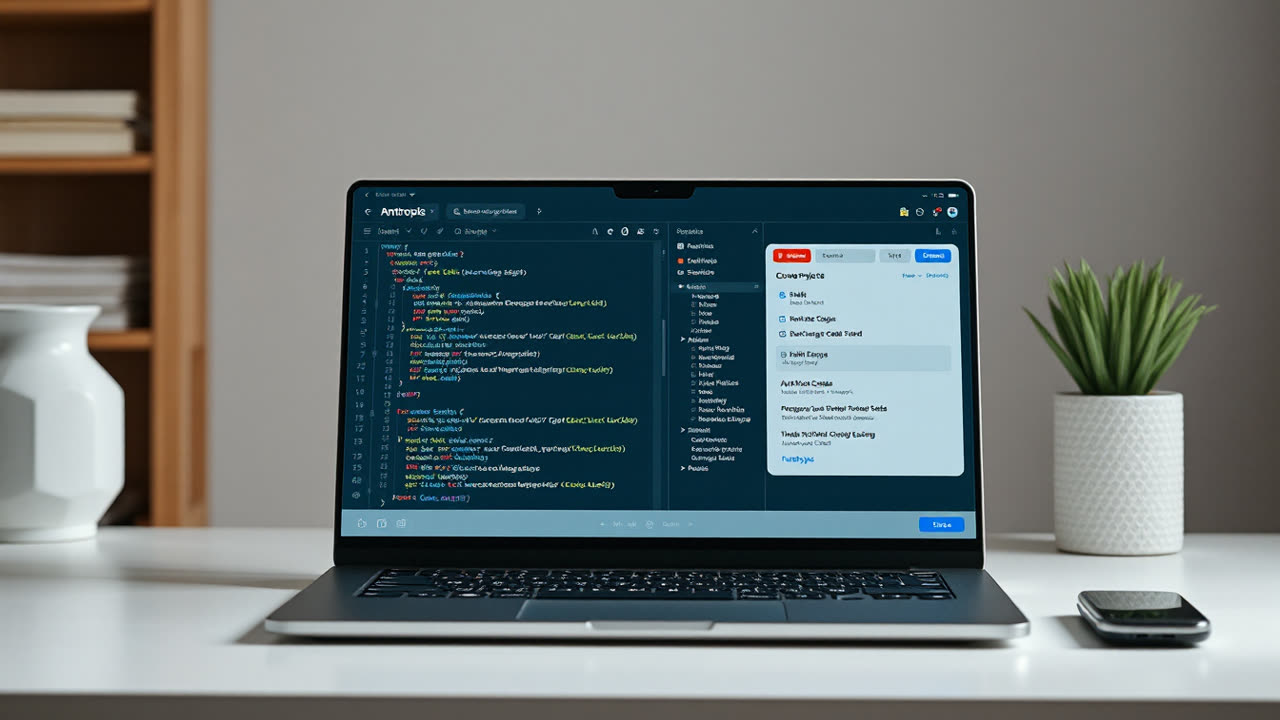
Anthropic has launched a significant redesign of its Claude Code Projects in beta, introducing parallel cloud sessions that maintain an active development environment and ongoing conversation even after a user closes their laptop. This architectural shift moves away from the prior "folder-plus-single-chat" model, transforming the coding experience into a single, persistent conversation where Claude serves as an active coordinator, dynamically creating and managing threads based on the developer's described work. This evolution fundamentally redefines the interaction paradigm with AI coding assistants, pushing beyond reactive code generation towards a truly collaborative and persistent partnership.
The core innovation lies in the "always-on" nature of these cloud sessions. Developers can describe a task or a problem, and Claude intelligently decides how to break it down, initiating separate threads for different components, debugging efforts, or feature implementations. This means a complex coding task, previously requiring meticulous context management by the developer across multiple files and chat windows, can now be orchestrated by Claude within a unified, persistent workspace. For the user, this translates into unprecedented continuity; returning to a project means picking up exactly where they left off, with Claude having potentially continued background processing or having prepared relevant context, eliminating the friction of re-establishing mental models and technical setups. This persistent state, managed in the cloud, offers a significant leap in developer productivity by minimizing cognitive load and maximizing flow state, particularly for large-scale or long-duration projects that often span multiple work sessions.
This development is poised to have a profound impact on user workflows and the broader software development industry. For individual developers, the ability to offload the burden of project coordination and context preservation to an AI means more time spent on creative problem-solving and less on administrative overhead. It facilitates true asynchronous work, allowing developers to make progress without needing to keep their local environment active. For teams, this could streamline collaboration, as project states and ongoing AI conversations could potentially be shared, offering a transparent, persistent record of development decisions and progress. The industry impact extends to accelerating the adoption of AI-native development environments. As AI models become more adept at not just generating code but also coordinating complex tasks and maintaining persistent state, the traditional IDE might evolve to become more of a thin client for cloud-based, AI-managed development sessions. This could drive further innovation in cloud infrastructure specifically tailored for AI-assisted software development.
Comparing this new iteration to its predecessor, the original Claude Code Projects functioned more like a static container—a folder holding files and a single, isolated chat session. While useful for contained tasks, it lacked the dynamic, persistent coordination now offered. A developer would effectively "reset" the AI's understanding of the broader project context with each new session or major task switch. The new model, by contrast, establishes a living, evolving understanding of the project, allowing Claude to build on prior interactions and maintain a holistic view. Against rivals like GitHub Copilot and Google's Gemini Code Assistant, Anthropic's new approach carves out a distinct niche. While competitors excel at real-time code completion, suggestion, and function generation, they largely operate as reactive assistants within a developer's local environment. They do not typically offer persistent, parallel cloud sessions that actively manage and coordinate project threads across multiple work periods, nor do they assume the role of an overarching project coordinator in the same explicit way. The "AI as coordinator" and "persistent cloud session" model represents a significant differentiator, moving beyond mere assistance to genuine partnership.
Looking ahead, the implications of persistent, AI-coordinated development environments are vast. We can anticipate further integration of version control systems directly into these AI-managed sessions, allowing Claude to intelligently suggest commits, manage branches, and even resolve merge conflicts with greater contextual awareness. The potential for autonomous execution of well-defined sub-tasks, with human oversight, becomes increasingly feasible. However, challenges remain. Ensuring robust data privacy and security for persistent cloud-based code projects will be paramount. Developers will also need to adapt to a new paradigm where the AI is not just a tool, but an active participant, requiring new skills in prompt engineering for coordination and in validating AI-driven decisions. The question of "hallucinations" or errors accumulating over long, persistent sessions will demand sophisticated error detection and correction mechanisms. Ultimately, Anthropic's Claude Code Projects beta marks a critical step towards a future where AI does not just write code, but actively manages, coordinates, and persistently assists in the entire software development lifecycle, promising a transformative leap in developer efficiency and the very nature of software creation.