Antiquated MacBook Uses Mirror, Webcam, and AI to Self-Generate AMD GPU Drivers
An ingenious setup involving an old MacBook, a mirror, a webcam, and an AI agent running on Omarchy Linux demonstrates a novel self-correcting feedback loop for autonomous software development, enabling the machine to visually debug and generate its own GPU drivers.
✨ This content was summarized and interpreted by AI; it may contain errors — please verify accuracy with the original sources. Learn more
Listen to this story
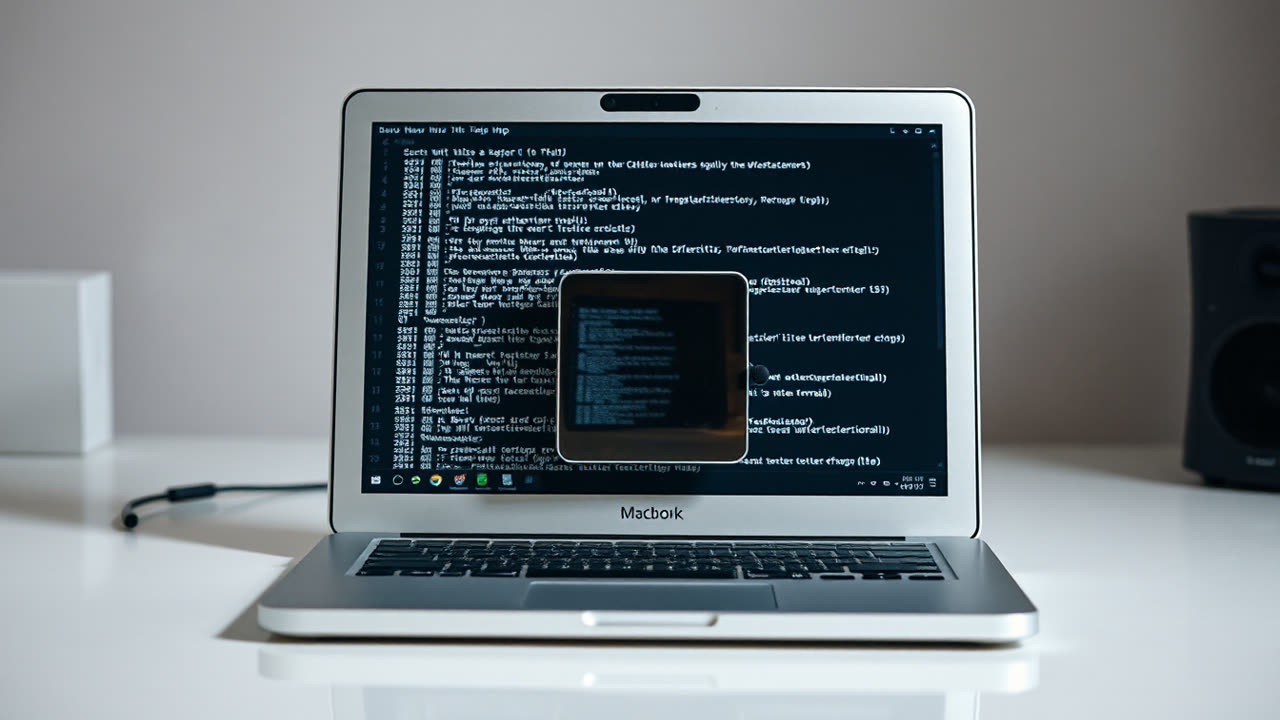
An antiquated MacBook has been observed employing a truly novel, almost surreal, method to generate its own AMD GPU drivers: leveraging its integrated webcam, a strategically placed mirror, and a sophisticated AI agent running on the 'agent-first' Omarchy Linux distribution, marking a significant, if unconventional, leap in autonomous system debugging and development. This ingenious setup allows the AI to visually inspect its own progress on the screen in real-time, effectively creating a self-correcting feedback loop for software development. The core innovation lies in Omarchy Linux's "agent-first" design, where an AI agent acts as the primary interface and debugs the system, including its own operations, a stark departure from traditional human-centric debugging workflows. This visual self-monitoring capability, where the AI "sees" its output and subsequent errors, represents a tangible step towards truly autonomous software engineering.
The implications for both users and the broader tech industry are profound, extending beyond mere driver optimization. For users, particularly those with older hardware or niche configurations, this approach could democratize access to updated drivers and improved performance, circumventing the often-slow and resource-intensive process of human-led driver development, especially for components that have fallen out of official support. Imagine a world where legacy hardware, previously destined for obsolescence, can dynamically adapt and improve its own software stack, extending its usable lifespan and reducing e-waste. This also opens avenues for highly specialized or experimental hardware to gain software support without requiring extensive human developer hours, potentially fueling innovation in hardware design.
From an industry perspective, this "agent-first" paradigm challenges established software development methodologies. Traditional driver development is a painstaking, error-prone process requiring deep hardware knowledge, extensive testing, and collaborative effort from large engineering teams. Companies like AMD and NVIDIA invest heavily in these efforts, often releasing drivers on a fixed schedule. An AI agent capable of autonomously identifying, coding, and debugging drivers suggests a future where software development becomes significantly more automated, potentially reducing time-to-market for new hardware features and accelerating bug fixes. This could lead to a paradigm shift where operating systems and core software components are not just designed to *run* applications but to *evolve* and *repair* themselves, much like a living organism. The ability for an AI to interpret visual feedback from the screen for debugging purposes transcends simple log analysis or automated testing scripts, offering a more holistic understanding of the system's state and behavior.
Comparing this to current industry practices, existing AI tools in software development primarily assist human developers with tasks like code completion, bug detection (static analysis), and automated testing. GitHub Copilot, for instance, generates code suggestions based on context, significantly boosting developer productivity. Similarly, various AI-powered testing frameworks can identify vulnerabilities or performance bottlenecks. However, these tools generally operate *under the direction* of a human developer. The Omarchy Linux scenario, by contrast, positions the AI as the *agent* of development and debugging, with the human potentially becoming more of a supervisor or architect. This shift from AI *assistance* to AI *agency* is a critical distinction. While Google's AlphaCode has shown impressive capabilities in competitive programming, solving problems independently, and DeepMind's AlphaDev has demonstrated the ability to discover more efficient sorting algorithms, the Omarchy Linux project extends this agency to real-time, visual-feedback-driven system-level debugging, a complex task that integrates multiple modalities of information.
Looking ahead, the "age of agents" Linux distro, exemplified by Omarchy, points towards a future where operating systems are far more dynamic and self-sufficient. We could see operating systems that continuously optimize themselves for specific workloads, adapt to new hardware peripherals without manual driver installation, and even proactively defend against exploits by patching vulnerabilities as they are discovered by an internal AI agent. The mirror-and-webcam setup, while seemingly rudimentary, highlights the nascent stage of this technology; future iterations will undoubtedly integrate more sophisticated internal diagnostic tools and direct programmatic access to graphical buffers, eliminating the need for external visual feedback. This approach could also accelerate the development of highly specialized embedded systems and IoT devices, where human intervention for software maintenance is impractical or impossible. However, challenges remain, including ensuring the safety and reliability of autonomously generated code, mitigating potential "AI hallucinations" that could introduce new bugs, and establishing robust validation frameworks for self-modifying systems. Nevertheless, this MacBook's unconventional journey to self-sufficiency offers a tantalizing glimpse into a future where our machines are not just tools, but active participants in their own evolution.