Apple has officially entered the foldable smartphone arena with the iPhone Duo, unveiled on September 9, 2026, and set for release on October 23, 2026, starting at $1,999.
This debut is poised to fundamentally alter group selfies, leveraging both the device's innovative foldable design and a suite of advanced camera features, including sophisticated AI-driven enhancements.
✨ This content was summarized and interpreted by AI; it may contain errors — please verify accuracy with the original sources. Learn more
Listen to this story
Apple has officially entered the foldable smartphone arena with the iPhone Duo, unveiled on September 9, 2026, and set for release on October 23, 2026, starting at $1,999. This debut is poised to fundamentally alter group selfies, leveraging both the device's innovative foldable design and a suite of advanced camera features, including sophisticated AI-driven enhancements. The Duo, featuring a 5.4-inch outer display and a expansive 7.6-inch inner display when unfolded, presents unprecedented placement options for photography, allowing users to move beyond the limitations of traditional slab smartphones.
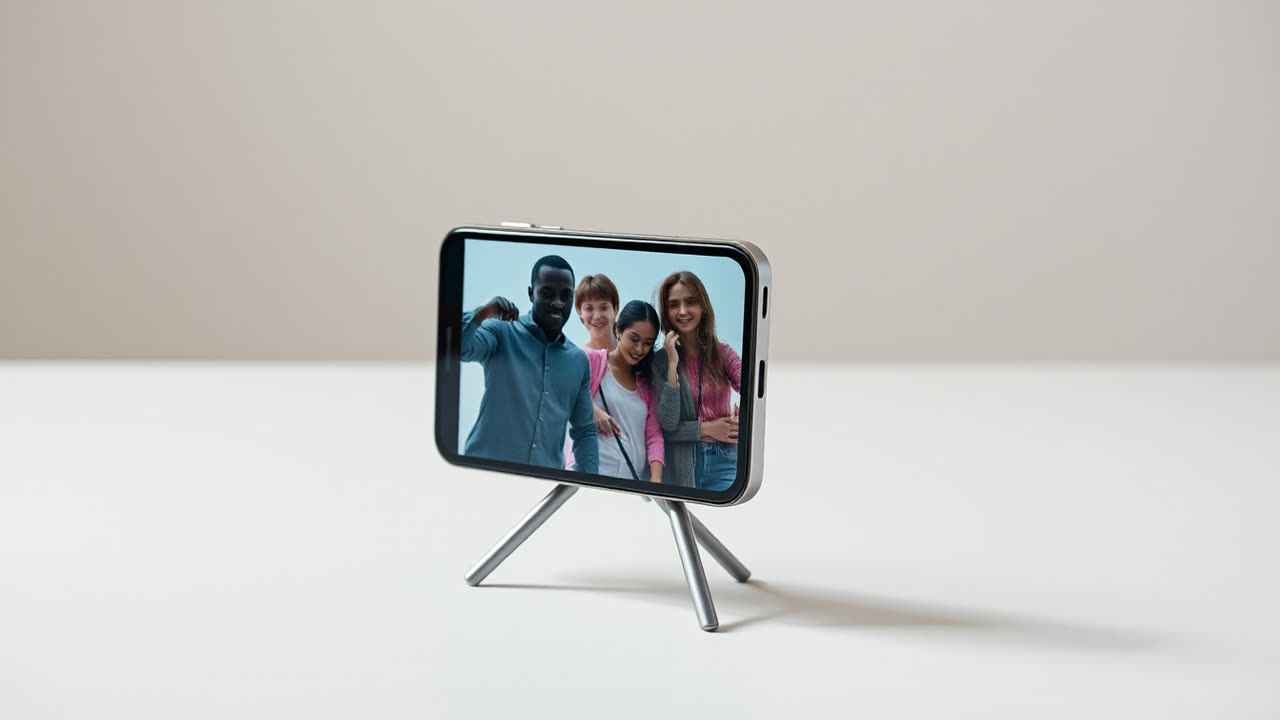
The foldable form factor itself introduces a paradigm shift in how users capture group photos. By partially folding the device, the iPhone Duo can act as its own tripod, enabling stable, hands-free shots without needing external accessories or relying on a stranger to take the picture. This inherent flexibility means users can position the phone at various angles — from ground-level wide shots to elevated perspectives — to include everyone in the frame, a significant improvement over awkward arm extensions or cropped compositions. Furthermore, the outer display can serve as a real-time viewfinder for subjects, ensuring everyone can see and adjust their pose before the shutter clicks, a capability unique to foldable designs. This is particularly beneficial for impromptu group moments where achieving the perfect shot is often a challenge.
Beyond hardware, the iPhone Duo integrates powerful AI camera features within iOS 27 that elevate group selfies. The 12-megapixel Center Stage camera on the 5.4-inch outer screen intelligently widens the frame for group photos and can switch between portrait and landscape framing, even if the phone remains vertical. This automatic adjustment ensures no one is left out, dynamically optimizing the composition as people enter or leave the shot. Apple's broader computational photography, powered by the A20 Pro chip and an updated Photonic Engine, processes light, reduces noise, and adjusts color in real-time, delivering professional-quality images even in challenging lighting conditions. Features like Spatial Reframing, introduced in iOS 27, allow users to edit the positions of objects and people in photos post-capture, and even adjust a person's head angle to appear as if they were looking at the camera. This level of AI-driven manipulation provides an unprecedented degree of control, virtually guaranteeing a "perfect" group selfie by rectifying minor imperfections after the fact.
The iPhone Duo's entry into the foldable market is a significant disruptor, projected to capture 25% of the global foldable market within months of its October 23 launch, selling an estimated 6 million units in 2026. This immediate impact positions Apple as the number two player behind Samsung, signaling a new era of competition and innovation in a segment that had previously been losing momentum. While Apple's device starts at a premium $1,999, it directly competes with established rivals like the Samsung Galaxy Z Fold8 Ultra and Google Pixel 11 Pro Fold. The Galaxy Z Fold8 Ultra boasts a 200-megapixel main sensor and a dedicated 3x telephoto lens, alongside dual 10-megapixel selfie cameras. The Pixel 11 Pro Fold, priced at $1,899, offers a 48-megapixel main camera and a 5x optical telephoto lens, also featuring dual 10-megapixel selfie cameras. The iPhone Duo, in contrast, utilizes a 48-megapixel main sensor, a 48-megapixel ultrawide, and achieves a "2x optical-quality Telephoto" through a crop from the main sensor, rather than a dedicated telephoto lens. This strategic choice emphasizes computational photography over raw optical hardware in some areas, a hallmark of Apple's approach.
Looking ahead, the convergence of foldable hardware and advanced AI will continue to redefine smartphone photography. Apple's ongoing investment in spatial photography, evidenced by patents combining wide and ultra-wide camera feeds for immersive 3D content, suggests future iPhones will prioritize experiences for devices like the Vision Pro. The iPhone Duo's foldable form factor, combined with evolving AI, will naturally lend itself to capturing such spatial content with greater ease and versatility. Furthermore, the increasing concern over AI-generated imagery has prompted Apple to introduce features like Apple Reference Image on the iPhone 18 Pro and Pro Max, which creates a cryptographically secured record to verify if a photo was genuinely captured by an iPhone camera. While not explicitly listed for the Duo, the integration of such authenticity features across Apple's premium lineup is inevitable, addressing the growing need for trust in a world of increasingly sophisticated digital manipulation. This signals a future where the "perfect" group selfie isn't just about flawless composition, but also verifiable authenticity, further enhancing the value and impact of moments captured on devices like the iPhone Duo.