Apple Overhauls Siri with Generative AI and Privacy-First 'Apple Intelligence'
Apple's iOS 27 introduces 'Siri AI,' a transformative, privacy-centric generative AI assistant powered by the Apple Intelligence framework, setting a new standard for on-device intelligence and multi-app functionality.
✨ This content was summarized and interpreted by AI; it may contain errors — please verify accuracy with the original sources. Learn more
Listen to this story
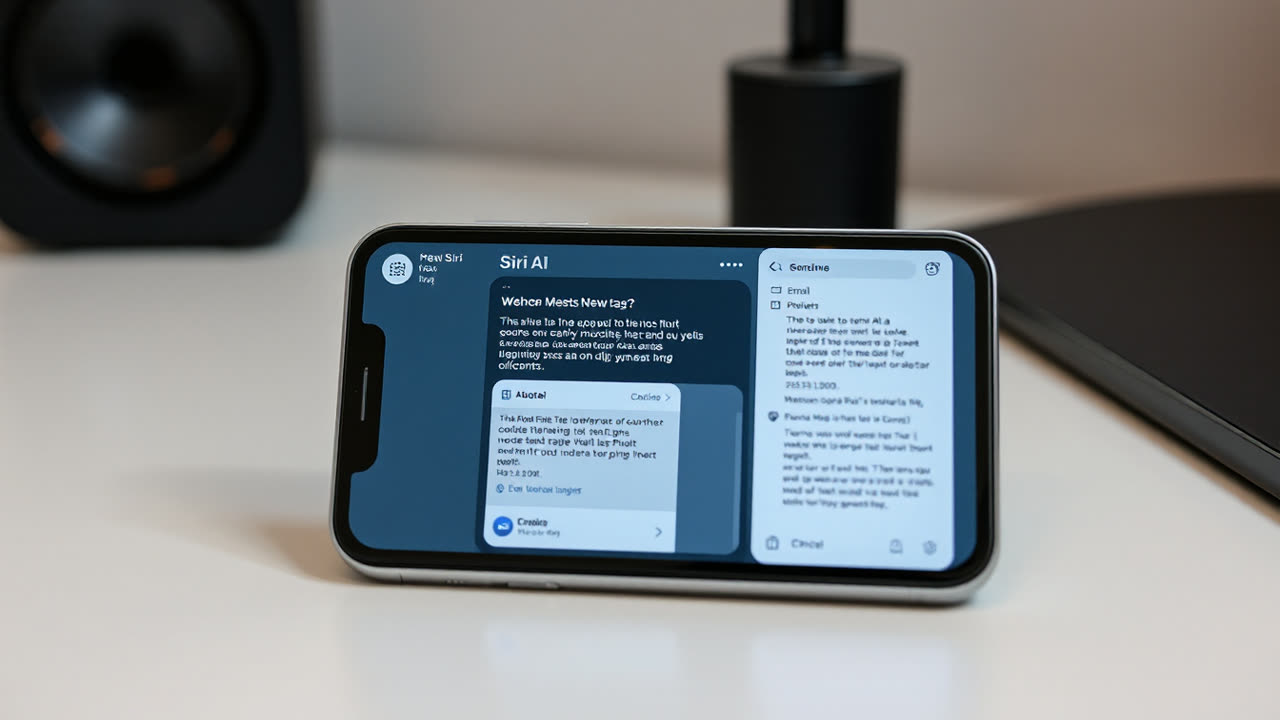
Apple's iOS 27, arriving this September 14, 2026, marks the most significant overhaul of Siri to date, transforming the long-criticized voice assistant into a profoundly more capable and personal AI, deeply integrated across the Apple ecosystem. Internally codenamed "Campos," this revamped Siri AI, powered by the overarching Apple Intelligence framework, introduces a suite of generative AI capabilities designed to understand personal context, maintain complex conversations, and perform multi-step actions across applications, setting a new benchmark for on-device intelligence.
The core of Siri AI's new functionality lies in its "on-screen awareness" and "personal context understanding." This means the assistant can now comprehend what users are actively viewing on their screen and leverage personal data from messages, emails, photos, and calendar events to provide relevant assistance. For instance, users can ask Siri to locate flight details from an email and then book a lunch reservation listed on their calendar, all without manually switching between applications. The integration extends to Visual Intelligence, allowing Siri to process visual information directly through the Camera app, enabling tasks like identifying nutritional facts from food packaging or facilitating bill splitting with friends via Apple Cash. Furthermore, Siri AI now offers sophisticated writing tools, providing suggestions for improvement, drafting text, or revising content across various applications. Accessibility features also see a major boost, with VoiceOver gaining the ability to generate detailed descriptions of images across the system.
This architectural shift represents a direct response to a market that has seen Siri increasingly lag behind rivals. For years, Siri was often perceived as a "crippled magic" that struggled with complex requests and lacked the contextual understanding offered by competitors. While Google Assistant, Amazon Alexa, and Microsoft Copilot have advanced their conversational AI capabilities, Apple's approach with Siri AI differentiates itself significantly through its unwavering commitment to user privacy. The system prioritizes "on-device processing," ensuring that AI tasks are handled directly on the user's iPhone, minimizing data transfer. For more complex requests requiring greater computational power, Apple employs its "Private Cloud Compute" (PCC) system, which extends the privacy and security of Apple devices into the cloud. PCC utilizes Apple Silicon-powered servers, but critically, user data is never stored, retained, or made accessible to Apple employees, a claim verifiable by independent privacy and security researchers. This privacy-first philosophy stands in contrast to many competitors who rely heavily on centralized cloud processing, offering a compelling advantage in an era of heightened data privacy concerns.
The industry impact of a truly intelligent, privacy-preserving Siri is substantial. For users, it promises a more seamless and intuitive interaction with their devices, transforming the iPhone into a proactive personal agent rather than a reactive command processor. The ability to manage complex, multi-app tasks with natural language and on-screen awareness significantly reduces friction in daily digital workflows. This evolution from a "passive responder into an active assistant" is poised to enhance user satisfaction and engagement across the Apple ecosystem. For the industry, Apple's deep integration of AI at the operating system level, rather than as a standalone app, sets a precedent. It leverages the company's powerful A20 Pro chip, with its 16-core Neural Engine doubling the AI processing power of its predecessor, enabling many of these advanced features to run locally. This also signals a strategic partnership with Google, as Apple is reportedly adopting Google's Gemini platform for some of its underlying foundation models, indicating a pragmatic approach to leveraging best-in-class AI while maintaining its privacy and integration strengths.
Looking ahead, while Siri AI represents a monumental leap, its initial rollout comes with caveats. The assistant is launching in beta with iOS 27 and will initially only support English, with other languages like French, Japanese, Korean, Portuguese, and Spanish slated for October 2026. Crucially, certain advanced features that rely on server-side models will be subject to daily usage limits, with Apple indicating that increased access may become available for a fee in the future. Furthermore, access to Siri AI in the European Union is restricted for iPhone, iPad, and Apple Watch users, though it will be available on Mac and Apple Vision Pro. Despite these initial limitations, the personal AI assistant market is experiencing exponential growth, projected to reach $19.63 billion by 2030, growing at a compound annual growth rate of 41.9%. Apple's aggressive move into this space, transforming Siri into a contextual action engine, positions it strongly within this expanding market. The future will likely see Apple continue to refine Siri AI's capabilities, expand language and regional support, and potentially introduce tiered access models, further solidifying its vision of a privacy-centric, deeply integrated AI that anticipates user needs and acts autonomously across all devices.