Apple Redefines User Experience with Deep AI Integration and Revamped Siri
Apple’s latest software updates fundamentally redefine the user experience by deeply embedding generative AI through "Apple Intelligence" and a significantly revamped Siri, positioning the company as a formidable contender in the rapidly evolving AI landscape and setting a new industry standard for privacy-first AI.
✨ This content was summarized and interpreted by AI; it may contain errors — please verify accuracy with the original sources. Learn more
Listen to this story
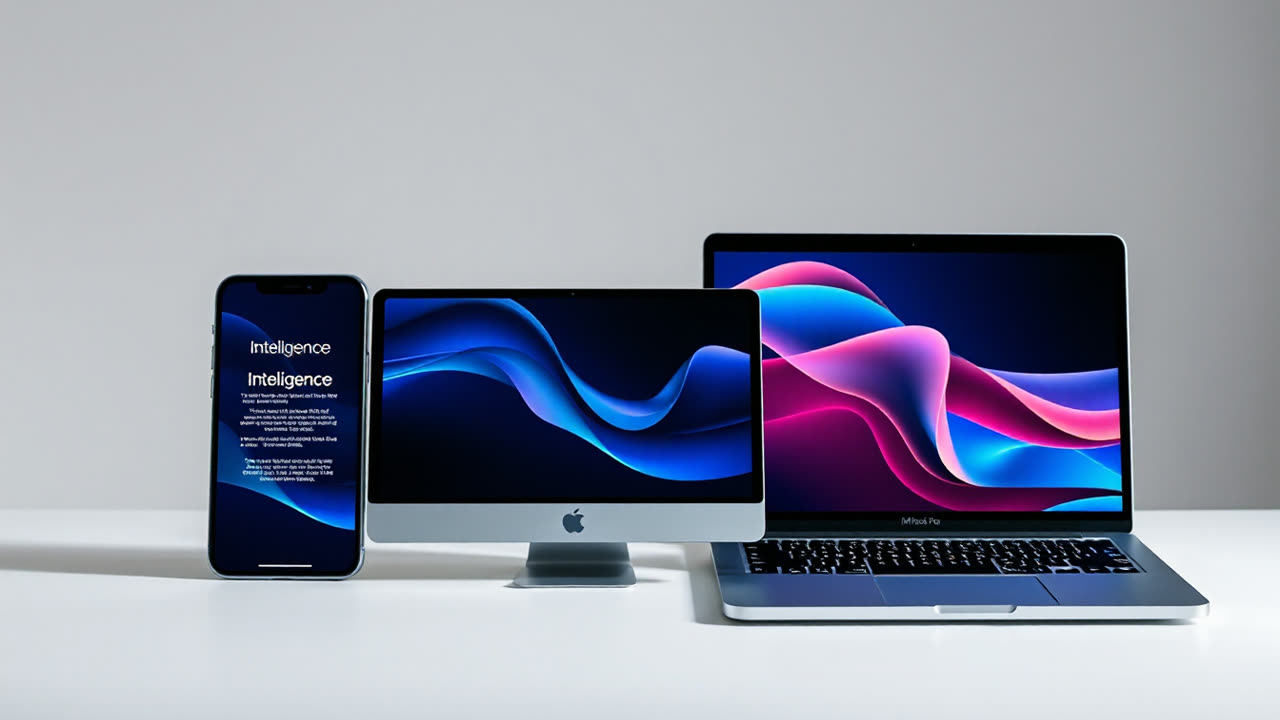
Apple’s latest software updates, now available across its platforms, fundamentally redefine the user experience by deeply embedding generative AI through "Apple Intelligence" and a significantly revamped Siri, positioning the company as a formidable contender in the rapidly evolving AI landscape. This pivotal release, which rolled out in early September 2026, marks Apple’s most ambitious foray into artificial intelligence to date, moving beyond incremental improvements to deliver a suite of features designed to understand and anticipate user needs contextually. At its core, Apple Intelligence leverages on-device processing for privacy-sensitive tasks, while more complex requests are handled by Private Cloud Compute, ensuring data remains secure and inaccessible to Apple itself. This hybrid approach directly addresses long-standing privacy concerns associated with cloud-based AI, a critical differentiator in a market increasingly wary of data exploitation.
The integration of Apple Intelligence profoundly impacts daily workflows, offering capabilities that transcend simple voice commands. Users can now generate custom images and emojis directly within messages using "Image Playground," a feature that understands natural language prompts to create personalized visual content. Writing tools have been enhanced with "Rewrite" and "Proofread" functions, allowing for instant text refinement and style adjustments across applications like Mail and Pages, dynamically adapting tone from professional to casual. Perhaps most impactful is the system-wide semantic search, enabling users to find specific photos or documents not just by keywords, but by describing their content, such as "find photos of Sarah at the beach last summer." This move towards semantic understanding dramatically reduces friction in information retrieval, transforming how users interact with their personal data.
Siri, long criticized for its limited capabilities compared to rivals, has received an overhaul that finally delivers on its original promise of an intelligent personal assistant. The new Siri is deeply integrated with Apple Intelligence, gaining enhanced natural language understanding and the ability to perform complex, multi-step actions across apps. It can now contextually understand what's on the user's screen, allowing for commands like "send this article to Mom" or "summarize these meeting notes." Furthermore, Siri can now answer questions about how to use Apple devices and applications, acting as an on-demand technical support agent. This represents a significant leap from its previous iteration, which often struggled with nuanced requests and lacked cross-application awareness. The updated Siri also features a more natural, expressive voice, further enhancing the user experience.
This strategic pivot matters immensely for both users and the broader tech industry. For users, the promise of a truly intelligent, privacy-respecting AI assistant embedded directly into their most-used devices offers unprecedented convenience and efficiency, potentially streamlining tasks that previously required multiple manual steps. The on-device processing and Private Cloud Compute architecture set a new standard for AI privacy, pressuring competitors to adopt similar robust safeguards. Industry-wide, Apple’s entry with such a comprehensive AI offering validates the generative AI trend as a mainstream technology, accelerating innovation across the board. Developers gain new frameworks and APIs to integrate Apple Intelligence into their own applications, potentially leading to a new wave of intelligent app experiences. The tight integration within Apple’s ecosystem further strengthens its walled garden, making it even more compelling for users to remain within the Apple fold, while simultaneously raising the bar for seamless cross-device functionality.
Compared to rivals, Apple Intelligence distinguishes itself primarily through its privacy-first approach and deep system-level integration. While Google's Gemini and Microsoft's Copilot offer powerful generative AI capabilities, they often rely heavily on cloud processing, raising data privacy concerns for many users. Samsung, with its Bixby and recent AI enhancements, has made strides, but often lacks the cohesive, system-wide integration that Apple has achieved. Prior generations of Apple software featured AI primarily for background tasks like photo recognition and predictive text; this new update moves AI to the forefront of user interaction, making it a proactive, rather than reactive, tool. The sheer scale and depth of integration across iOS, iPadOS, and macOS, coupled with the new Siri, positions Apple to potentially redefine user expectations for what a personal computer and mobile device can accomplish.
Looking ahead, the initial rollout of Apple Intelligence and the revamped Siri is likely just the beginning. Future updates will undoubtedly expand the range of applications and services that can leverage these AI capabilities. Deeper integration with third-party apps, allowing Siri to perform complex actions across an even wider array of services, is an expected next step. We can also anticipate more sophisticated multimodal AI, enabling Siri to process visual and auditory input more effectively in conjunction with text. The development of specialized AI models tailored for specific professional workflows, perhaps through partnerships or dedicated developer tools, could also emerge. The long-term trajectory suggests an evolution towards an ambient intelligence, where Apple devices anticipate needs and provide assistance almost imperceptibly, making technology truly disappear into the background while serving the user’s intent. This release solidifies Apple's commitment to leading the next era of personal computing, one defined by intelligent, context-aware, and privacy-centric AI.