Apple's Foldable iPhone Threatens iPad Mini's Niche
Apple's rumored entry into the foldable smartphone market, potentially dubbed the "iPhone Duo" by some, presents a fascinating dilemma for consumers weighing the benefits of a large, pocketable screen against the dedicated tablet experience offered by the iPad Mini.
✨ This content was summarized and interpreted by AI; it may contain errors — please verify accuracy with the original sources. Learn more
Listen to this story
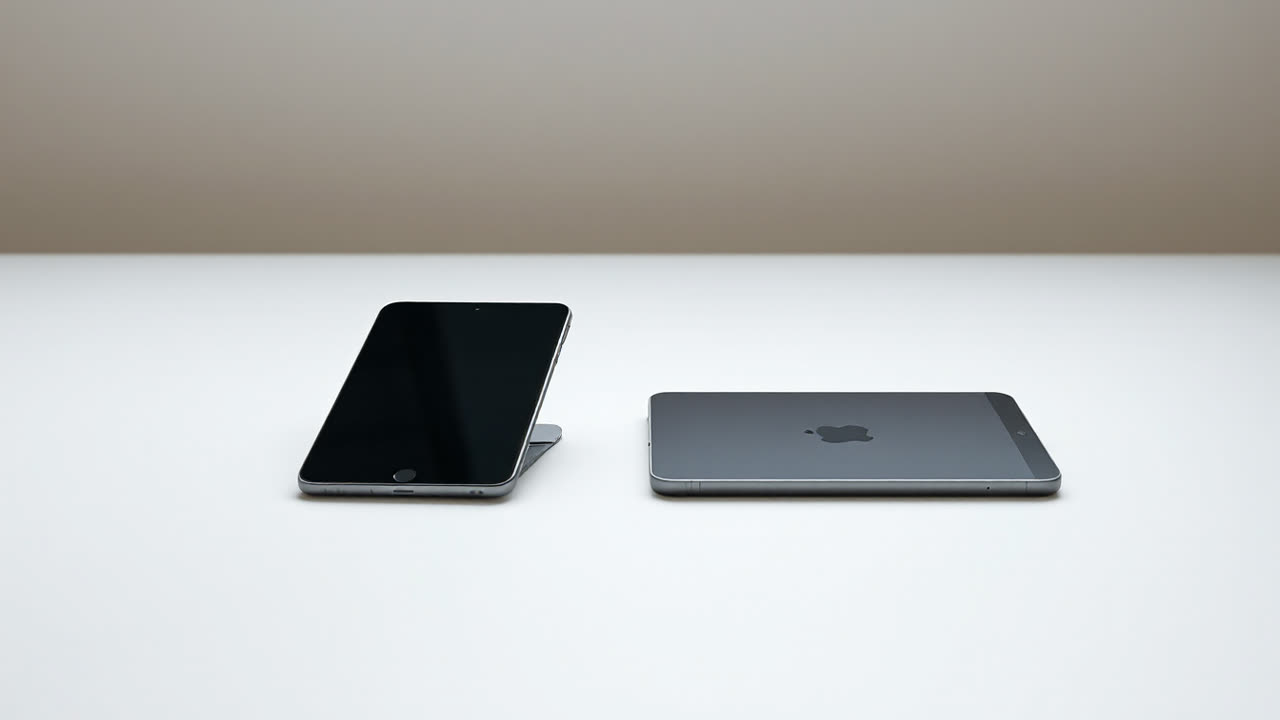
Apple's rumored entry into the foldable smartphone market, potentially dubbed the "iPhone Duo" by some, presents a fascinating dilemma for consumers weighing the benefits of a large, pocketable screen against the dedicated tablet experience offered by the iPad Mini. While a foldable iPhone promises a tablet-like canvas that collapses into a standard smartphone footprint, its very existence challenges the long-held segmentation of Apple's device lineup, potentially cannibalizing sales of its smaller tablet and redefining mobile productivity.
The core appeal of a device like the speculative iPhone Duo lies in its dual nature: a premium smartphone that unfurls to reveal a significantly larger internal display. Current industry rumors suggest Apple's foldable could feature an internal screen size approaching 8 inches, rivaling the 8.3-inch Liquid Retina display of the latest iPad Mini (6th generation, released September 2021). This expanded real estate would fundamentally alter the iPhone experience, enabling enhanced multitasking, more immersive media consumption, and a superior canvas for content creation on the go. Imagine running two full-screen apps side-by-side, or editing documents and photos with a level of precision previously reserved for tablets. For users prioritizing ultimate portability without sacrificing screen size, the foldable form factor is undeniably compelling, allowing a device with tablet ambitions to slip into a pocket when closed. This contrasts sharply with the iPad Mini, which, despite its compact size, remains a two-handed device demanding a bag or larger pocket for transport.
However, the "tablet-like experience" of a foldable iPhone may not fully replicate or surpass that of a dedicated iPad Mini. The iPad Mini, powered by the A15 Bionic chip in its current iteration, offers robust performance within a unibody design optimized purely for its larger screen. Its aspect ratio and software optimizations are tailored for tablet applications, offering a consistent and expansive view without the crease or hinge mechanisms inherent to foldables. The iPad Mini also boasts superior battery life, typically offering up to 10 hours of web surfing or video playback on Wi-Fi, a benchmark that foldable phones, with their two displays and complex internal mechanisms, often struggle to match. Furthermore, the iPad Mini seamlessly integrates with the Apple Pencil 2nd generation, transforming it into a powerful tool for note-taking, sketching, and precise input—a functionality that, while potentially coming to a foldable iPhone, would face ergonomic challenges on a less rigid, potentially creased surface.
The impact on users and the industry would be profound. For users, the choice becomes less about "phone *and* tablet" and more about "phone *as* tablet." This could lead to a consolidation of devices for power users, simplifying their tech carry. However, the likely premium pricing of an iPhone Duo—analysts project initial foldable iPhones to start well above current iPhone Pro Max models, possibly exceeding $1,700 or even $2,000—would place it firmly in the luxury segment, making the $499 starting price of the iPad Mini an attractive alternative for budget-conscious consumers seeking a large screen. For Apple, introducing a foldable iPhone would be a strategic move to capture a share of the burgeoning foldable market, currently dominated by Samsung, and to push the boundaries of mobile innovation. It would also force a re-evaluation of its tablet strategy, potentially positioning the iPad Mini as a more affordable, dedicated productivity or entertainment device, while the foldable iPhone caters to the bleeding-edge segment.
Comparing a hypothetical iPhone Duo to current rivals like Samsung's Galaxy Z Fold series reveals Apple's potential advantages in software integration and ecosystem maturity, but also highlights the engineering challenges. Samsung's foldables, now in their fifth and sixth generations, have refined the foldable experience, but Apple's rumored delayed entry suggests a focus on perfecting the hinge, display durability, and software optimization for a seamless user experience. Apple's control over both hardware and software could result in a more polished, less compromised foldable device from day one, potentially offering superior app scaling and a more robust ecosystem of applications optimized for both folded and unfolded states. This contrasts with earlier foldable implementations that sometimes struggled with app compatibility and display integrity.
Looking ahead, the introduction of an iPhone Duo would undoubtedly accelerate innovation across the entire smartphone industry, pushing rivals to further refine their foldable offerings and potentially inspiring new form factors. For Apple, it represents a pivotal moment, signaling a willingness to embrace radical design changes while carefully balancing user experience with technological feasibility. The iPad Mini, rather than being rendered obsolete, would likely find its niche reinforced as an accessible, high-performance compact tablet, particularly appealing to students, artists, and casual users who value its straightforward, reliable design and lower entry cost. Future iterations of the iPad Mini might even see further differentiation, perhaps with enhanced Apple Pencil features or specialized software, to solidify its position against the encroaching capabilities of foldable smartphones. Ultimately, the choice between an iPhone Duo and an iPad Mini will boil down to a user's priorities: the ultimate convergence of phone and tablet in a single, premium, pocketable device, or a dedicated, optimized tablet experience at a more accessible price point.