Apple's Handoff and Continuity: Seamless Workflow and Ecosystem Lock-in
Apple's Handoff feature, a cornerstone of its Continuity ecosystem, allows users to seamlessly transfer tasks between Apple devices, creating an uninterrupted workflow that transcends individual hardware.
✨ This content was summarized and interpreted by AI; it may contain errors — please verify accuracy with the original sources. Learn more
Listen to this story
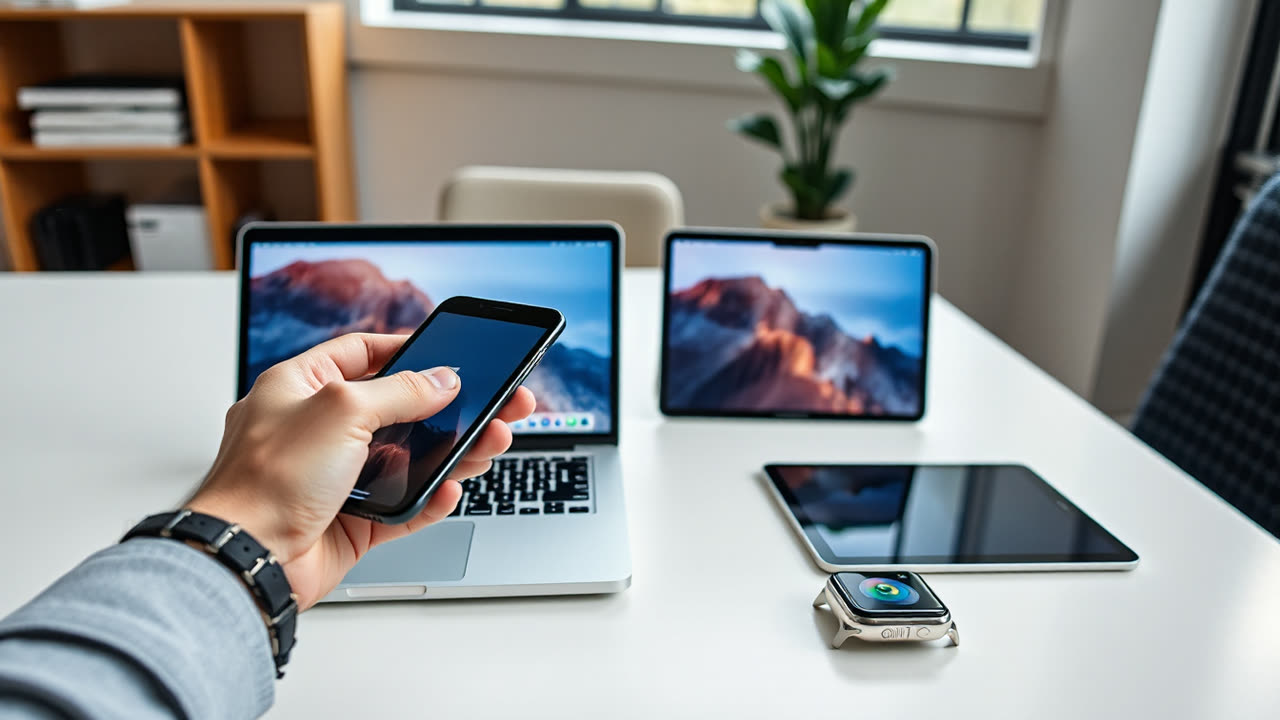
Apple's Handoff, a cornerstone of its Continuity ecosystem, allows users to seamlessly transfer tasks between Apple devices, creating an uninterrupted workflow that transcends individual hardware. Introduced with iOS 8 and macOS Yosemite in 2014, Handoff enables an individual to start an email on their iPhone, for instance, and effortlessly pick up exactly where they left off on their Mac, or begin browsing a webpage on an iPad and continue on an iPhone. This functionality relies on Bluetooth Low Energy (BLE) for device discovery, Wi-Fi for data transfer, and iCloud for synchronization, ensuring that as long as devices are signed into the same Apple ID and within proximity, the transition is instantaneous and fluid.
While Handoff itself is a device-level feature requiring no specific carrier support, the broader concept of "one mobile number, two phones" or extending cellular capabilities across multiple devices *does* heavily involve carriers. The most prominent example is the Apple Watch with cellular, which shares the iPhone's primary number, allowing users to make and receive calls and texts directly from their wrist, even when the iPhone is not nearby. This requires a cellular plan extension for the Apple Watch, offered by major carriers globally such as AT&T's NumberSync, Verizon's NumberShare, and T-Mobile's DIGITS in the U.S., as well as Vodafone and EE in the UK, among many others internationally. Beyond the Watch, Apple's Continuity features also allow iPhones to route calls and texts to other Apple devices like iPads and Macs, effectively extending the primary phone number's reach. This means an incoming call to an iPhone can ring on a MacBook Pro, and users can answer it directly from their laptop, provided the devices are on the same Wi-Fi network and signed into the same Apple ID. This creates a powerful illusion of a single, omnipresent phone number, minimizing the friction of device switching and maximizing accessibility.
The true significance of Handoff and the broader Continuity suite lies in its profound impact on user productivity and Apple's strategic ecosystem lock-in. For users, it eradicates micro-interruptions that accumulate throughout the day, transforming disjointed device interactions into a cohesive experience. Professionals can draft documents on a Mac, take a call on an iPad, and respond to a message on an iPhone, all without breaking stride or manually transferring files. This convenience fosters a deep reliance on the Apple ecosystem, making it increasingly difficult for users to switch to competing platforms without sacrificing a significant portion of their established workflow efficiency. The industry impact is equally substantial: Apple's seamless integration sets a high bar for competitors, pushing them to develop their own cross-device functionalities. While Android and Windows ecosystems offer analogous features, such as Google's Quick Share for file transfers and Microsoft's Phone Link for integrating Android phones with Windows PCs, they often fall short of Apple's deep, system-level integration and the sheer breadth of supported application types for task continuity. Samsung's Flow attempts to bridge this gap for its own devices, but lacks the ubiquitous cross-device presence that Apple commands across its varied hardware portfolio.
Handoff's initial introduction in 2014 marked a pivotal moment, cementing Apple's vision for a unified computing experience. It arrived alongside other crucial Continuity features like Universal Clipboard, which allows copying content on one device and pasting it on another, and Instant Hotspot, simplifying internet access across devices. This collective push underscored Apple's strategic advantage: owning both hardware and software allowed for unparalleled integration that rivals, operating on fragmented platforms, struggled to match. The seamless nature of Handoff, requiring minimal user intervention beyond proximity and a shared Apple ID, has remained a core differentiator.
Looking ahead, the evolution of Handoff and Continuity will likely see even deeper integration, potentially leveraging advanced machine learning and artificial intelligence to anticipate user needs. Imagine an iPhone automatically preparing relevant documents on a Mac when a user sits down at their desk, or a task initiated on an iPhone being intelligently paused and offered on an Apple Vision Pro as the user dons the headset, complete with spatial context. The recent introduction of Apple Vision Pro presents a fertile ground for Handoff's expansion, allowing for seamless transition of tasks from traditional screens into spatial computing environments. While the core "one mobile number, two phones" concept remains tied to carrier services for true cellular duplication, the underlying Continuity framework, powered by Handoff, will continue to expand the perceived reach and capability of a single mobile number across an ever-growing array of Apple devices, solidifying the company's ecosystem advantage and redefining personal computing fluidity.