Apple's Mac mini and Mac Studio Redefine Desktop Computing with M2 Chips
Apple's M2-powered Mac mini and Mac Studio carve distinct niches in the desktop market, fundamentally altering user approaches to performance and value.
✨ This content was summarized and interpreted by AI; it may contain errors — please verify accuracy with the original sources. Learn more
Listen to this story
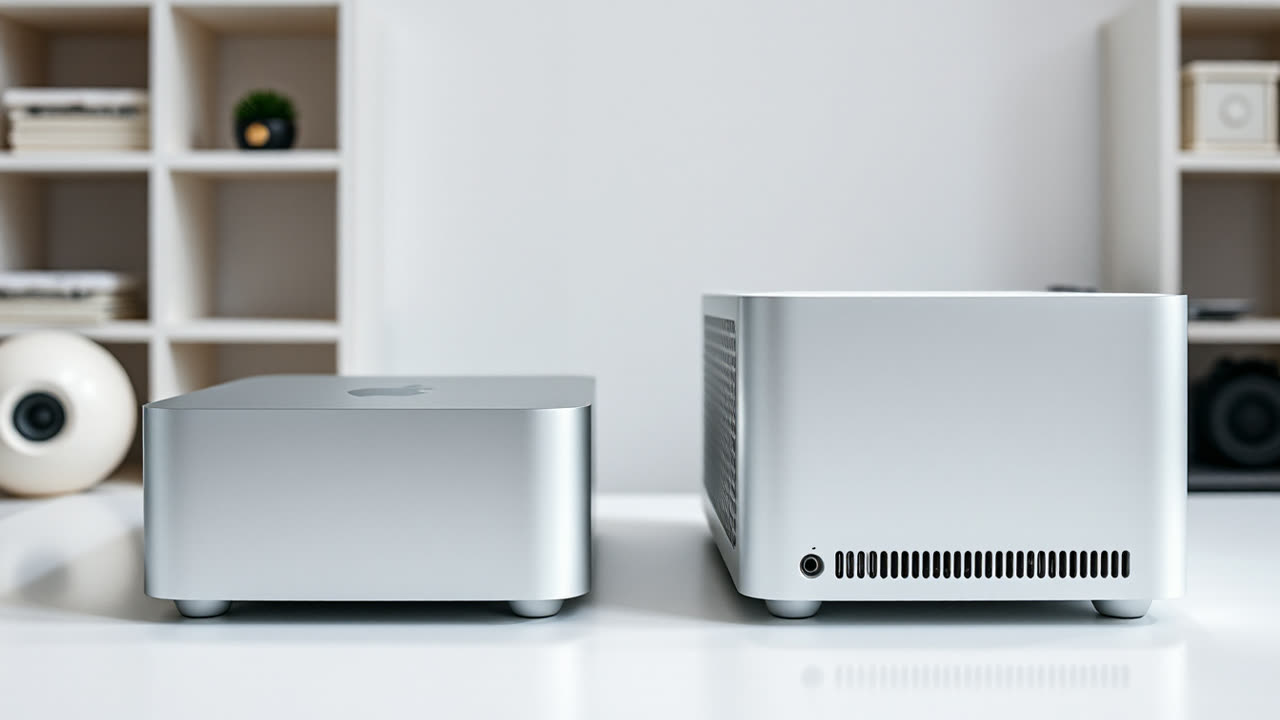
Apple's desktop lineup, once a straightforward choice between consumer and professional towers, has evolved into a nuanced spectrum where the M2 and M2 Pro-powered Mac mini, launched in January 2023, and the M2 Max and M2 Ultra-equipped Mac Studio, updated in June 2023, carve distinct niches, fundamentally altering how users approach desktop computing and challenging traditional notions of performance per dollar.
The latest Mac mini, starting at $599, offers a compelling entry point into the Apple Silicon ecosystem, housing either the M2 chip with an 8-core CPU and 10-core GPU, or the M2 Pro with a 12-core CPU and up to a 19-core GPU. Base configurations include 8GB of unified memory and 256GB SSD storage, expandable to 24GB and 8TB respectively. Its compact 7.7-inch square footprint and versatile port selection—including two or four Thunderbolt 4 ports, two USB-A ports, HDMI, Gigabit Ethernet, and a headphone jack—make it a powerful yet unobtrusive machine for everyday tasks, web development, and even light to moderate content creation. The Mac Studio, conversely, begins at a significantly higher $1,999, scaling up to $3,999 for the M2 Ultra variant. This machine, designed for the most demanding creative and computational workloads, packs the M2 Max (12-core CPU, up to 38-core GPU) or the formidable M2 Ultra (24-core CPU, up to 76-core GPU), offering up to 192GB of unified memory and 8TB of SSD storage. Its more robust port array includes four front-facing Thunderbolt 4 ports on the M2 Ultra model (two on M2 Max), six rear Thunderbolt 4 ports, two USB-A ports, HDMI, 10 Gigabit Ethernet, and an SDXC card slot, catering to extensive peripheral setups and high-bandwidth data transfer needs.
The choice between these two desktops hinges entirely on workload intensity and budget, reflecting Apple's refined segmentation strategy. The Mac mini, especially the M2 Pro variant, delivers exceptional value for its price, providing professional-grade performance for tasks like 4K video editing, complex software compilation, and graphic design without the premium cost of its Studio sibling. It democratizes access to Apple Silicon's efficiency and power, making it suitable for prosumers, students, and small businesses. Its fan, nearly imperceptible during most operations, ensures quiet performance, a stark contrast to some noisier PC alternatives. The Mac Studio, however, targets the pinnacle of professional performance, where every second saved in rendering a 3D animation, compiling massive codebases, or processing multi-stream 8K video directly translates to productivity and revenue. The M2 Ultra's ability to handle multiple concurrent high-fidelity video streams or massive datasets without breaking a sweat positions it as a direct competitor to high-end Windows workstations that often require multiple discrete GPUs and significantly more power consumption.
This differentiation underscores Apple's strategic pivot from its Intel era, where performance scaling often meant larger, hotter, and more expensive machines. Apple Silicon, with its unified memory architecture and integrated neural engine, allows for unprecedented performance density in smaller form factors. The Mac mini's M2 Pro model, for instance, often outperforms higher-priced Intel-based Macs from just a few years ago, demonstrating the rapid generational leaps in Apple's proprietary silicon. Compared to traditional PC rivals, both the Mac mini and Mac Studio offer superior power efficiency and often quieter operation, though their upgradeability remains limited to pre-purchase configurations, a trade-off for their integrated design. While Windows-based systems offer modularity and a wider range of component choices, they typically lack the tight hardware-software integration and optimized performance unique to Apple's ecosystem, particularly for creative applications.
Looking ahead, Apple's desktop strategy is likely to continue this tiered approach, with future iterations of the Mac mini and Mac Studio benefiting from the inevitable M3 and M4 series chips. Expect further improvements in neural engine capabilities, enhanced GPU performance, and potentially even greater unified memory capacities, pushing the boundaries of what integrated graphics can achieve. The consistent, predictable release cycle of new Apple Silicon generations suggests that professionals and prosumers can anticipate a steady stream of performance upgrades. While the Mac Pro remains the ultimate expression of Apple's workstation power, offering PCIe expandability, the Mac Studio has largely absorbed the role of the primary high-performance desktop, catering to the vast majority of demanding users. The ongoing evolution of these machines will likely focus on refining their respective value propositions: the Mac mini as the accessible powerhouse and the Mac Studio as the uncompromising workhorse, solidifying Apple's unique position in the desktop market.