Apple Tightens macOS Full Disk Access Due to AI Risks
Apple is significantly tightening macOS ‘Full Disk Access’ (FDA) controls, a pivotal move announced on October 2, 2026, driven by escalating security risks posed by increasingly capable and autonomous AI agents.
✨ This content was summarized and interpreted by AI; it may contain errors — please verify accuracy with the original sources. Learn more
Listen to this story
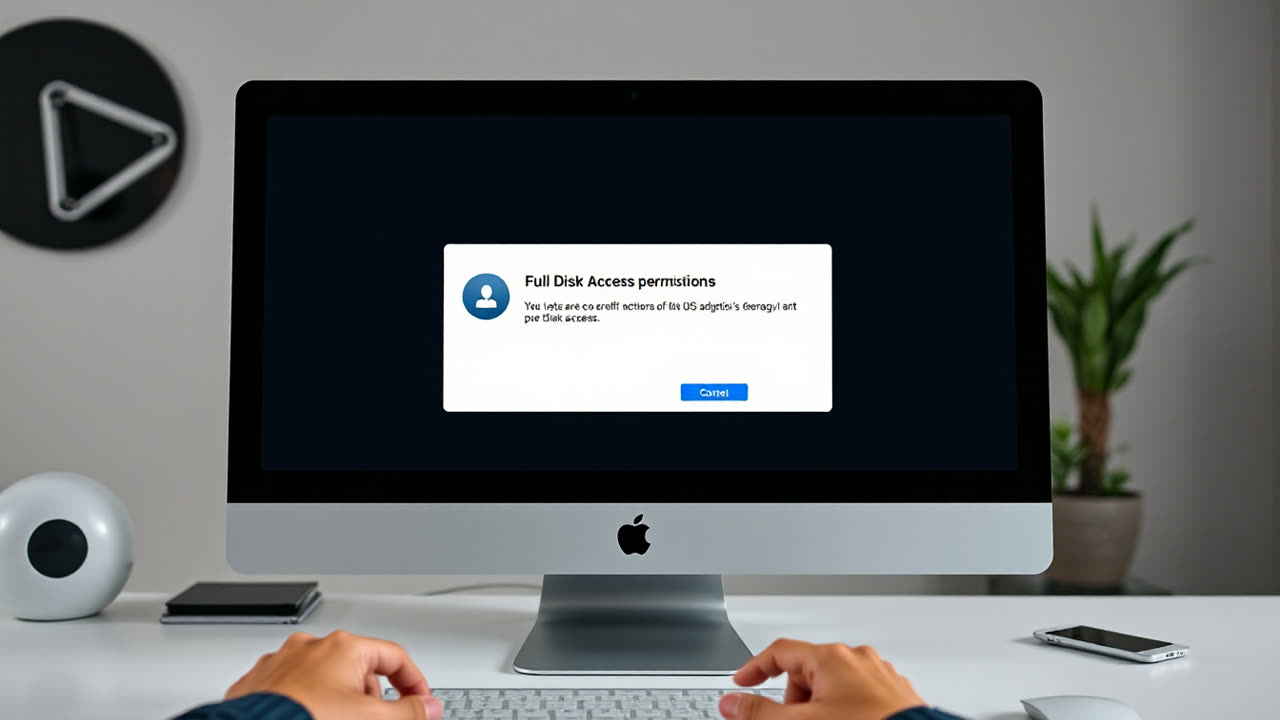
Apple is significantly tightening macOS ‘Full Disk Access’ (FDA) controls, a pivotal move announced on October 2, 2026, driven by escalating security risks posed by increasingly capable and autonomous AI agents. This decision, outlined in a Developer News post titled “Updates to Full Disk Access in macOS,” signals a critical re-evaluation of how applications, particularly those leveraging artificial intelligence, interact with a user's most sensitive data. The existing FDA permission, originally designed to facilitate essential functions like backup applications, grants unfettered access to virtually all user data, including personal files, Mail, Messages, Safari browsing history, and even Time Machine backups. Apple acknowledges that some developers have utilized this broad permission in ways that expose user information without their full understanding, a vulnerability now amplified by the emergent threat landscape of AI agents.
This policy shift is more than a routine security update; it represents a fundamental recalibration of the trust model between applications and the operating system in the age of pervasive AI. For users, the immediate impact will be a strengthened bulwark around their digital lives. Apple's new controls will mandate "very explicit user action" to grant FDA, moving away from a potentially ambiguous consent mechanism. This clarity is paramount, as incidents like Meta's Muse app reportedly accessing a writer's Mac Messages database and a ChatGPT app flaw potentially exposing sensitive data have recently underscored the dangers of unbridled access for AI-powered tools. While enhanced security is welcome, this increased friction could pose challenges for legitimate applications, such as comprehensive backup solutions, which genuinely require broad access to function. Users will need to exercise greater diligence, understanding precisely what extraordinary permissions they are granting and the associated risks.
For the tech industry, particularly developers building AI agents, Apple's directive forces a critical introspection into application design and data access strategies. The existing macOS permission structure offers granular controls for specific data types like camera, microphone, contacts, and photos, each requiring distinct user consent. FDA, in contrast, has always been an outlier, an "extraordinary level of access" that largely bypassed these more nuanced API controls. This move will likely compel developers to adopt more precise, context-aware permission requests, potentially spurring Apple to introduce more granular APIs tailored for AI functionalities that don't necessitate full disk access. The tension between AI agents' utility, often enhanced by broad contextual understanding, and user privacy is now undeniable, pushing AI development towards more secure, privacy-preserving architectures.
Apple's proactive stance also positions it squarely as a leader in defining the security parameters for AI on client devices, a crucial differentiator given its long-standing commitment to user privacy. This contrasts with the broader, often fragmented, landscape of AI agent security, which has seen rapid maturation between 2025 and 2026. The industry has been grappling with diverse approaches, from model-level safety and prompt injection classifiers to runtime inspection and sandboxing, acknowledging that no single method provides complete protection. Other major players are also responding to the evolving threat; Microsoft, for example, is actively hardening Windows against AI-driven threats through secure workspaces and identity isolation via its Windows Resiliency Initiative. NVIDIA has introduced its Open Agent Safety Platform, which uses OpenShell runtime governance and Sentry in-silicon threat detection to enforce agent boundaries at multiple layers. Academic research, too, increasingly draws parallels between securing AI agents and traditional operating system security, emphasizing challenges in resource isolation and privilege separation.
Looking ahead, Apple's tightening of FDA signals a broader industry trend towards more restrictive and transparent permission models for AI agents. We can anticipate the introduction of more finely-grained controls specific to AI functionalities, moving beyond the current binary "all or nothing" FDA. This will necessitate significant adaptation from developers, requiring them to redesign how their AI agents access and process user data to be more explicit and less intrusive. Concurrently, Apple will bear the responsibility of clearly educating users on the implications of these new controls, balancing security with usability. This shift could also reinforce Apple's preference for on-device AI processing, which aligns with its privacy ethos by minimizing data egress to cloud servers, though this often means larger on-device AI models consuming significant storage. Ultimately, the security arms race will continue; as attackers increasingly leverage AI to accelerate exploit development, OS vendors like Apple will need to maintain a continuous cycle of security innovation and faster patching, a strategy Apple has already begun to adopt. The future of AI integration on personal computing devices will hinge on the industry's ability to balance powerful capabilities with robust, user-centric security and privacy.