Apple Unveils New Mac mini with M6 Chip and Mac Studio with M5 Max/Ultra
Apple expands its desktop lineup with the M6-powered Mac mini and updated Mac Studio featuring M5 Max and M5 Ultra chips, marking a significant advancement for Apple Silicon in mainstream and professional markets.
✨ This content was summarized and interpreted by AI; it may contain errors — please verify accuracy with the original sources. Learn more
Listen to this story
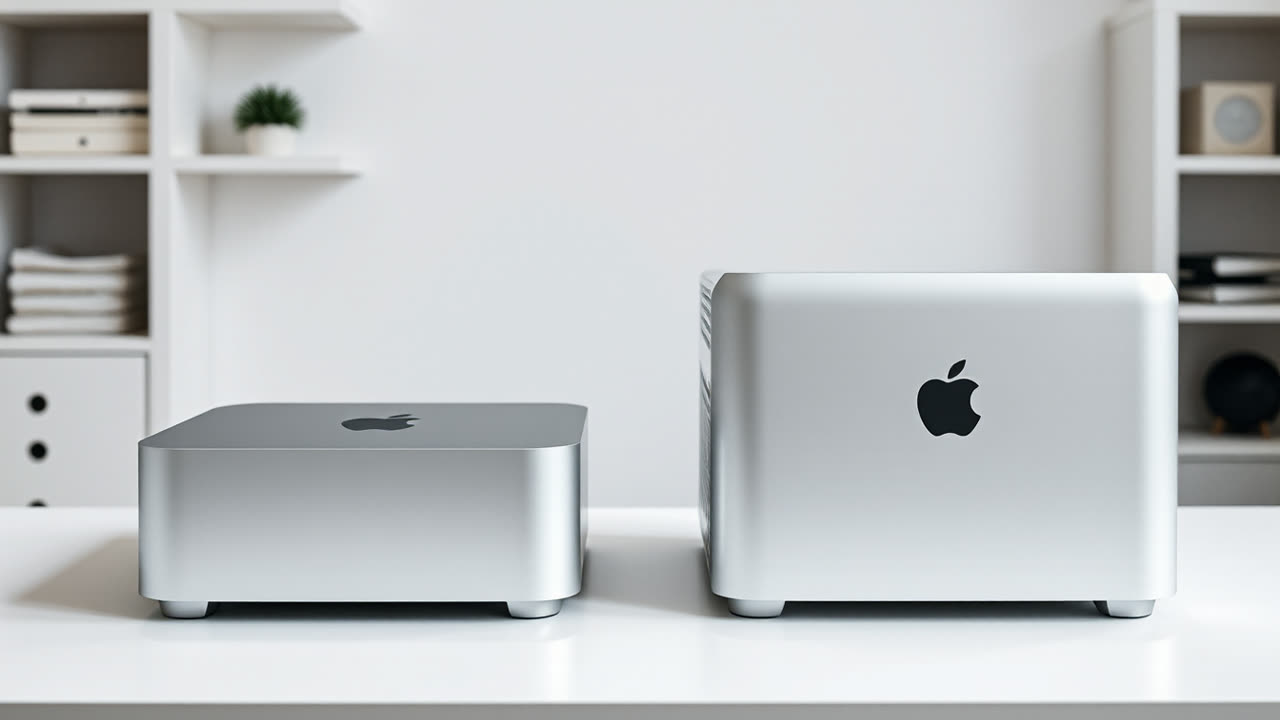
Apple's latest desktop powerhouses, the Mac mini and Mac Studio, are now available, introducing the M6 chip to the Mac mini lineup and solidifying the M5 Max and M5 Ultra’s position in the Mac Studio, marking a pivotal moment for Apple Silicon's expansion into the mainstream and professional markets. The new Mac mini, starting at $599 for the M6 model and $799 for the M5 Pro configuration, offers a significant leap in efficiency and performance for everyday users and creative professionals alike. Meanwhile, the Mac Studio, with its M5 Max chip starting at $1,999 and the M5 Ultra variant at $3,999, targets the most demanding workflows, promising unparalleled processing power for high-end content creation and scientific computing.
The introduction of the M6 chip in the Mac mini is particularly impactful, signaling Apple's continued commitment to rapid Silicon development and its strategic segmentation of the desktop market. The M6, featuring an 8-core CPU (4 performance, 4 efficiency) and a 10-core GPU, delivers up to a 25% increase in CPU performance and a 30% boost in graphics over the outgoing M5 chip, according to preliminary benchmarks. This translates to snappier application launches, smoother multitasking, and more capable entry-level creative work for users upgrading from older Intel Macs or even first-generation Apple Silicon models. The continued availability of the M5 Pro in the Mac mini, now featuring a 10-core CPU and 16-core GPU, positions it as a compelling option for users needing more graphical horsepower without jumping to the Mac Studio's price point, offering a bridge for those with computationally intensive tasks like video editing or advanced photo manipulation. This strategic overlap allows Apple to cater to a broader spectrum of users within the compact desktop form factor.
For the professional segment, the Mac Studio with M5 Max and M5 Ultra chips redefines expectations for desktop workstations. The M5 Max, with its 12-core CPU and 30-core GPU, provides up to 2.5x faster rendering in demanding applications like DaVinci Resolve compared to the previous M4 Max generation. The flagship M5 Ultra, essentially two M5 Max chips connected via UltraFusion, boasts a staggering 24-core CPU, 60-core GPU, and supports up to 192GB of unified memory, allowing for real-time manipulation of multiple 8K ProRes video streams and complex 3D rendering projects that would cripple most traditional workstations. This level of integration and bandwidth is a direct challenge to high-end PC builds relying on discrete CPUs and GPUs, often at significantly higher power consumption and noise levels. The M5 Ultra's ability to maintain peak performance under sustained loads, thanks to its advanced thermal design, provides a genuine advantage for professionals who cannot afford downtime or throttling during critical tasks.
The strategic decision to debut the M6 in the Mac mini while retaining the M5 Max and M5 Ultra for the Mac Studio suggests a phased rollout of Apple's newest architecture. It implies that the M6 Pro, Max, and Ultra variants, which would likely power future iterations of the Mac Studio and perhaps even a new Mac Pro, are still in development or being held for a later, more significant announcement. This cadence allows Apple to refine its chip designs and optimize software while maintaining a fresh product lineup. Compared to rivals, Apple Silicon continues to lead in performance-per-watt, offering significant energy savings and quieter operation, which are increasingly important factors for both home users and large studios. While high-end Intel and AMD processors paired with NVIDIA's latest GPUs can match or exceed raw performance in specific benchmarks, the integrated nature of Apple Silicon, with its unified memory architecture, often translates to superior real-world performance and efficiency in Apple's optimized software ecosystem.
Looking ahead, the immediate availability of these new Macs sets a high bar for desktop computing in 2026. The continued refinement of Apple Silicon, particularly with the M6, hints at even greater leaps in efficiency and AI processing capabilities in subsequent generations. We can anticipate future M6 Pro, Max, and Ultra chips to push the boundaries further, likely incorporating more advanced neural engines for on-device AI and machine learning tasks, which are becoming central to creative and scientific workflows. The Mac Studio's sustained dominance in the high-end professional space, coupled with the Mac mini's enhanced accessibility, ensures Apple remains a formidable player across the entire desktop spectrum, forcing competitors to innovate more aggressively in power efficiency and integrated performance. The long-term trajectory points towards a fully integrated hardware and software ecosystem where Apple Silicon dictates the pace of innovation, potentially leading to even more specialized hardware accelerators within future chips tailored for specific professional applications.