Apple Watch's New AI Features Normalize Digital Eavesdropping, Sparking Privacy Concerns
Apple's latest Apple Watch, unveiled in September 2026, integrates groundbreaking AI for real-time speech transcription and ambient conversation summaries, pushing wearable tech boundaries while normalizing perpetual digital eavesdropping and sparking profound questions about consent and privacy.
✨ This content was summarized and interpreted by AI; it may contain errors — please verify accuracy with the original sources. Learn more
Listen to this story
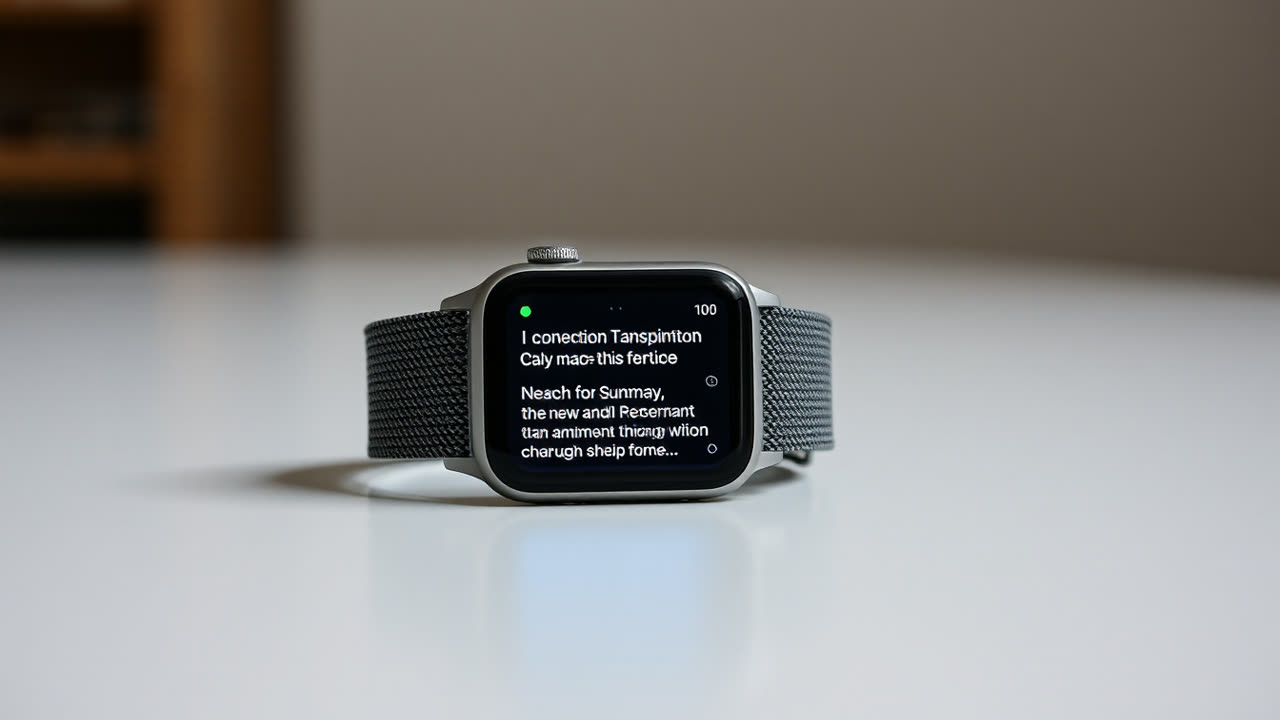
Apple’s latest iteration of the Apple Watch, unveiled in September 2026, integrates groundbreaking AI capabilities that allow for real-time speech transcription and ambient conversation summaries, pushing the boundaries of wearable technology but simultaneously normalizing a state of perpetual digital eavesdropping. This significant leap forward, while promising enhanced utility and accessibility, immediately ignites profound questions about consent, personal privacy, and the subtle yet pervasive shifts in human behavior when individuals operate under the implicit understanding that their environment could always be logged. Apple maintains that these new features process audio on-device and do not save raw audio files, a critical distinction intended to allay immediate fears of data breaches or misuse. However, the very existence of tools capable of dissecting and summarizing live speech fundamentally alters the social contract between individuals and their personal technology.
The core functionality revolves around two key advancements: a "Recent Speech Transcription" feature that can convert spoken words into text snippets for quick review, and a more ambitious "Ambient Conversation Summary" which uses on-device neural engines to distil the essence of nearby dialogues into concise, actionable summaries. These features are designed to assist users in recalling forgotten details from meetings, remembering casual recommendations, or simply keeping track of complex social interactions without needing to actively take notes. For individuals with memory impairments or certain cognitive disabilities, these tools could offer unprecedented support, providing a tangible benefit that underscores Apple's consistent push for accessibility. Yet, the convenience comes at a steep psychological cost, as the line between private thought and public record blurs.
The "always listening" paradigm, while not entirely new—voice assistants like Siri, Alexa, and Google Assistant have long operated with wake-word detection—is elevated to a new level of pervasiveness with the Apple Watch’s capabilities. Previous iterations of smartwatches primarily focused on health metrics, notifications, and basic voice commands, with any audio capture being explicit and brief. Now, the device is designed to be an active, if silent, participant in ongoing conversations. This shift from reactive listening to proactive, contextual processing represents a fundamental redefinition of the smartwatch’s role. Rivals like Samsung's Galaxy Watch and Google's Pixel Watch have offered limited on-device transcription and voice memo functions, but none have yet deployed ambient summarization with the same level of sophistication or integration, making Apple's offering a significant competitive differentiator. The industry will undoubtedly watch closely to gauge user adoption and regulatory responses, potentially spurring a new arms race in ambient AI.
The most critical impact lies in the subtle modification of human behavior. When individuals are aware that a device on their wrist could be transcribing or summarizing their words, even if the raw audio isn't saved, it introduces a chilling effect on spontaneous expression. Conversations may become more guarded, less authentic, and filtered through a lens of potential digital permanence. This isn't about malicious intent from Apple; it's about the inherent psychological impact of omnipresent recording capabilities. The concept of "informed consent" becomes incredibly complex in social settings, as it’s impractical to ask every person in proximity to an Apple Watch user for permission to have their speech processed. Furthermore, while Apple emphasizes on-device processing, the very act of generating a summary implies a degree of data interpretation that, however anonymized, still captures the *meaning* of private interactions. This could lead to a cultural shift where privacy is no longer an expectation in public or semi-public spaces but a privilege that must be actively, and often awkwardly, negotiated.
Looking ahead, the trajectory of ambient AI in wearables suggests an inevitable move towards even more sophisticated, context-aware processing. Future iterations could leverage these summaries to proactively offer information, schedule events, or even detect emotional states, blurring the lines between personal assistant and omnipresent observer. The regulatory landscape is ill-equipped to handle the nuances of "processed audio" versus "raw audio" when the output still captures sensitive information. Governments and privacy advocates will need to push for clearer guidelines on what constitutes "data collection" in an ambient AI environment, and how consent can be meaningfully obtained in fluid social interactions. The challenge for Apple and other tech giants will be to innovate responsibly, recognizing that while technology can augment human capabilities, it must not inadvertently erode the fundamental human right to unmonitored thought and expression. The current Apple Watch features are not just technological advancements; they are a societal experiment in redefining the boundaries of personal space in the digital age.