Apple Watch Series 12 Unveils 'Audio Intelligence' with Live Rewind and Siri Recap
Apple Watch Series 12 introduces 'Audio Intelligence,' featuring Live Rewind and Siri Recap for real-time conversation transcription and summarization, sparking both excitement for productivity and critical privacy debates.
✨ This content was summarized and interpreted by AI; it may contain errors — please verify accuracy with the original sources. Learn more
Listen to this story
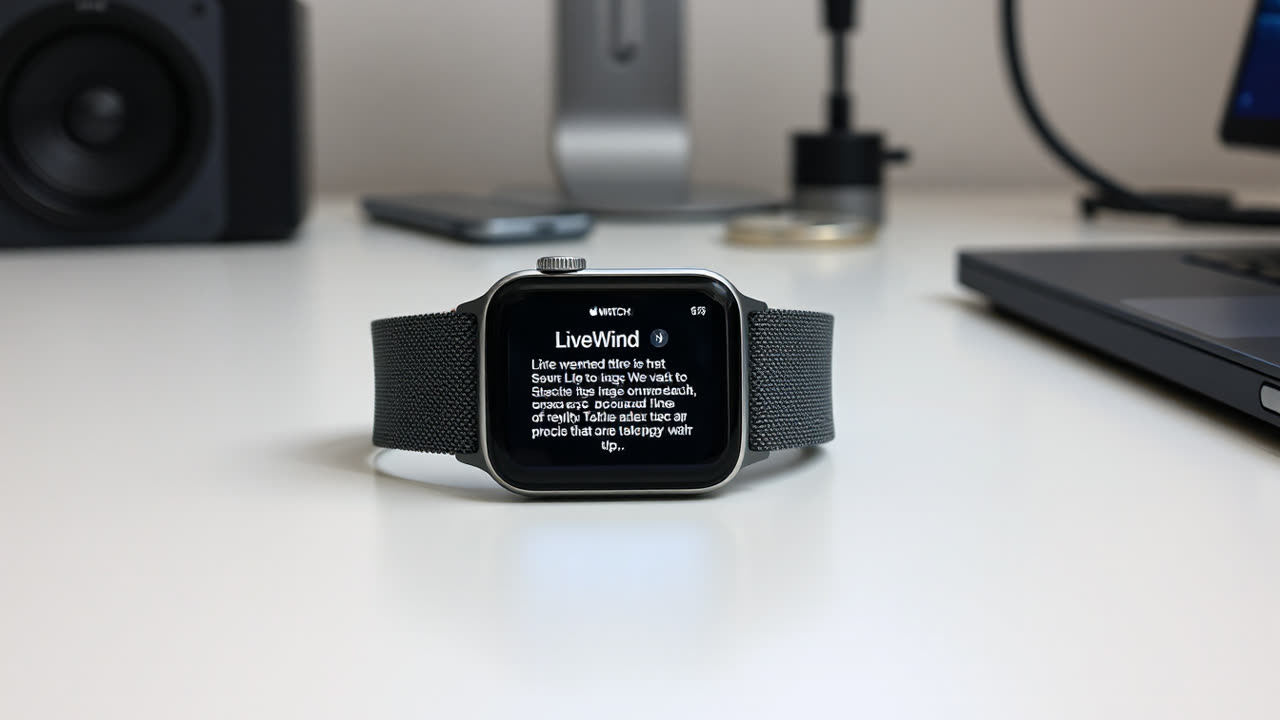
Apple Watch Series 12, unveiled on September 9, 2026, is set to revolutionize personal assistance with its groundbreaking "Audio Intelligence" features, most notably "Live Rewind" and "Siri Recap," which allow users to effectively "rewind" and summarize real-life conversations. This ambitious leap, powered by the new S11 chip, positions the Apple Watch as a sophisticated AI-powered note-taker, moving far beyond its traditional role as a health and fitness tracker. The implications for daily productivity, accessibility, and, critically, personal privacy are profound, sparking a necessary debate about the line between convenience and pervasive surveillance.
At its core, Audio Intelligence comprises four key features: Live Rewind, Siri Recap, Sound Recognition, and Shazam. Live Rewind enables users to instantaneously transcribe the preceding 15 seconds of a conversation with a double-press of the Digital Crown, a feature Apple demonstrated with a restaurant worker listing daily specials. This on-demand recall, delivered as text snippets, aims to prevent missed details in fast-paced exchanges or moments of inattention. Siri Recap, on the other hand, takes a more expansive approach, generating high-level summaries and key points from detected conversations, which are then reviewable in the Siri app. Sound Recognition, another addition, brings accessibility benefits by alerting users who are deaf or hard of hearing to critical ambient sounds like sirens, alarms, or a baby crying, even without an iPhone present. These features, slated for beta release later this year in English, are exclusive to the Apple Watch Series 12 and Apple Watch Ultra 4, requiring an Apple Intelligence-enabled iPhone 16 or later.
The immediate impact on user experience is undeniable. For professionals, Siri Recap could transform meeting efficiency, providing instant summaries and action items without the need for dedicated note-takers. Students could capture crucial lecture points, and individuals prone to distractions might find Live Rewind an invaluable memory aid for everything from recipe instructions to spontaneous recommendations. This shift transforms the Watch from a passive data collector into an active, intelligent companion designed to enhance presence and engagement in daily interactions. Beyond convenience, Sound Recognition significantly boosts the Watch's accessibility credentials, offering vital auditory alerts to a community often underserved by mainstream tech.
However, the introduction of "always-listening" capabilities, even with robust privacy safeguards, inherently raises concerns. The prompt's sardonic reference to a "spyware feature" encapsulates the public's apprehension, reminiscent of the backlash faced by early smart glasses that struggled with privacy perceptions. Indeed, the very notion of a device constantly processing ambient audio can evoke unease, prompting questions about data collection, third-party sharing, and consent from bystanders.
Apple has clearly anticipated this scrutiny, implementing an array of "Privacy by Design" measures to differentiate its offering and build user trust. Crucially, Apple states that Audio Intelligence features *do not create or store audio recordings*. Instead, raw audio is processed within a "Secure Exclave" on the S11 chip – a dedicated, hardware-isolated compartment that is inaccessible to the operating system, other apps, the user, and even Apple itself. After processing, this raw audio is immediately deleted.
Furthermore, Apple has engineered specific transparency and control mechanisms. All Audio Intelligence features are strictly opt-in, requiring explicit user activation. For Live Rewind, activating the feature triggers an audible chime and a full-display animation with a microphone indicator, ensuring that people nearby are aware it's being used, even if the Watch is on silent. Siri Recap, while ambiently listening, is configurable, allowing users to schedule its operation or toggle it on/off from Control Center. Its summaries are high-level, designed to exclude sensitive information, and critically, do not identify speakers or attribute content, mitigating concerns about individual surveillance. The resulting text snippets and summaries are end-to-end encrypted and synced via iCloud in the Siri app, with Apple asserting it cannot access this data due to its Private Cloud Compute architecture. Summaries are also auto-deleted after seven days.
In the competitive landscape, Apple is entering a space already occupied by dedicated AI wearables like TicNote, Bee, and Omi, which offer similar real-time transcription, summarization, and action-item generation from conversations. These devices, some of which store data indefinitely or rely heavily on cloud processing, have often been lauded for their utility but also met with privacy questions. Apple's robust, hardware-backed, and transparent privacy framework presents a significant differentiator. While rivals like Fieldy and TicNote also emphasize end-to-end encryption and no audio storage, Apple's established brand trust and integrated ecosystem, combined with the Secure Exclave on the S11 chip, may offer a stronger reassurance to privacy-conscious consumers.
Looking ahead, Apple's cautious rollout—beta only, English-first, and initially excluding the EU, where stringent regulations like GDPR and the AI Act apply—suggests a strategic approach to gather feedback and navigate potential regulatory challenges. The success of Audio Intelligence will hinge not just on its technical prowess, but on Apple's ability to consistently communicate and uphold its privacy promises in the face of ongoing public skepticism about always-on listening devices. Should it succeed, this feature set could establish a new paradigm for personal AI, pushing the Apple Watch further into the realm of indispensable cognitive augmentation, while simultaneously setting a high bar for privacy-centric design in future wearable technologies, including the nascent smart glasses market. However, failure to maintain public trust could lead to a significant backlash, demonstrating that even with the most advanced privacy architecture, perception remains paramount in the era of ubiquitous AI.