AstroForge Puts AI in Command of Deep-Space Exploration with Autonomy-1 Spacecraft
AstroForge is deploying a small, transformer-based AI model to autonomously command its Autonomy-1 spacecraft, marking a pivotal shift towards self-sufficient deep-space missions.
✨ This content was summarized and interpreted by AI; it may contain errors — please verify accuracy with the original sources. Learn more
Listen to this story
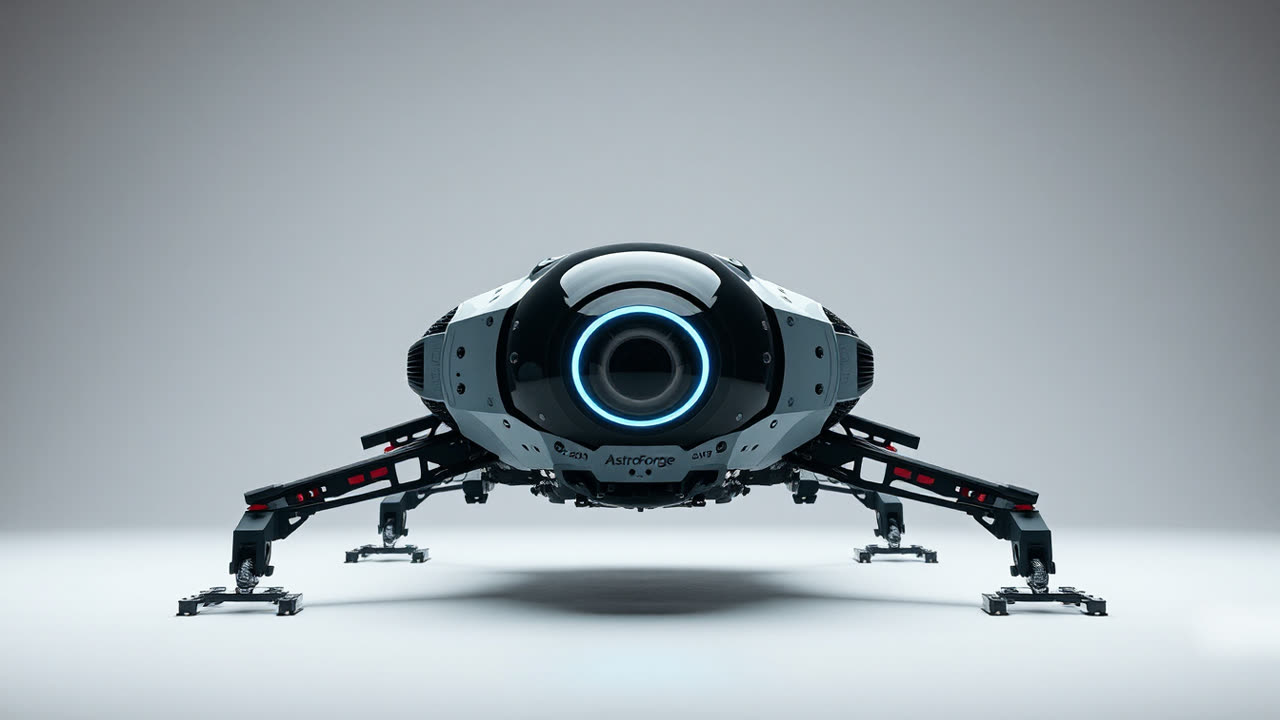
AstroForge is set to revolutionize deep-space exploration by entrusting a small, transformer-based AI model with autonomous command of its upcoming Autonomy-1 spacecraft, a move that significantly escalates the role of artificial intelligence beyond Earth's orbit. This pioneering mission, detailed by TechCrunch on September 22, 2026, marks a critical inflection point, transitioning from pre-programmed directives and ground control to on-board, real-time decision-making by an AI, fundamentally altering the operational paradigm for future space probes.
The AI, designed to manage complex navigation, resource allocation, and scientific data acquisition, represents a leap towards truly self-sufficient space missions, particularly for distant ventures where communication delays render human-in-the-loop control impractical.
This deployment of a transformer model, a type of neural network celebrated for its efficacy in processing sequential data and learning complex relationships, signifies a profound shift from traditional rule-based autonomy often seen in earlier spacecraft. While previous missions have incorporated elements of AI for specific tasks like fault detection or image recognition, Autonomy-1's AI is poised to orchestrate mission-critical functions across the entire operational spectrum, from propulsion adjustments to managing scientific instruments. The model’s compact size is particularly noteworthy, indicating significant advancements in AI efficiency and optimization for resource-constrained environments like spacecraft, where every gram and watt counts. This miniaturization allows for sophisticated intelligence without the prohibitive mass or power consumption typically associated with advanced computing.
The implications for the burgeoning space industry are vast and multifaceted. For users, particularly those involved in scientific research or commercial ventures like asteroid mining, Autonomy-1 promises unprecedented operational flexibility and accelerated data collection. Missions can adapt dynamically to unforeseen conditions, optimize observation windows, and potentially discover new phenomena without constant human intervention, significantly reducing mission timelines and costs associated with extensive ground support. The ability for a spacecraft to independently identify and analyze anomalies, re-plan trajectories, or prioritize scientific targets on the fly could unlock discoveries that might otherwise be missed or delayed by the latency inherent in Earth-based command.
From an industry perspective, AstroForge's bold step elevates the competitive stakes in autonomous space technology. While companies like Maxar and Airbus have integrated AI for satellite imaging analysis and orbital maneuver optimization, Autonomy-1 ventures into comprehensive, mission-level AI command in deep space. This creates a new benchmark for operational autonomy, pushing rivals to accelerate their own AI integration strategies to remain competitive in segments like lunar exploration, Mars missions, and, crucially, asteroid resource prospecting—AstroForge's ultimate long-term goal. The success of Autonomy-1 could validate the business case for highly autonomous, AI-driven asteroid mining operations, significantly de-risking future investments in this nascent sector.
Historically, space autonomy has progressed incrementally, from simple timers and thermostats on early satellites to sophisticated fault detection and recovery systems on probes like the Mars rovers. These systems, while advanced, largely operated within pre-defined parameters, relying on extensive ground testing and human override. The transformer-based AI on Autonomy-1 represents a departure from this, moving towards genuine cognitive autonomy where the AI can infer, learn, and adapt in real-time. This is analogous to the shift from expert systems to deep learning in terrestrial AI applications, offering a level of adaptability and robustness previously unattainable in space hardware. Compared to the relatively constrained AI applications on prior generations, Autonomy-1's AI aims for a holistic command architecture, making decisions that integrate multiple subsystems and mission objectives simultaneously.
Looking ahead, the success of Autonomy-1 could catalyze a paradigm shift across the entire space ecosystem. We can anticipate a proliferation of smaller, more intelligent probes capable of executing complex missions with minimal human oversight. This could democratize access to deep space, enabling smaller nations or private entities to undertake ambitious projects without the massive infrastructure traditionally required. Furthermore, the data generated by Autonomy-1's AI, detailing its decision-making processes and performance metrics, will be invaluable for training even more sophisticated models, potentially leading to fully self-replicating or self-repairing autonomous systems. The next frontier will likely involve multi-agent AI systems, where a swarm of autonomous spacecraft collaborate to achieve a common objective, perhaps exploring an asteroid belt or constructing orbital infrastructure. AstroForge's Autonomy-1 is not merely launching a spacecraft; it is launching a new era of intelligent, independent space exploration.