Axis Robotics Unveils AXIS: Browser-Based Platform Democratizes Robot Data Collection
Axis Robotics has unveiled AXIS, a browser-based data engine featuring 207 robot manipulation tasks and 50,129 trajectories, addressing the critical bottleneck of slow dataset growth in robotics by democratizing data collection.
✨ This content was summarized and interpreted by AI; it may contain errors — please verify accuracy with the original sources. Learn more
Listen to this story
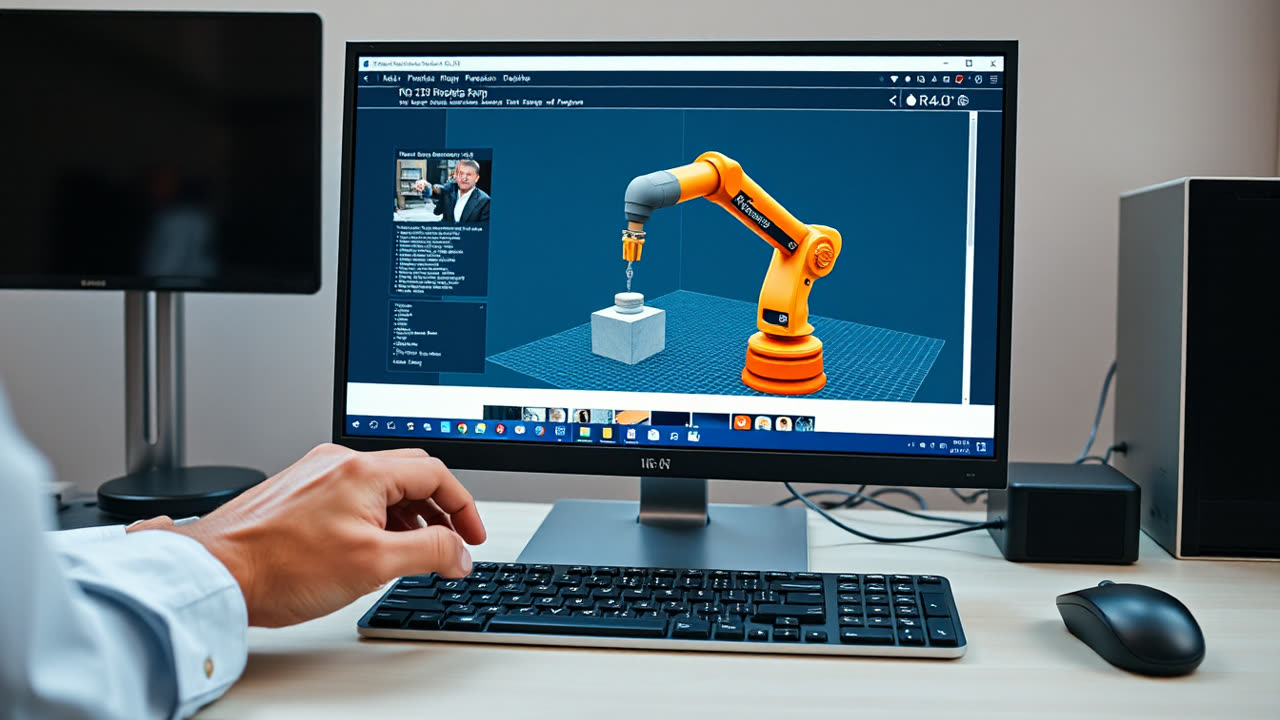
Axis Robotics has unveiled AXIS, a browser-based data engine featuring 207 robot manipulation tasks and 50,129 trajectories, addressing the critical bottleneck of slow dataset growth in robotics by democratizing data collection. The platform, described as a "growable community-driven data engine," moves the traditionally hardware-intensive process of demonstration collection into a web browser, offloading computationally expensive operations to backend GPUs. This innovative approach directly challenges the conventional paradigm where robot dataset creation is largely confined to specialized laboratories, requiring significant investments in physical robots and local GPU setups.
The core problem AXIS tackles is the stark disparity between the rapid advancement of AI models and the sluggish pace of data generation in robotics. Unlike fields such as natural language processing or computer vision, which benefit from vast, pre-existing internet-scale datasets, robotics lacks an equivalent archive of real-world physical interactions. Every robot trajectory, every grasp, and every manipulation task must be physically performed, captured, and meticulously structured, a process that is both expensive and time-consuming. This "robot data gap" has become the primary bottleneck for deploying intelligent robotic systems, with data quality and diversity often outweighing model architecture in importance.
AXIS fundamentally shifts this dynamic by enabling browser-based teleoperation, allowing a distributed community of users to contribute demonstrations using standard input devices like keyboards, mice, or gamepads. By leveraging technologies such as MuJoCo-WASM, the simulation runs directly within the user's web browser, eliminating the need for local software installations or specialized hardware. This separation of interactive collection (requiring low latency) from heavy backend processing (demanding high throughput) is key to its scalability. The collected demonstrations, which include diverse human behavioral patterns in approach, grasp timing, and execution style, are then transformed into training-ready data through automated success checking, quality filtering, trajectory smoothing, and visual and physics-based augmentation using IsaacSim. This continuous, generative process, rather than static dataset releases, allows for measurable dataset growth and refinement.
The impact of AXIS on the robotics industry is multifaceted and profound. Firstly, it significantly lowers the barrier to entry for robot learning research and development. Smaller labs, individual researchers, and educational institutions can now contribute to and access large-scale datasets without the prohibitive cost of owning and maintaining extensive robot fleets. This democratization fosters a more inclusive and accelerated research environment, potentially leading to a broader array of innovations and applications. Secondly, AXIS promises to dramatically accelerate the training of more robust and general-purpose robot policies. The current AXIS dataset, with its 207 diverse tasks, including pick-and-place, stacking, pouring, articulated-object handling, and tool use, and over 50,000 human-teleoperated trajectories on a simulated Franka Research 3 arm, has already demonstrated its effectiveness. Pretraining on the AXIS V1 dataset has shown to improve the overall success rate of the π⁰.⁵ vision-language-action (VLA) policy by 5.8% and outperform models pretrained on RoboCasa365 by 37.3%, particularly under challenging conditions like layout, sensor-noise, and camera perturbations. This highlights the critical role of diverse, high-quality data in enabling robots to generalize to unseen tasks and environments.
Compared to prior generations, which often relied on laborious manual teleoperation with physical robots or limited synthetic data generation, AXIS represents a significant leap. While synthetic data generation is a growing market, valued at $2.48 billion in 2026 and projected to reach $7.71 billion by 2030, it struggles with sim-to-real transfer, especially in contact-rich tasks. AXIS, by integrating human demonstrations, even "noisy, suboptimal" ones from a diverse crowd, and combining them with automated augmentation, offers a pathway to bridge this gap. Existing cloud robotics platforms like Google Cloud Robotics Core or AWS IoT Greengrass primarily focus on deployment, management, and inference, while AXIS specifically targets the often-overlooked and resource-intensive data collection phase. Initiatives like LeRobot also aim to lower barriers with hardware-agnostic interfaces and standardized datasets, but AXIS's emphasis on browser-based, community-driven *collection* for simulation stands out.
Looking ahead, AXIS could usher in an era of "Physical AI" where robot learning models are continuously improved by an ever-growing, diverse stream of human-generated data. The ability to rapidly generate and iterate on datasets based on model performance and failure cases, as Axis Robotics intends with its "compounding data engine," suggests a future of faster development cycles for general-purpose robots. This could lead to foundational models for robotics that are as robust and adaptable as large language models are for text. However, challenges remain, including ensuring data quality and consistency from a diverse community, addressing potential biases in human demonstrations, and developing robust methods for real-world validation of policies trained on simulated data. The ethical implications of large-scale human-generated data for autonomous systems will also require careful consideration. Nevertheless, AXIS presents a compelling blueprint for how the robotics community can collectively overcome its most persistent data bottleneck, paving the way for a new generation of intelligent, adaptable robots.