Calendly Pivots to AI, Launches Meeting Note-Taker and Intelligent Assistant
The ubiquitous scheduling platform Calendly has significantly broadened its ambition, launching an AI-powered meeting note-taker and an intelligent scheduling assistant named Callie, marking a pivotal expansion into comprehensive meeting lifecycle management.
✨ This content was summarized and interpreted by AI; it may contain errors — please verify accuracy with the original sources. Learn more
Listen to this story
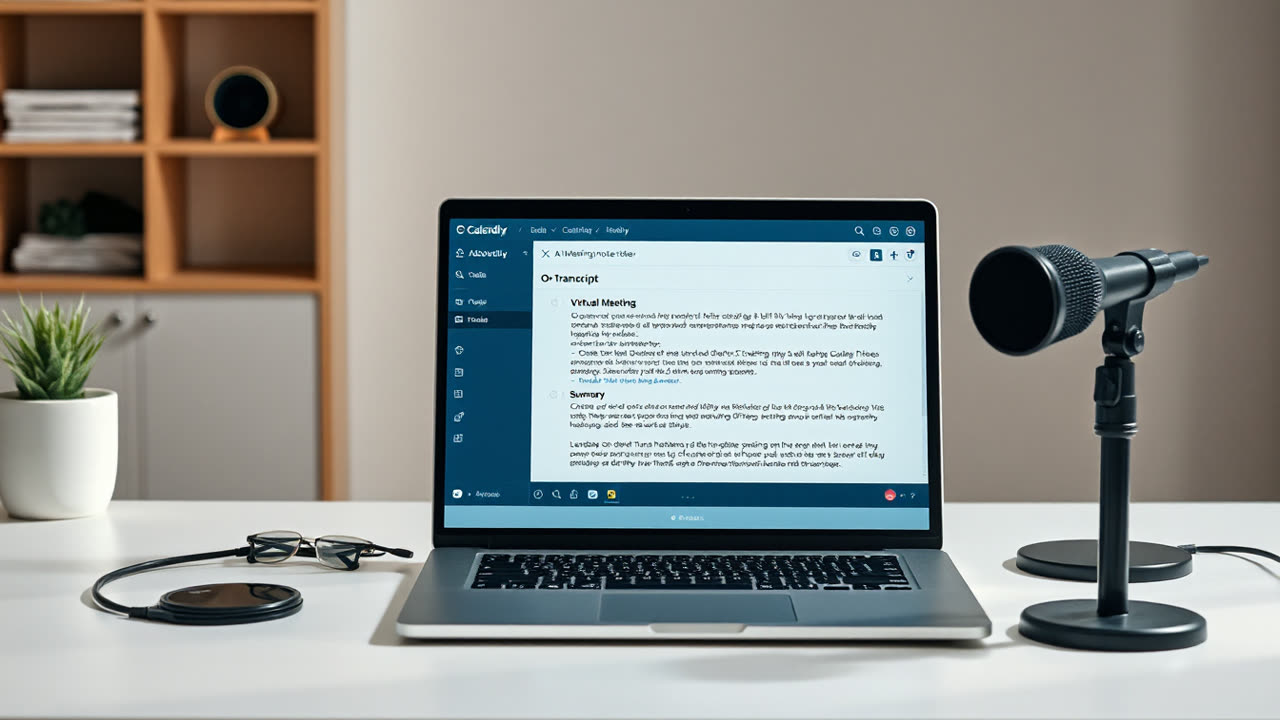
Calendly, the ubiquitous scheduling platform, has significantly broadened its ambition beyond merely booking meetings, launching an AI-powered meeting note-taker and an intelligent scheduling assistant named Callie, marking a pivotal expansion into the broader meeting lifecycle management space. This strategic pivot, announced on August 19, 2026, positions Calendly to compete directly with a burgeoning ecosystem of AI productivity tools, fundamentally altering its market identity from a scheduling utility to a comprehensive meeting intelligence provider.
The new Notetaker feature provides AI-generated summaries, full transcripts, and actionable items from recorded Zoom, Google Meet, and Microsoft Teams calls, irrespective of whether the meeting was initially scheduled through Calendly. It offers an interactive chat interface, allowing users to query the meeting transcript for specific details and even generate drafted follow-up emails. Privacy is addressed through pre-meeting notifications and in-meeting consent prompts, with attendees having the option to stop recording at any time. Complementing this, Callie, the AI scheduling assistant, streamlines the pre- and post-meeting workflow by handling email-based scheduling coordination and providing in-app chat capabilities for meeting preparation, recall of past conversation details, and tracking action items. Both Notetaker and Callie are currently in limited availability or private beta for select users, indicating a phased rollout.
This expansion is more than an incremental feature update; it represents Calendly's calculated move to capture greater value across the entire meeting experience, from initial booking to post-meeting follow-through. For users, the impact is substantial: a reduction in administrative overhead, improved recall of meeting decisions, and a more integrated workflow that minimizes context switching. Professionals spend an average of 31 hours per month in meetings, often forgetting 50% of the content within 24 hours, a problem AI note-takers aim to solve by providing reliable, searchable records and extracting tasks. By offering both scheduling and post-meeting intelligence within a single ecosystem, Calendly aims to deliver a seamless user experience that its scheduling-only rivals cannot match. The promise of Callie, in particular, to manage scheduling directly from email threads without requiring a dedicated booking link simplifies a common pain point in one-on-one interactions. Furthermore, Calendly explicitly states it does not sell user data or use it to train AI models, a critical assurance in an era of heightened privacy concerns.
In the competitive landscape, Calendly’s new offerings throw down a gauntlet to established players. The AI meeting note-taker market in 2026 is robust, with solutions like Laxis, Otter.ai, Fireflies.ai, and Fathom offering sophisticated transcription, summarization, and CRM integrations. Laxis, for instance, is highly rated for its bot-free recording, personalized summaries, and native HubSpot and Salesforce CRM integration starting at $15.99 per month. Fireflies.ai and Otter.ai are also prominent, often used for team collaboration and CRM integrations. Native AI features within platforms like Zoom, Google Meet, and Microsoft Teams also serve a similar purpose. Calendly's Notetaker differentiates itself by its inherent connection to the scheduling flow, eliminating the friction of integrating a separate tool. This "one less thing to connect" argument could be compelling for many organizations already entrenched in Calendly's ecosystem.
For scheduling assistants, Callie enters a field with existing AI tools like x.ai and other calendar optimization platforms. While Calendly has long dominated the "send a link, pick a time" paradigm, tools like Reclaim.ai and Cal.com have emerged as powerful alternatives, offering more advanced scheduling logic and control over booking flows, with paid plans starting around $10-15 per month. HubSpot Meetings also provides CRM-native scheduling for its users. Callie's strength lies in its natural language processing for email-based scheduling and its integration with Calendly's existing calendar data and event types.
Calendly's existing pricing structure includes a free plan with limited features (one event type, one connected calendar), a Standard plan at $10 per seat per month (billed annually), and a Teams plan at $16 per seat per month (billed annually). While the pricing for the new AI features is not explicitly detailed as a separate tier, their availability to "select users" suggests potential integration into higher-tier plans or as premium add-ons. This strategy could drive upgrades from Calendly's vast free and Standard user base, seeking to consolidate their productivity tools.
Looking ahead, Calendly's move signals a broader industry trend towards comprehensive, AI-powered productivity platforms that manage the entire meeting lifecycle. The future of workplace tools isn't just about isolated functions but about integrated workflows that automate routine cognitive tasks, freeing up human capacity for more strategic work. Calendly's deep integration with existing calendar systems and its expansive user base give it a strong advantage in this evolving landscape. The challenge will be to ensure that the AI offerings consistently deliver high accuracy and genuine utility, particularly in complex meeting scenarios, and to effectively communicate their value proposition against a backdrop of specialized, often highly performant, competitors. If successful, Calendly could solidify its position not just as a scheduling leader, but as a central hub for meeting intelligence, driving renewals and expansion by proving its value across the entire customer journey.