Caterpillar Deploys AI Robot Dogs for Industrial Safety
Caterpillar is revolutionizing safety inspections on its construction sites and factories by deploying AI-powered robot dogs, developed with FieldAI and NVIDIA, to enhance efficiency and drastically reduce workplace hazards.
✨ This content was summarized and interpreted by AI; it may contain errors — please verify accuracy with the original sources. Learn more
Listen to this story
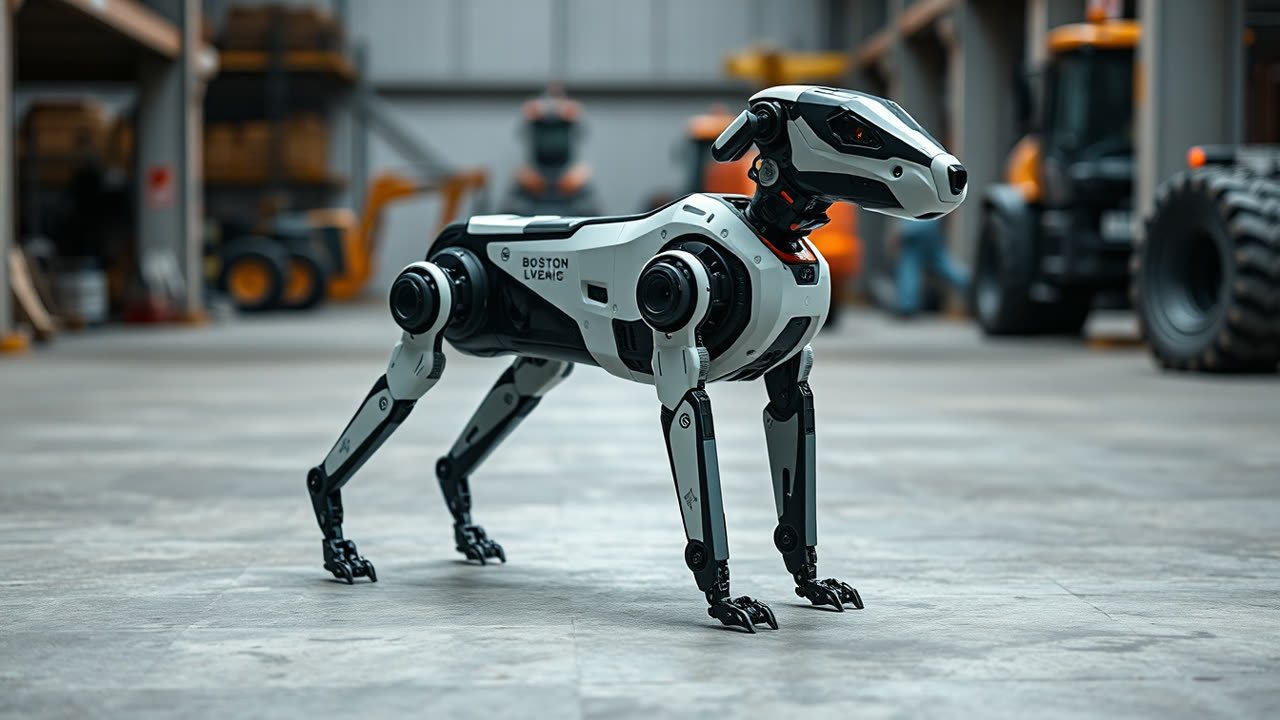
Caterpillar is deploying AI-powered robot dogs, developed in collaboration with FieldAI and leveraging NVIDIA technologies and digital twin capabilities, to revolutionize safety inspections on its construction sites and in factories, marking a significant shift in industrial safety paradigms. This initiative, moving beyond traditional human-centric oversight, aims to enhance efficiency and drastically reduce workplace hazards by automating meticulous and often dangerous inspection tasks. The core technology involves highly mobile robotic platforms equipped with advanced sensors, operating within a digital twin environment of the physical site, to detect anomalies, monitor environmental conditions, and identify potential safety violations with unprecedented precision and consistency.
The immediate impact on the construction and manufacturing sectors is profound, challenging conventional notions of labor roles and safety management. While the headline "THEY TOOK R JOBS" captures an initial human reaction, the reality is more nuanced; these robots are initially augmenting, rather than entirely replacing, human safety personnel, allowing them to focus on higher-level problem-solving and strategic risk mitigation rather than repetitive data collection. For users – the construction workers and factory employees – this promises a safer working environment by proactively identifying risks like structural inconsistencies, equipment malfunctions, or hazardous material leaks before they escalate into incidents. Companies stand to benefit from reduced accident rates, lower insurance premiums, and minimized project delays due to safety breaches, leading to substantial operational cost savings and improved project timelines. The integration of digital twins means that real-time data from the robot dogs is immediately mapped onto a virtual replica of the site, enabling predictive maintenance and rapid incident response through a centralized, data-driven command center.
Historically, safety inspections in heavy industries have relied heavily on human vigilance, often involving manual checklists, visual assessments, and periodic audits. This method, while indispensable, is prone to human error, fatigue, and limitations in accessing hazardous or confined spaces. Earlier generations of industrial robotics focused primarily on repetitive manufacturing tasks, lacking the autonomy, perception, and navigation capabilities required for dynamic and unstructured environments like construction sites. Caterpillar's move, powered by FieldAI's specialized AI models and NVIDIA's advanced GPU computing and AI platforms, represents a leap forward, endowing robots with the intelligence to autonomously navigate complex terrains, interpret sensor data, and make context-aware decisions. Competitors like Boston Dynamics' Spot robot have demonstrated similar mobility and payload capabilities, but Caterpillar's specific application, integrating deeply with digital twins and FieldAI's domain-specific AI, points to a highly tailored and vertically integrated solution for heavy industry. This integrated approach, combining physical robotics with virtual models, offers a level of insight and control previously unattainable, moving beyond simple data logging to proactive, intelligent risk assessment.
Looking ahead, the deployment of AI-powered robot safety inspectors by an industry giant like Caterpillar signals a broader, irreversible trend towards autonomous systems in industrial operations. We can anticipate rapid advancements in robot dexterity, sensor fusion, and AI interpretation capabilities, enabling robots to perform even more complex diagnostic tasks, such as structural integrity assessments using ultrasonic or thermal imaging, or even minor on-site repairs. The regulatory landscape will likely evolve to accommodate these new technologies, establishing standards for robot performance, data security, and human-robot collaboration. Furthermore, the partnership with NVIDIA suggests an ongoing push towards edge computing and advanced AI processing directly on the robots, reducing reliance on constant cloud connectivity and enabling faster, more robust decision-making in remote or challenging environments. The initial focus on safety inspections will likely expand to encompass quality control, progress monitoring, and inventory management, transforming the entire operational workflow of construction sites and factories into highly automated, data-rich ecosystems. This shift will necessitate new skill sets for the human workforce, focusing on robot supervision, data analysis, and AI model refinement, rather than traditional manual inspection tasks, ultimately reshaping the future of work in heavy industry.