Cerebras Unveils Wafer-Scale AI Roadmap: Tripled Performance & Stacked DRAM
Cerebras Systems has announced its next-generation AI hardware roadmap at Hot Chips 2026, revealing the Nexus system architecture that triples rack-scale performance and plans for stacked DRAM integration in its CS-6 wafer.
✨ This content was summarized and interpreted by AI; it may contain errors — please verify accuracy with the original sources. Learn more
Listen to this story
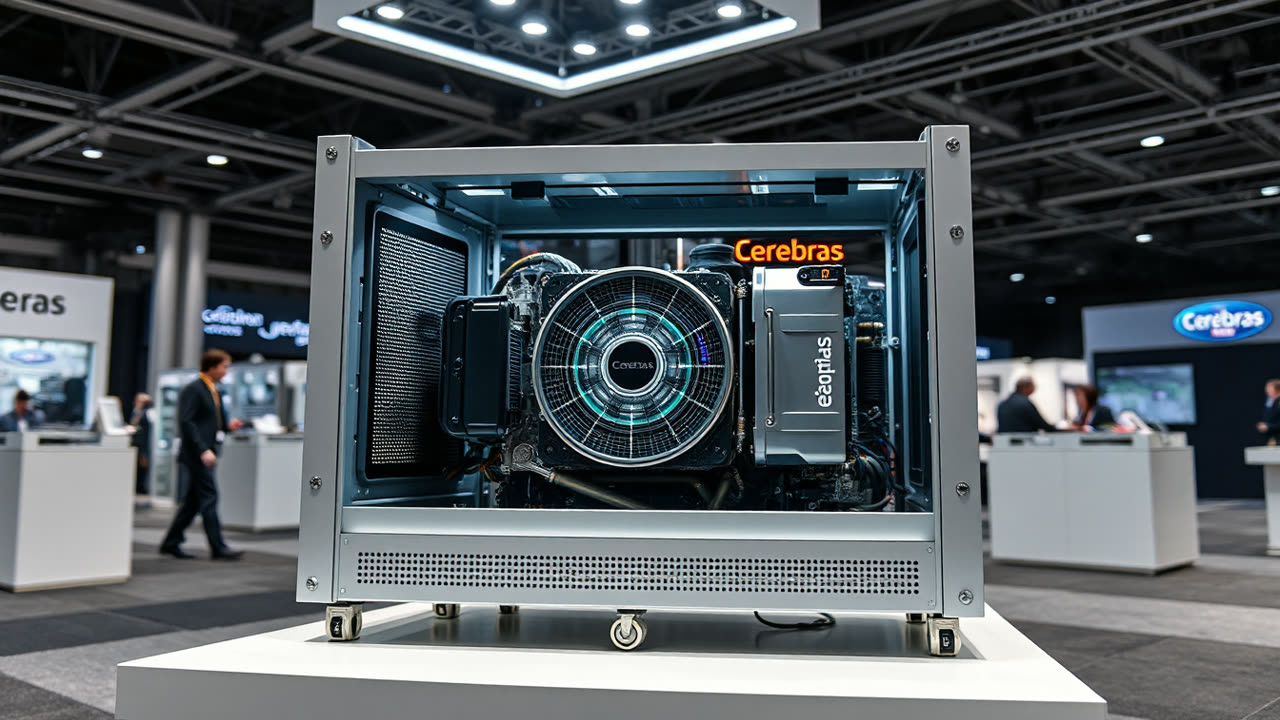
Cerebras Systems has unveiled its ambitious next-generation AI hardware roadmap at Hot Chips 2026, signaling a significant leap forward in wafer-scale computing with its Nexus system architecture tripling rack-scale performance and the forthcoming CS-6 wafer set to integrate stacked DRAM. This announcement underscores Cerebras' continued commitment to addressing the escalating demands of large-scale AI models by pushing the boundaries of silicon integration and memory architecture.
The core of Cerebras' strategy revolves around its Wafer-Scale Engine (WSE), a monolithic processor built on an entire silicon wafer, which distinguishes it fundamentally from traditional GPU clusters that rely on interconnecting many smaller chips. The current WSE-3, powering the CS-3 system, already boasts an impressive 4 trillion transistors, 900,000 AI cores, and 44GB of on-chip SRAM, delivering an aggregate memory bandwidth exceeding 21 petabytes per second (PB/s)—a staggering 7,000 times greater than Nvidia's H100. This architecture inherently minimizes the latency and bandwidth bottlenecks that plague multi-chip GPU systems, particularly for memory-bandwidth-limited workloads.
The newly revealed Nexus system architecture for the CS-4 rack-scale accelerator is poised to triple rack-scale performance, a critical advancement as AI models continue to grow exponentially in size and complexity. Cerebras' existing SwarmX interconnect technology, designed for data-parallel scaling, already enables near-linear performance gains across multiple CS-2 systems, allowing clusters of up to 163 million AI-optimized cores. The Nexus architecture likely builds upon this foundation, optimizing communication and data flow further to achieve the announced performance increase at the rack level. This improvement is vital for accelerating the training and inference of colossal models, where efficient data movement is as crucial as raw computational power.
Perhaps the most forward-looking aspect of the announcement is the plan to incorporate stacked DRAM directly into the CS-6 wafer. This move directly addresses the "memory wall"—the bottleneck where processor speed outpaces memory access speed—which is a persistent challenge in high-performance computing and AI. Stacked DRAM, like High Bandwidth Memory (HBM), vertically integrates multiple memory dies, drastically reducing the physical distance data must travel, thereby boosting bandwidth and lowering power consumption. HBM4, for instance, is targeted for a 2026 rollout, promising approximately 2 TB/s per stack and up to 48 GB per package with 12 to 16 layers. Integrating such technology directly onto the wafer-scale processor, as Cerebras plans for CS-6, could unlock unprecedented levels of on-chip memory bandwidth and capacity, further solidifying the wafer-scale advantage by bringing memory even closer to the compute elements. This could enable the CS-6 to handle even larger models entirely within its on-chip memory environment, circumventing the need for external memory transfers that introduce latency and consume significant power.
This architectural evolution comes at a time when the AI industry is grappling with immense power consumption and the physical footprint of massive GPU clusters. Training large language models can involve tens of thousands of GPUs, leading to significant power swings and substantial energy demands. While companies like AMD are projecting a 20x increase in rack-scale energy efficiency for AI training and inference by 2030, having achieved an estimated 4x increase by mid-2026, Cerebras' wafer-scale approach inherently offers advantages in consolidating compute and memory, potentially leading to greater overall system efficiency. A single Cerebras CS-2, for instance, can deliver performance equivalent to many tens to hundreds of GPUs, yet a direct power comparison showed a single CS-2 consumed power equivalent to roughly three Nvidia H100 DGX servers, or 24 GPUs. This suggests architectural efficiency gains, even if the absolute power draw remains high for a single unit.
Compared to rivals, Cerebras' wafer-scale strategy stands in stark contrast to the chiplet-based designs increasingly adopted by Nvidia and AMD. Nvidia's roadmap, with products like the Vera Rubin platform confirmed for full production around GTC 2026, focuses on scaling performance through advanced packaging and interconnects like NVLink-C2C, which offers high-bandwidth, low-latency coherent data transfers between chiplets. AMD's Instinct MI300X, released in late 2023, already features 192 GB of HBM3 memory with 5.3 TB/s bandwidth across its chiplet design, excelling in memory-bound LLM inference. The emerging open standards like UALink 1.0 and CXL 4.0, set to enable multi-vendor interoperability and multi-rack memory pooling by late 2026 and 2027 respectively, also aim to tackle interconnect bottlenecks in distributed GPU systems. Cerebras, however, largely bypasses these inter-chip communication challenges by putting nearly all compute and memory on a single, giant piece of silicon.
The outlook for Cerebras' wafer-scale technology is promising, particularly for the largest and most demanding AI workloads that are constrained by memory bandwidth and inter-processor communication. The integration of stacked DRAM in the CS-6 represents a natural evolution, pushing the "memory close to compute" paradigm to its logical extreme. This could enable training of models with trillions of parameters more efficiently, accelerating scientific discovery and the development of next-generation AI. However, challenges in manufacturing yield for such large monolithic chips and advanced thermal management remain critical considerations. As the industry moves towards "AI factories" and increasingly specialized hardware, Cerebras' unique approach offers a compelling alternative to traditional scaling, potentially redefining the economics and performance ceiling for extreme-scale AI. The emphasis on rack-scale performance and integrated memory suggests a future where entire AI supercomputers could be condensed into fewer, more powerful, and more efficient units.