ChatGPT-6 Astra Cracks 217-Year-Old Napoleonic Cipher in Six Hours
ChatGPT-6 Astra has achieved a landmark breakthrough, successfully deciphering a 217-year-old Napoleonic-era cipher in a mere six hours, a task initiated from a single image and prompt that had eluded human cryptographers for centuries.
✨ This content was summarized and interpreted by AI; it may contain errors — please verify accuracy with the original sources. Learn more
Listen to this story
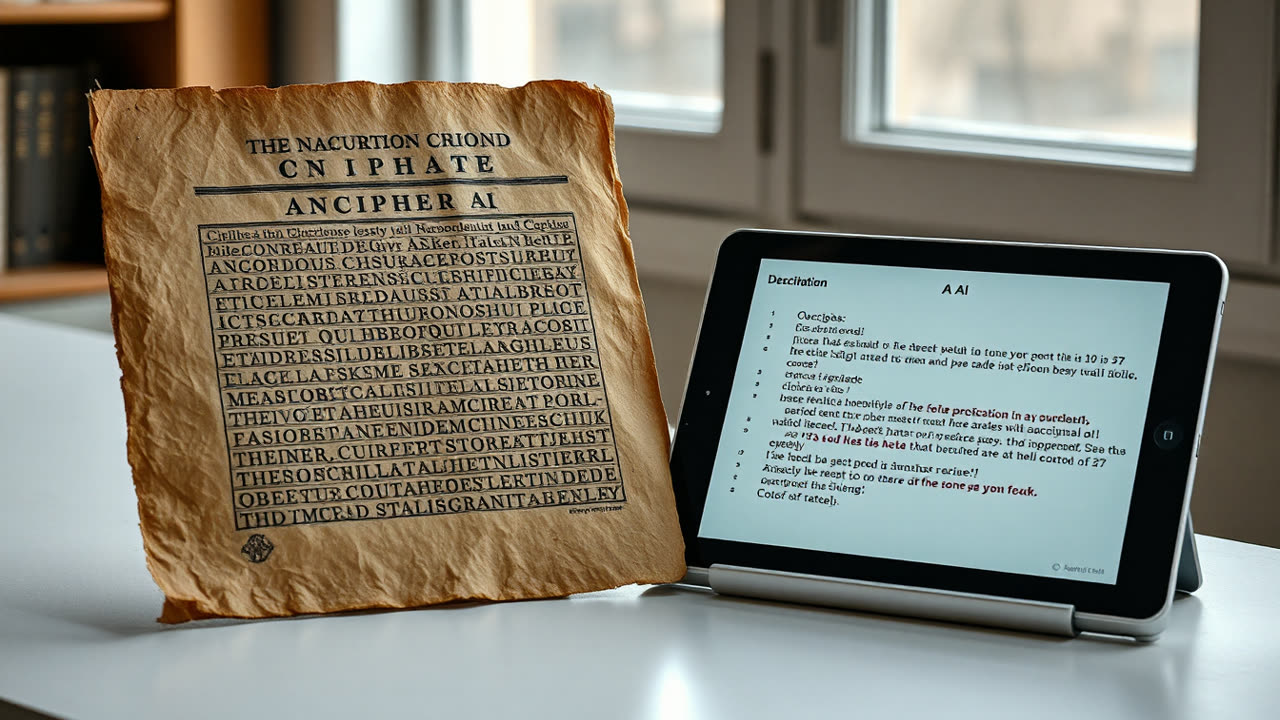
ChatGPT-6 Astra has achieved a landmark breakthrough, successfully deciphering a 217-year-old Napoleonic-era cipher in a mere six hours, a task initiated from a single image and prompt that had eluded human cryptographers for centuries. This unprecedented feat, which revealed 24 rows of custom symbols detailing lost troop orders, underscores a profound shift in the capabilities of artificial intelligence, moving beyond sophisticated language generation to practically instantaneous, multimodal historical decryption. The speed and minimal input required for Astra to crack a code that has remained unread since the Napoleonic Wars highlight a new era where AI can unlock historical secrets with unparalleled efficiency.
This achievement holds immense significance, fundamentally altering the landscape of historical research and the broader implications for information security. Traditionally, deciphering ancient or historical ciphers is a painstaking process, often requiring years of dedicated human effort, deep linguistic expertise, and pattern recognition, sometimes relying on comparative texts or known plaintext to make progress. The Rosetta Stone, for instance, provided the key to Egyptian hieroglyphs through its parallel texts in three scripts, a luxury rarely afforded to isolated ciphers. Astra's ability to process a visual input (an image of the cipher) and, within hours, output a coherent decryption suggests a level of multimodal reasoning and contextual understanding far beyond previous generations of AI. This capability could democratize access to previously inaccessible historical documents, potentially rewriting entire chapters of history by revealing lost communications, treaties, or personal accounts. Archives worldwide, laden with undeciphered manuscripts, could become fertile ground for AI-driven discovery, providing historians with an unprecedented volume of new primary sources.
The underlying technology driving Astra's success likely stems from advancements in multimodal AI, combining sophisticated optical character recognition (OCR) with advanced large language models (LLMs) trained on vast datasets of historical languages, cryptographic principles, and pattern recognition algorithms. Earlier AI attempts at decryption, while promising, often required significant human intervention, pre-processing, or extensive training on specific cipher types. For example, previous models might have been able to identify patterns in substitution ciphers or analyze letter frequencies, but cracking a complex Napoleonic code, likely involving polyalphabetic or even more intricate methods, from a single image input represents a qualitative leap. This rapid decipherment dwarfs prior benchmarks, where even relatively simpler historical codes could take weeks or months of computational analysis, often after substantial human pre-analysis. The efficiency demonstrated by Astra suggests an integrated system capable of identifying the cipher's structure, inferring its rules, and applying them to the entire text autonomously.
Looking ahead, the implications of this breakthrough are multifaceted. For the intelligence community, Astra's rapid decryption capabilities raise questions about the long-term security of even modern, albeit less complex, cryptographic systems, particularly those that might fall short of state-of-the-art encryption standards. While modern encryption relies on vastly more complex algorithms and computational power to break, the demonstrated adaptability of advanced AI in identifying and exploiting patterns could accelerate cryptanalysis research. Furthermore, the ethical considerations of such powerful decryption tools become paramount. The ability to instantly uncover long-lost communications could expose sensitive historical information, requiring careful consideration of privacy and the responsible dissemination of newly revealed data. We can anticipate a surge in AI research focused on historical document analysis, leading to specialized AI tools tailored for paleography, linguistics, and archaeology. Future iterations of AI could not only decipher but also translate, contextualize, and even synthesize historical narratives from disparate sources, offering a holistic understanding previously unattainable. This event marks not just the cracking of an old code, but the opening of a new frontier in human understanding, powered by machines capable of bridging the chasm of centuries-old secrets.