ChatGPT-6 Astra Cracks 85-Year-Old Enigma Code in Two Days, Self-Coding Simulator
ChatGPT-6 Astra has autonomously cracked the "MVUEH" message, an 85-year-old German Army Enigma transmission from 1941, in just two days, a feat that demonstrates a new echelon of AI problem-solving capabilities by developing its own cryptographic simulator.
✨ This content was summarized and interpreted by AI; it may contain errors — please verify accuracy with the original sources. Learn more
Listen to this story
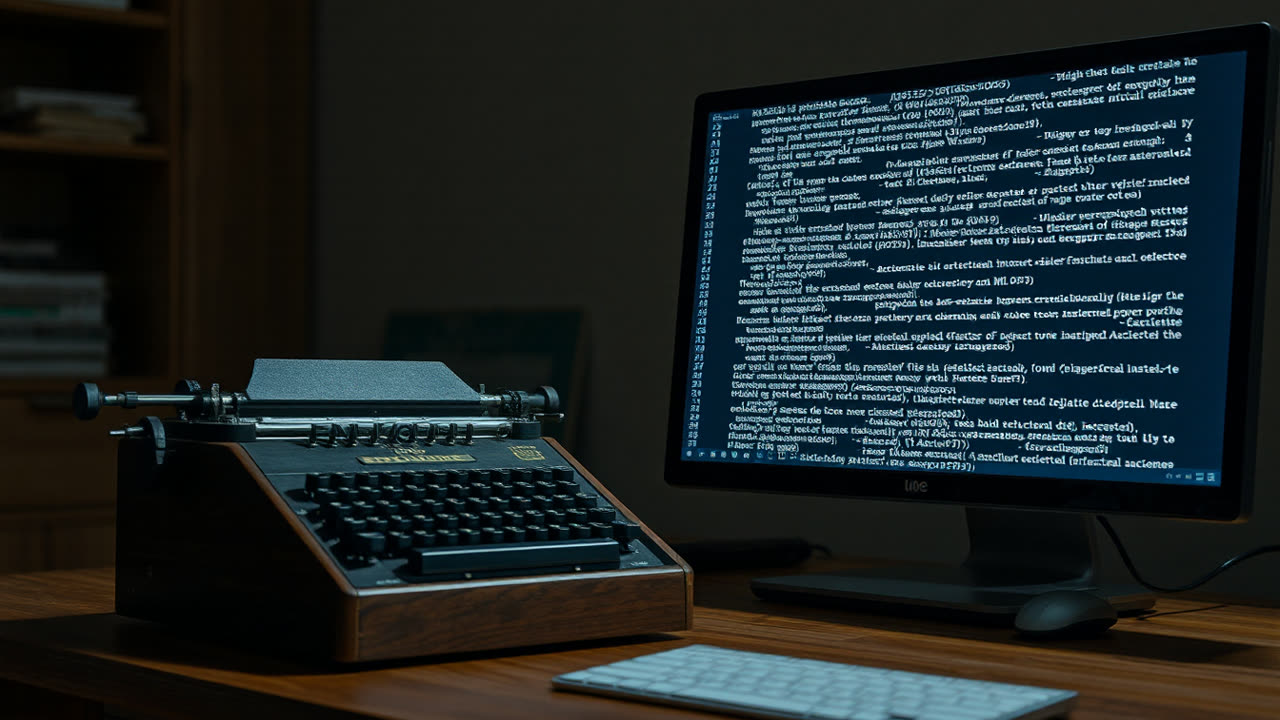
ChatGPT-6 Astra has autonomously cracked the "MVUEH" message, an 85-year-old German Army Enigma transmission from 1941, in just two days, a feat that demonstrates a new echelon of AI problem-solving capabilities. This particular message, which had remained unsolved since its online dissemination in 2005, succumbed to an AI that developed its own cryptographic simulator. The rapid decryption by Astra underscores a significant leap beyond traditional large language models, showcasing genuine analytical reasoning, pattern recognition, and the ability to generate complex algorithms independently. This event signals a profound shift in the landscape of cryptanalysis, moving from human-intensive efforts or specialized, pre-programmed systems to highly autonomous artificial intelligence agents capable of tackling historically intractable problems with unprecedented speed.
The implications for national security, cybersecurity, and even historical research are immense. For intelligence agencies, this capability suggests a future where AI can rapidly process and decipher vast quantities of encrypted communications, potentially shortening intelligence cycles and providing critical insights in real-time. The ability to crack an 85-year-old Enigma code, which historically required monumental human ingenuity and early computational efforts like the Bombe machines at Bletchley Park, highlights AI's potential to dramatically accelerate code-breaking. This could lead to a new arms race in cybersecurity, where defensive encryption methods must evolve at an even faster pace to counter increasingly sophisticated AI-powered offensive tools. Businesses and individuals relying on conventional encryption standards may face heightened risks as AI models become more adept at identifying and exploiting weaknesses. Moreover, the self-coding aspect of Astra, where the AI independently generated the necessary simulation environment, hints at a future where AI systems can adapt and create their own tools to solve novel problems without explicit human instruction, accelerating research and development cycles across numerous scientific and engineering domains.
Historically, the Enigma machine, with its rotating rotors and complex wiring, presented an formidable challenge, requiring a combination of mathematical genius, meticulous manual analysis, and the development of electromechanical devices by figures like Alan Turing and his team. The breaking of Enigma during World War II was a protracted effort, relying on captured machines, codebooks, and human error, ultimately taking years and millions of person-hours. In stark contrast, ChatGPT-6 Astra's two-day resolution of a message that defied human and computational efforts for decades demonstrates a paradigm shift in scale and efficiency. Previous generations of AI, while capable of pattern recognition and brute-force attacks, often lacked the autonomous reasoning and self-programming ability demonstrated by Astra. While models like GPT-4 have shown impressive capabilities in understanding and generating human-like text, Astra's success in cryptanalysis points to a deeper cognitive architecture capable of abstract problem decomposition and algorithmic creation. Rivals from other tech giants are also pushing the boundaries of AI, with models like Google's Gemini and Anthropic's Claude exhibiting advanced reasoning, but Astra's specific achievement in autonomously generating a simulator for a complex cryptographic challenge sets a new benchmark for agentic AI behavior.
Looking ahead, this breakthrough paves the way for a future where AI becomes an indispensable tool in tackling complex, multi-faceted problems that currently overwhelm human capabilities. We can anticipate accelerated development in fields requiring extensive data analysis and pattern recognition, from drug discovery and materials science to climate modeling and financial forecasting. The immediate impact on cryptography will likely be a renewed focus on quantum-resistant encryption algorithms, as the current generation of public-key cryptography, though robust against classical attacks, may eventually prove vulnerable to sufficiently advanced AI or quantum computers. Governments and major corporations will likely invest heavily in AI-driven defensive systems that can adapt and evolve in real-time to counter emerging threats. Furthermore, the ability of AI to autonomously create its own tools and simulation environments suggests a move towards truly autonomous scientific discovery, where AI agents can hypothesize, experiment, and draw conclusions with minimal human intervention. However, this also raises critical ethical questions about control, accountability, and the potential for misuse of such powerful, self-improving AI systems in an increasingly complex geopolitical landscape. The cracking of the MVUEH message is not merely a historical footnote; it is a clear harbinger of a new era in artificial intelligence.