ChatGPT Now Generates Custom iMessage & WhatsApp Stickers, Revolutionizing Digital Expression
OpenAI's new ChatGPT feature allows users to instantly create and export personalized sticker packs for major messaging apps, transforming self-expression and tapping into a booming market.
✨ This content was summarized and interpreted by AI; it may contain errors — please verify accuracy with the original sources. Learn more
Listen to this story
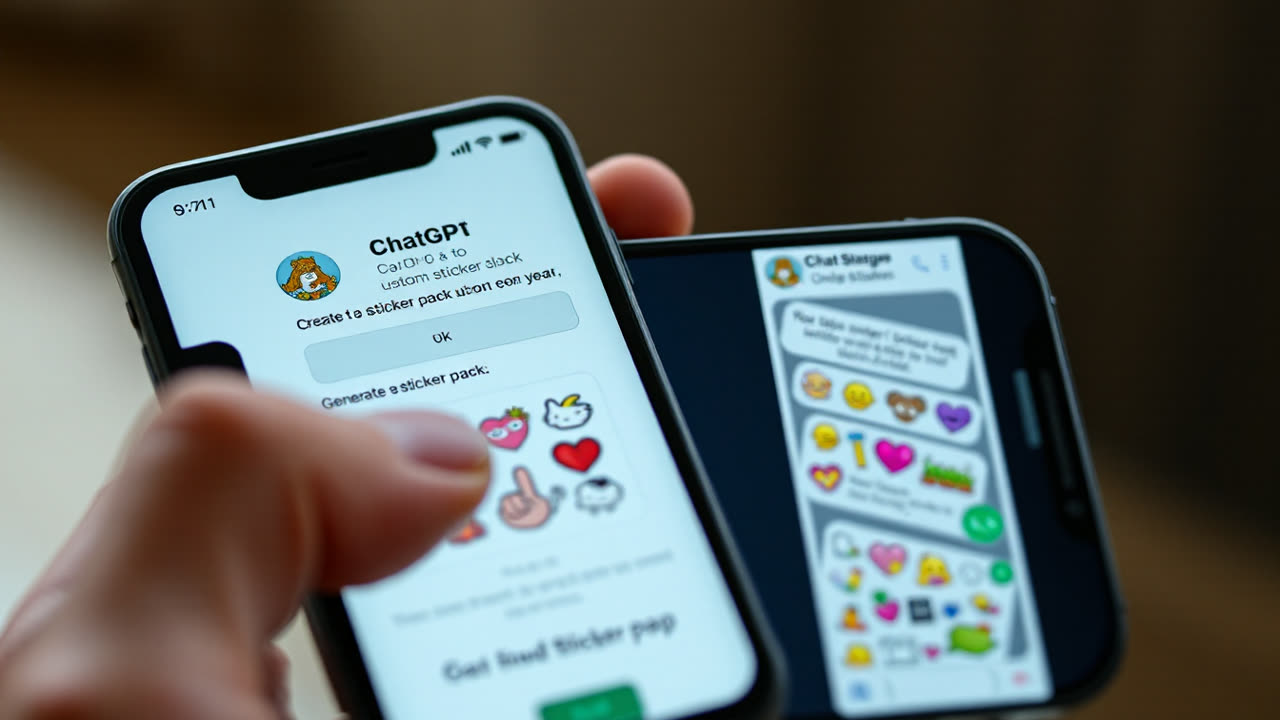
The ability for ChatGPT to directly generate and export personalized stickers for iMessage and WhatsApp, a feature officially rolled out by OpenAI in August 2026, marks a significant evolution in digital communication and AI's role in creative content generation. This new functionality, accessible through the ChatGPT mobile app's "Images" section, allows users to transform photos, ideas, or even inside jokes into custom sticker packs with transparent backgrounds, fundamentally changing how individuals express themselves in messaging.
Previously, creating custom stickers for platforms like WhatsApp and iMessage often involved a more fragmented and technically demanding process. While Apple's iOS 17 introduced the ability to turn photos into basic cut-out stickers, and third-party apps offered more advanced editing, these methods typically required manual background removal, design adjustments, or navigating separate applications for creation and export. WhatsApp stickers, for instance, have specific technical requirements, including 512x512 pixel dimensions and a file size limit of 100KB, necessitating careful optimization. ChatGPT's integrated workflow streamlines this, allowing users to select styles, provide reference images or emojis, and receive a set of nine ready-to-use stickers in moments, which can then be directly added to iMessage or WhatsApp. For WhatsApp, a minimum of three stickers must be exported as a pack, a Meta platform requirement, not a ChatGPT limitation.
This development matters immensely for users, shifting personalization from a niche activity for the tech-savvy to an accessible, instant creative outlet. The global personalized stickers market, valued at USD 4.84 billion in 2025, is projected to reach USD 8.45 billion by 2035, growing at a CAGR of 5.73%, driven by increasing demand for self-expression and personalized digital content. ChatGPT's direct integration taps directly into this demand, offering a frictionless path to unique visual communication. It moves beyond simple photo cutouts, employing generative AI to "transform, stylize, and invent," turning a mere snapshot into a deliberately designed sticker. This capability enhances user engagement and experience, as personalized content is inherently more relevant and impactful.
From an industry perspective, OpenAI's move signifies a deepening integration of generative AI into the fabric of everyday communication platforms. This follows a broader trend where AI is increasingly embedded in mobile apps, influencing everything from content recommendations to conversational experiences. The AI-Generated Animated Sticker market alone is expected to grow at a CAGR of 19.5% from 2026 to 2034, reaching an estimated USD 9.67 billion by 2034, underscoring the commercial potential of AI in expressive digital content. While other AI image generators like DALL-E 3 (which ChatGPT's image generation is built upon), Midjourney, Stable Diffusion, Adobe Firefly, and Picsart can also create sticker-style art, ChatGPT's unique advantage lies in its direct, conversational pack creation and seamless export to major messaging apps. This direct pipeline eliminates the need for users to manually save images, remove backgrounds, or use separate sticker-pack creator apps, a workflow that often proves cumbersome.
Looking ahead, this trend will likely accelerate the demand for more sophisticated, context-aware AI personalization in messaging. We can anticipate AI tools offering not just static stickers but also animated ones, potentially even generating stickers that react to the sentiment of a conversation in real-time. The integration of AI for creating diverse content formats, from memes to personalized emails, is already boosting creative productivity and enabling agile marketing for businesses. However, challenges remain. Copyright ownership of purely AI-generated art, without significant human creative input, is generally not recognized in the United States, meaning such stickers may fall into the public domain. This legal ambiguity could impact commercial applications or brand protection for AI-created sticker designs. Furthermore, the ethical considerations of AI-generated content, including potential misuse or the generation of inappropriate material, will necessitate robust moderation and responsible AI development. As AI becomes an invisible assistant in our digital lives, its capabilities will continue to expand, making personalized expression more vivid and accessible, while also pushing developers and policymakers to address the evolving landscape of digital creativity and ownership.
FACTS: How to use ChatGPT to make stickers for iMessage and WhatsApp — The default sticker options in iMessage and WhatsApp are cool but maybe a little limited. Now, with help from ChatGPT's AI tool, things have got a bit more fun. (kaynak: Engadget, https://www.engadget.com/2255727/how-to-use-chatgpt-make-stickers-imessage-whatsapp/)