China's Sugon Unveils 'World's First' 64-Thread Mobile AI Workstation
Sugon's new mobile workstation features a groundbreaking 64-thread processor and 16GB VRAM, promising cloud-level AI performance on-the-go and marking a significant step in China's tech self-sufficiency.
✨ This content was summarized and interpreted by AI; it may contain errors — please verify accuracy with the original sources. Learn more
Listen to this story
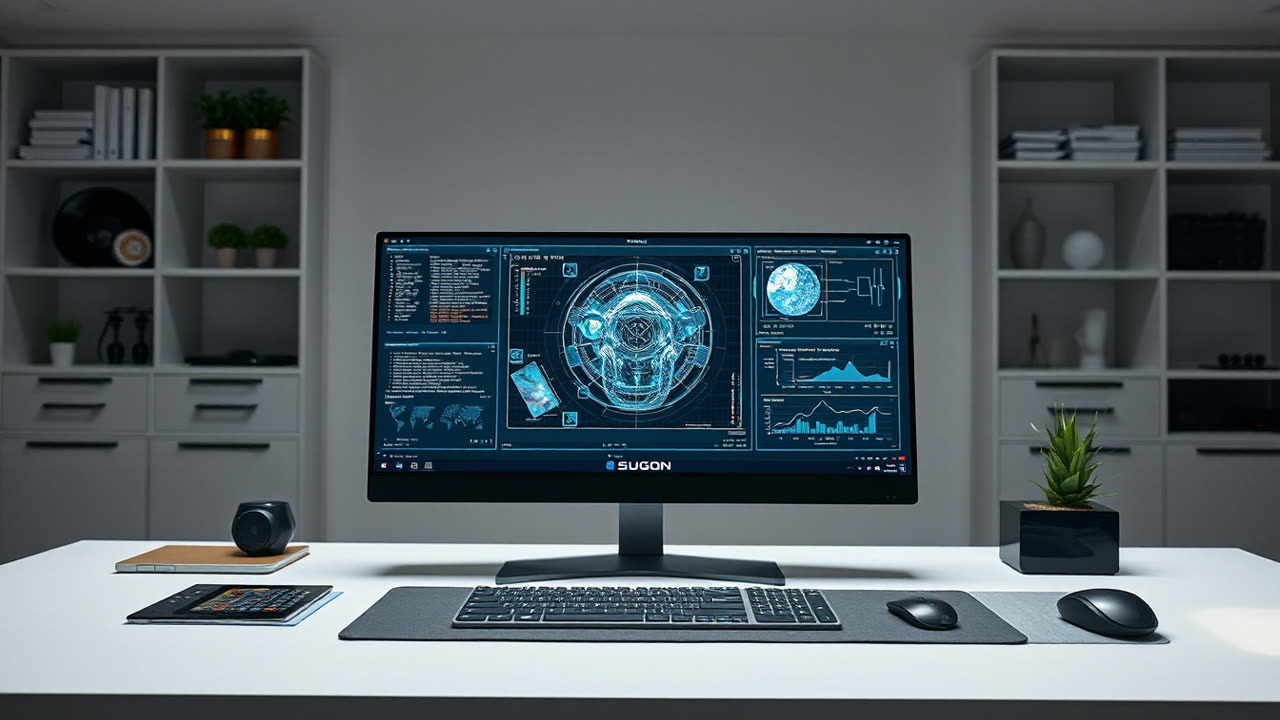
China's supercomputer manufacturer Sugon has unveiled a mobile workstation boasting a "world's first" 64-thread processor paired with a discrete GPU featuring 16GB of VRAM, specifically engineered for on-device AI workloads. This new device, teased in an ITHome report, promises cloud-level performance, claiming 3X to 5X faster AI inference than mainstream products, with a reported throughput of up to 50 tokens per second when running a 35-billion-parameter Mixture of Experts (MoE) model locally. The workstation itself is remarkably thin at 0.665 inches (16.9 mm), aligning with premium lightweight laptops, a significant departure from the bulky "pseudo-portable" workstations of the past.
This announcement marks a critical juncture for both the mobile workstation market and China's strategic push for technological self-sufficiency in high-performance computing (HPC) and artificial intelligence. The "homegrown" CPU is highly likely to be a Hygon C86 processor, given Sugon's long-standing partnership with Hygon, in which Sugon is the largest shareholder. While Sugon itself does not produce processors, its close relationship with Hygon, which originated from a joint venture with AMD, has been pivotal in its hardware development. Hygon's C86-5G series, featuring a "new self-developed microarchitecture" and four-way simultaneous multithreading (SMT4), could provide the 16-core, 64-thread configuration hinted at for this mobile workstation. This move signifies China's ongoing efforts to reduce reliance on foreign computing ecosystems, a strategy that has accelerated amidst geopolitical tensions and US sanctions on high-performance chips.
The impact on users and the industry could be transformative. For data scientists, AI developers, and researchers, a truly mobile workstation capable of handling complex AI models locally offers unprecedented flexibility and productivity. Currently, running large language models (LLMs) and other demanding AI tasks often necessitates cloud access or powerful, stationary desktop workstations. The ability to perform high-speed inference on a 35B MoE model at 50 tokens per second on a portable device could democratize access to advanced AI development, enabling real-time applications in diverse fields from medical diagnostics to autonomous systems without constant internet connectivity or cloud computing costs. This could accelerate innovation in edge AI, where processing data closer to the source is crucial for latency, privacy, and efficiency.
Comparing this offering to existing solutions reveals its ambitious positioning. While high-thread-count CPUs exist in the desktop and server space (e.g., AMD Ryzen Threadripper CPUs can offer up to 64 cores and 128 threads), bringing such a core count to a truly mobile form factor is a significant engineering feat. Mainstream mobile CPUs from Intel and AMD, even their latest generations like Intel Core Ultra and AMD Ryzen AI Max+ PRO series, typically focus on balancing performance with power efficiency and often feature fewer physical cores and threads, though they increasingly integrate Neural Processing Units (NPUs) for AI acceleration. The 16GB of VRAM on the mystery discrete GPU is also a critical specification for AI workloads, as VRAM capacity is often the primary bottleneck for running larger models. While NVIDIA's high-end mobile GPUs for workstations offer substantial VRAM, a 16GB configuration in a thin form factor, especially if it's a domestically developed GPU, would be noteworthy. The performance claim of 3-5X faster AI inference than "mainstream products" is bold and, if validated, would position Sugon's workstation as a formidable contender for mobile AI tasks.
Sugon itself is a well-established player in the supercomputing arena, a spin-off from the Chinese Academy of Sciences (CAS), with a history dating back to 1996. The company has consistently ranked among the top supercomputer manufacturers in China and Asia, with its Nebula HPC system even securing the second spot globally in 2010. This rich background in high-performance computing lends credibility to its ambitions in the mobile workstation space. The development aligns with China's broader national strategy to achieve self-reliance in HPC, evident in initiatives like the Yisuanfangzhou software platform, which aims to facilitate the migration of scientific software to domestic chips and overcome dependence on ecosystems like NVIDIA's CUDA.
Looking ahead, the success of Sugon's 64-thread mobile workstation hinges on several factors beyond raw specifications. The "mystery GPU" will need to offer competitive performance and, crucially, robust software support and an accessible ecosystem for AI developers. NVIDIA's CUDA platform remains dominant in AI due to its extensive tools and frameworks. The integration of this new hardware with China's developing indigenous software ecosystem, such as Yisuanfangzhou, will be vital for widespread adoption. Furthermore, availability and pricing, which Sugon has not yet revealed, will play a significant role in its market penetration. If Sugon can deliver on its performance promises and build a compelling software environment, this mobile workstation could significantly advance the capabilities of on-device AI, fostering greater computational independence for China and potentially setting a new benchmark for portable AI power globally. The long-term trajectory points towards increasingly powerful, AI-centric mobile hardware, blurring the lines between traditional laptops and specialized workstations. This move by Sugon exemplifies the accelerating global race for AI supremacy, with an emphasis on democratizing high-performance AI beyond the data center.