China's Tiangong Ultra Robot Shatters Usain Bolt's 100m Record
A humanoid robot from China has surpassed human athletic limits by breaking Usain Bolt's long-standing 100-meter dash record, signaling a new era for robotic agility and speed.
✨ This content was summarized and interpreted by AI; it may contain errors — please verify accuracy with the original sources. Learn more
Listen to this story
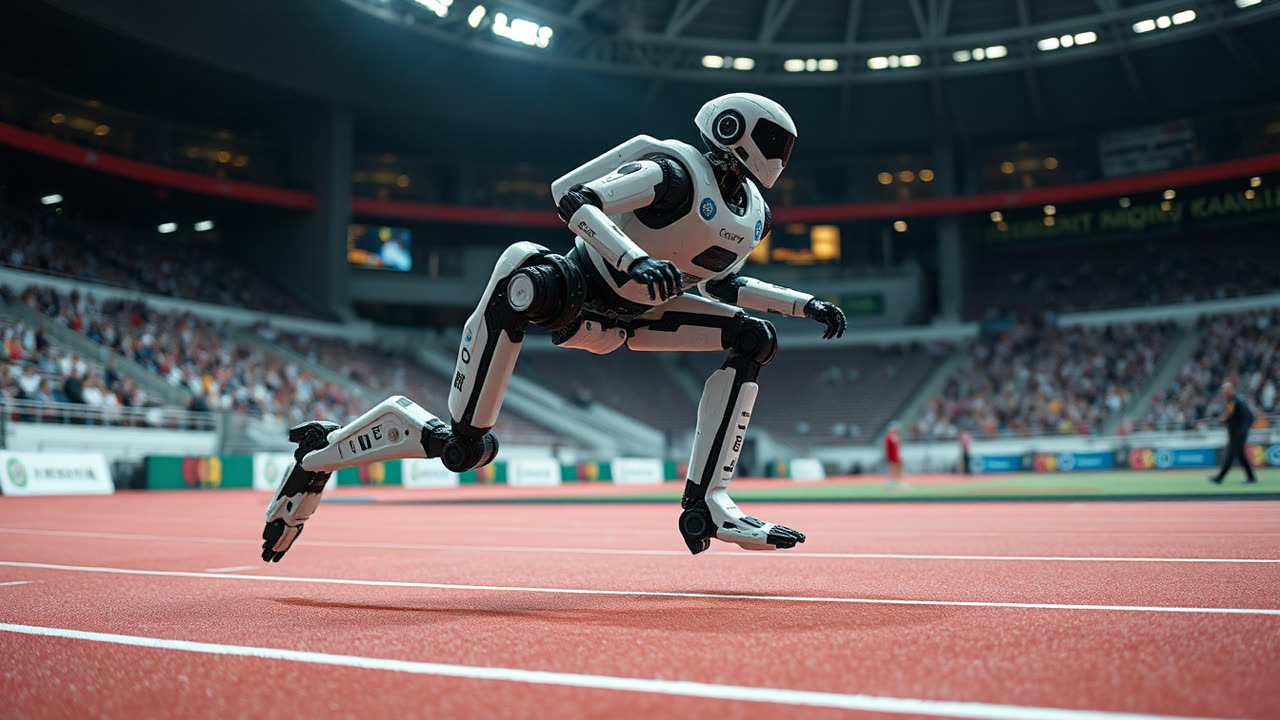
Shattering the seemingly insurmountable 9.58-second 100-meter dash record set by Usain Bolt in 2009, China's Tiangong Ultra humanoid robot stunned spectators and experts alike at the World Humanoid Robot Games in Beijing on Saturday, signaling a profound shift in the capabilities of bipedal machines. Developed by Beijing Humanoid, the robotic sprinter's preliminary heat performance not only eclipsed human athletic limits but also firmly planted a flag for a new era of robotic agility and speed. This unprecedented feat, achieved through a blend of advanced materials, sophisticated AI-driven locomotion algorithms, and powerful actuators, transcends a mere sports record; it redefines the very parameters of robot-human interaction and industrial application.
The significance of Tiangong Ultra's sprint extends far beyond the track, fundamentally altering perceptions of what humanoid robots can achieve and accelerating their integration into complex, dynamic environments. For years, bipedal locomotion, particularly at high speeds, remained a formidable challenge, plagued by issues of balance, energy efficiency, and dynamic stability. Early pioneers like Boston Dynamics' Atlas demonstrated remarkable parkour and dance routines, showcasing agility and recovery from perturbations, but never approached the raw straight-line speed of an elite human athlete. Agility Robotics' Digit, while designed for logistics and last-mile delivery, prioritizes robustness and carrying capacity over outright velocity. Tesla's Optimus, still largely in development, aims for general-purpose utility, with speed not being its primary, initially demonstrated attribute. The Tiangong Ultra's breakthrough signifies a leap in kinetic energy management and real-time environmental adaptation, indicating that the control systems have matured to a point where predictive modeling and rapid force application can mimic, and now exceed, human neuromuscular efficiency.
This unprecedented speed has immediate, transformative implications across multiple industries. In logistics and warehousing, where robots already handle repetitive tasks, humanoids capable of rapid traversal could revolutionize order fulfillment, particularly in sprawling facilities. Imagine robots not just picking and placing, but swiftly navigating complex layouts, potentially reducing delivery times and optimizing inventory management in ways previously unimaginable for bipedal systems. Furthermore, in disaster response and hazardous environments, where speed of deployment and intervention is critical, robots like Tiangong Ultra could reach danger zones faster, performing reconnaissance or even initial rescue operations before human teams can safely enter. The ability to move with such velocity and precision also opens avenues for advanced manufacturing processes requiring rapid manipulation and movement across factory floors.
The engineering behind Tiangong Ultra likely combines breakthroughs in lightweight, high-strength composite materials with compact, high-torque electric motors that offer unparalleled power-to-weight ratios. Crucially, the AI driving its gait must possess an exceptionally sophisticated understanding of dynamic balance and predictive control, adjusting foot placement and body lean in milliseconds to maintain stability at speeds previously reserved for wheeled or tracked systems. This contrasts sharply with prior generations of humanoid robots, which often prioritized stability and manipulation over raw speed, or achieved speed through less dynamically complex gaits. The competitive environment of the World Humanoid Robot Games undoubtedly pushed developers to optimize every aspect of the robot's design, fostering innovation through direct rivalry.
Looking ahead, Tiangong Ultra's record-breaking sprint is not an endpoint but a dramatic beginning. The immediate next steps will involve refining these high-speed locomotion capabilities for greater endurance, navigating varied terrains, and integrating complex manipulation tasks without compromising velocity. We can anticipate a rapid proliferation of "athletic" robotic platforms, not just for sport, but for practical applications where speed, agility, and bipedal form factor converge. The ethical and societal implications will also come into sharper focus; as robots become increasingly capable of outperforming humans in physical feats, discussions around job displacement, human augmentation, and the role of autonomous agents in society will intensify. The "robot Olympics" may soon feature events far more complex than a mere sprint, pushing humanoids to perform feats of strength, dexterity, and endurance that will continue to blur the lines between human and machine capabilities, ultimately reshaping our physical world and our place within it.