Chinese Automakers Enter Humanoid Robot Race, Challenging Tesla's Vision
Major Chinese automakers like XPeng, NIO, and Geely are aggressively investing in humanoid robot development, mirroring Tesla's strategic bet on these machines as the next major profit driver and reshaping the global tech landscape.
✨ This content was summarized and interpreted by AI; it may contain errors — please verify accuracy with the original sources. Learn more
Listen to this story
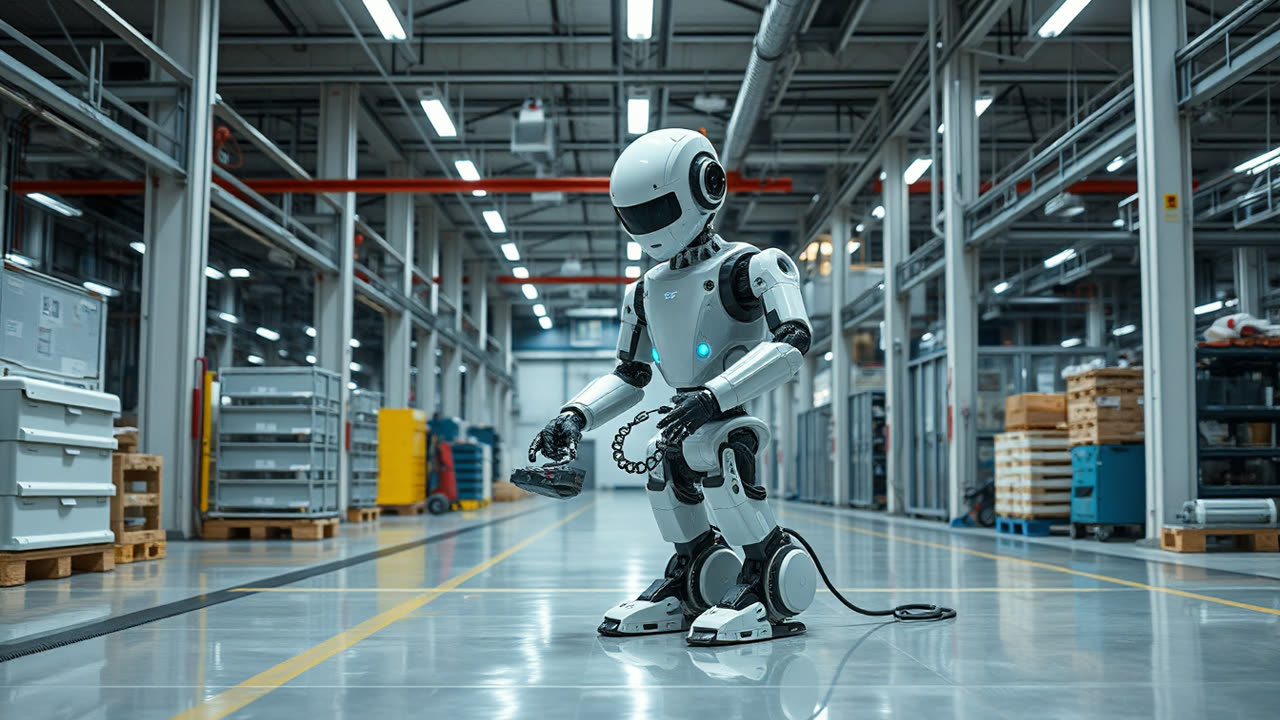
A significant new front in the global technology race has opened, with multiple major Chinese automakers now aggressively pursuing humanoid robot development, mirroring Tesla's high-stakes bet on these machines as the next epochal profit driver. This strategic pivot, first gaining widespread attention in late 2025 and accelerating through 2026, sees companies like XPeng, NIO, and Geely-backed entities allocating substantial R&D capital and engineering talent to bring bipedal robots out of the lab and into industrial and, eventually, consumer applications. The move is not merely imitative; it represents a calculated gamble on a convergence of advanced AI, improved battery technology, and increasingly sophisticated mechatronics that promises to redefine manufacturing, logistics, and even domestic life.
The rationale is clear: should humanoid robots achieve even a fraction of their theoretical versatility, they could unlock unprecedented efficiencies and create entirely new service economies. Tesla's Optimus project, despite its public demonstrations often showcasing nascent capabilities, has consistently underscored the long-term vision of a workforce capable of performing tasks unsuitable or unsafe for humans, or simply to augment human labor at scale. Chinese automakers, already leaders in electric vehicle (EV) innovation and smart manufacturing, are uniquely positioned to leverage this paradigm shift. Their existing expertise in complex supply chains, automated production lines, and AI-driven vehicle systems provides a robust foundation for integrating humanoid robotics. For instance, companies like XPeng have openly discussed plans to deploy their "PX5" humanoid robot prototypes in their own smart factories by late 2027, initially for repetitive and physically demanding tasks like material handling and quality inspection. This internal application serves as a crucial proving ground, allowing for rapid iteration and cost optimization before broader commercialization.
This push is distinct from previous waves of industrial automation, which primarily focused on fixed-arm robots or specialized AGVs (Automated Guided Vehicles). Humanoid robots, by design, aim for human-like dexterity and adaptability, enabling them to navigate dynamic environments, use human tools, and perform a far wider array of tasks without extensive retooling of workspaces. The recent breakthroughs in large language models (LLMs) and reinforcement learning have been critical enablers, allowing robots to interpret complex commands, learn from demonstration, and adapt to unforeseen circumstances with a level of cognitive flexibility previously unattainable. Companies like Huawei, a significant player in AI and chip development, are also reportedly providing foundational AI frameworks and specialized processors to several Chinese robotics ventures, including those tied to automakers, further accelerating their progress. This integrated approach, leveraging national AI capabilities, could give Chinese players a significant edge in developing intelligent robot brains.
The potential impact on the industry is multifaceted. Firstly, it promises a dramatic overhaul of manufacturing. Imagine assembly lines where humanoid robots seamlessly work alongside humans, adapting to variations in product design or production flow with minimal reprogramming. This could lead to significant cost reductions in labor and increased flexibility in production, particularly for high-mix, low-volume manufacturing. Secondly, it could create entirely new revenue streams for automakers. Beyond internal deployment, these companies envision selling or leasing robots for logistics, elder care, retail, and even household assistance. The aspiration is to move beyond selling vehicles to becoming providers of general-purpose intelligent agents. This expansion represents a direct challenge to established robotics firms and a significant diversification for the automotive sector. The global humanoid robot market, currently valued at around $2 billion in 2026, is projected to grow to over $20 billion by 2030, a testament to this burgeoning interest.
However, significant hurdles remain. The cost of manufacturing humanoid robots, while decreasing, is still prohibitive for widespread adoption outside of specialized industrial uses. Current estimates place a fully capable research-grade humanoid robot at several hundred thousand dollars, though mass production is expected to drive this down considerably, potentially to the tens of thousands by the early 2030s. Furthermore, the robustness, reliability, and safety of these robots in unstructured environments are still areas of active development. Ethical considerations, particularly regarding job displacement and human-robot interaction in public spaces, will also require careful navigation and regulatory frameworks.
Looking ahead, the next 24-36 months will be critical. We can expect to see initial, limited deployments of these humanoid robots in controlled factory environments within China, focusing on validating their efficiency and safety metrics. The key competitive battleground will shift from raw dexterity to intelligent task execution and seamless integration into existing human workflows. The companies that can demonstrate practical, scalable applications and achieve significant cost reductions will likely dominate the early market. Furthermore, the Chinese government's strong backing for advanced manufacturing and AI initiatives suggests a favorable policy environment, potentially including subsidies and research grants, which will undoubtedly fuel this rapid advancement. While Tesla has undeniably trailblazed this path, the concerted, well-resourced entry of Chinese automotive giants signals a competitive landscape that is rapidly intensifying, promising a future where humanoid robots are no longer science fiction but an integral part of the global economy.