d-Matrix Unveils Raptor AI Accelerator with Groundbreaking 3D DRAM Stacking
d-Matrix's Raptor AI accelerator introduces an unprecedented 100 TB/s memory bandwidth per card by directly stacking its compute die onto custom DRAM, setting a new benchmark for generative inference.
✨ This content was summarized and interpreted by AI; it may contain errors — please verify accuracy with the original sources. Learn more
Listen to this story
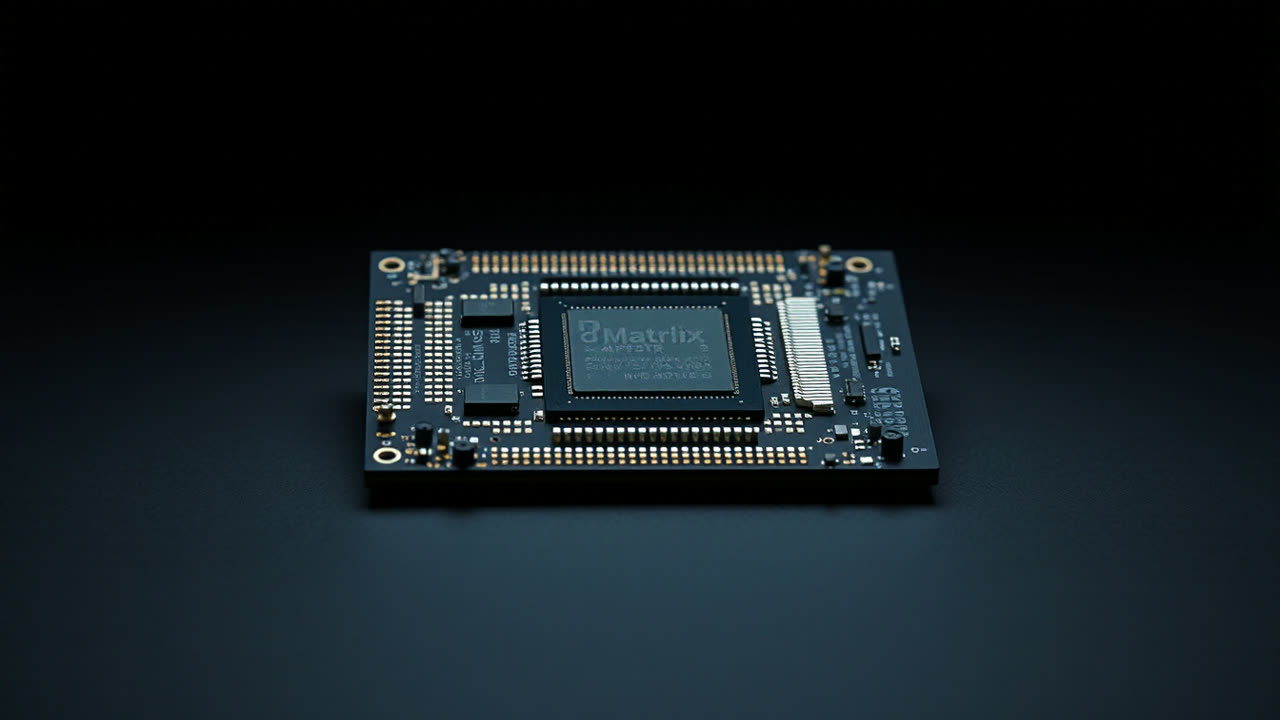
d-Matrix unveiled its Raptor AI accelerator at Hot Chips 2026, showcasing a groundbreaking architecture that directly stacks its compute die onto custom DRAM, achieving an unprecedented 100 terabytes per second (TB/s) of memory bandwidth per card. This significant leap in bandwidth is facilitated by bonding a TSMC 4nm compute die face-to-face at an exceptionally tight 36-micron pitch on top of a specially designed DRAM die, positioning Raptor as the industry's first 3D DRAM accelerator specifically engineered for generative inference.
This innovative 3D stacking approach directly addresses one of the most critical bottlenecks in large language model (LLM) inference: memory bandwidth. Generative AI models, particularly those with trillions of parameters, demand enormous amounts of data movement between processing units and memory. Traditional architectures often rely on High Bandwidth Memory (HBM) stacks, which, while powerful, still involve physical separation and latency penalties. d-Matrix's direct integration drastically reduces the physical distance data must travel, slashing latency and enabling the massive 100 TB/s throughput, which is orders of magnitude higher than typical HBM3E implementations found in current top-tier AI accelerators. For instance, NVIDIA's Hopper H100, a leading inference chip, delivers up to 3.35 TB/s of memory bandwidth, making d-Matrix's offering a potential game-changer for real-time, high-throughput generative AI applications.
The impact on users and the industry is profound. For end-users, this technology could translate into significantly faster response times for complex AI queries, more fluid and natural conversational AI experiences, and the ability to run larger, more sophisticated generative models on edge devices or in smaller data centers with reduced latency. Imagine near-instantaneous image generation from text prompts, real-time video synthesis, or highly personalized AI assistants that can process vast amounts of contextual information without noticeable delays. For industries heavily reliant on AI, such as healthcare, finance, and automotive, the ability to perform complex generative inference at such speeds opens new avenues for innovation, from accelerated drug discovery to real-time fraud detection and autonomous driving decision-making.
From an industry perspective, d-Matrix's Raptor challenges the established dominance of general-purpose GPUs in the AI inference space, particularly for generative models. By optimizing the memory subsystem for the specific demands of generative inference—characterized by high memory access patterns and sparse computations—d-Matrix is carving out a niche that traditional architectures struggle to fill efficiently. The custom DRAM design, combined with the 4nm TSMC compute die, suggests a highly specialized and energy-efficient solution, which is crucial for scaling AI infrastructure. Energy efficiency directly impacts operational costs for data centers, making Raptor an attractive proposition for cloud providers and enterprises deploying large-scale AI. This also signals a growing trend towards domain-specific architectures (DSAs) that move beyond the one-size-fits-all approach of GPUs, focusing on the unique computational and memory access patterns of AI workloads.
Comparing Raptor to current solutions, its 3D DRAM integration stands apart. While other companies like Intel with its Ponte Vecchio (Gaudi 3) and AMD with MI300X utilize advanced packaging technologies like 3D stacking for chiplets and HBM, d-Matrix's direct bonding of compute *onto* custom DRAM is a distinct architectural innovation. This is not merely about stacking logic dies or memory dies separately but creating a tightly integrated, single-unit memory-compute complex. Prior generations of d-Matrix products, such as their "Cerebras-like" approach to sparsity, laid the groundwork for specialized AI processing, but Raptor's 3D DRAM integration represents a significant architectural evolution, moving from maximizing on-chip compute density to revolutionizing data access. The 36-micron pitch is particularly aggressive, indicating sophisticated bonding techniques that push the boundaries of current manufacturing capabilities, potentially leveraging hybrid bonding advancements seen in other cutting-edge chip designs.
Looking ahead, d-Matrix's success with Raptor could catalyze broader adoption of 3D DRAM accelerators for AI. The industry may see other players, including established giants, explore similar tight integration strategies to overcome memory walls. Further advancements could involve even denser stacking, more sophisticated in-memory computing capabilities within the custom DRAM itself, or heterogeneous integration with other specialized processing units. The challenge will be scaling this complex manufacturing process, ensuring reliability, and developing a robust software ecosystem that can fully leverage Raptor's unique capabilities. If d-Matrix can deliver on its promise of superior performance and efficiency for generative AI inference, it could force a re-evaluation of fundamental AI accelerator design principles, pushing the industry towards more specialized, highly integrated, and memory-optimized architectures. This innovation at Hot Chips 2026 suggests a future where the physical proximity of compute and memory dictates the next generation of AI performance breakthroughs.