DeepSeek AI Launches Open-Source 'Harness' to Revolutionize AI Agent Development
DeepSeek AI introduces DeepSeek Harness v0.1, an MIT-licensed agent runtime built on a radical "everything is a plugin" philosophy, aiming to reshape the AI agent industry by offering unparalleled modularity and challenging proprietary frameworks.
✨ This content was summarized and interpreted by AI; it may contain errors — please verify accuracy with the original sources. Learn more
Listen to this story
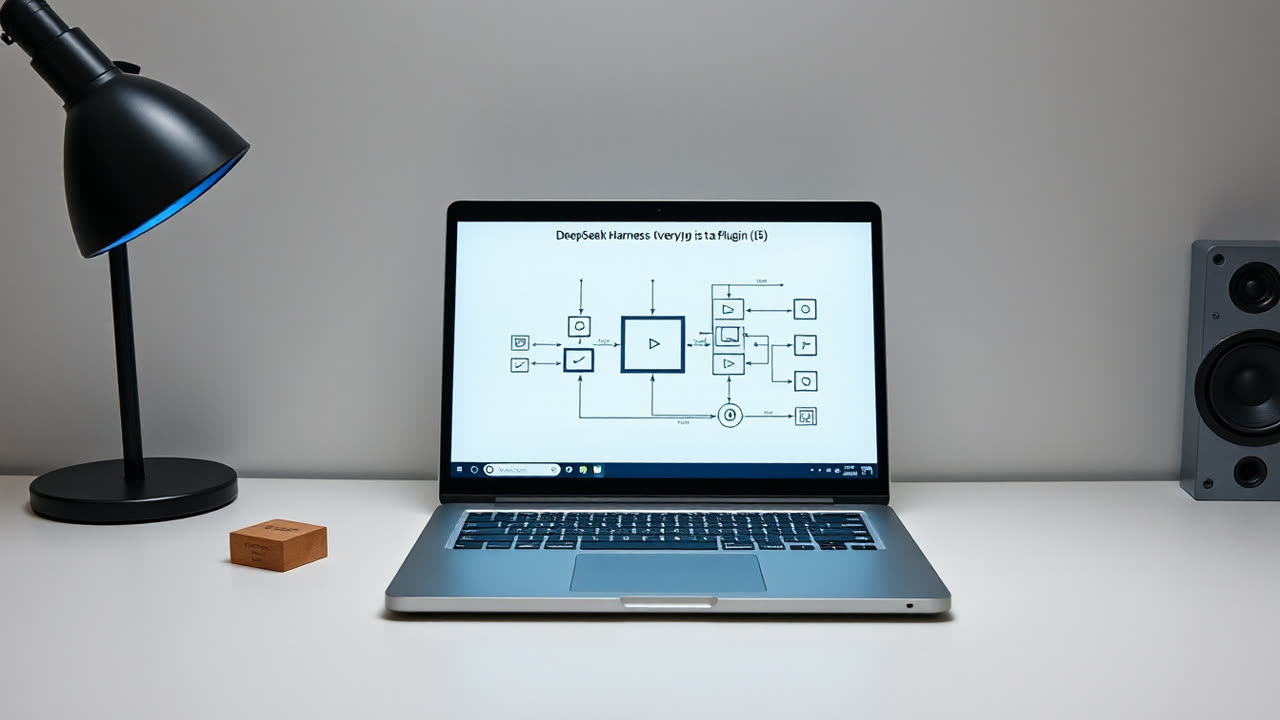
DeepSeek AI has launched DeepSeek Harness v0.1 in developer preview, an MIT-licensed agent harness designed with a radical "everything is a plugin" philosophy, fundamentally reshaping how developers can build and deploy AI agents. This new open-source runtime, built on the Cordis meta-framework, allows virtually every agent capability—including models, tools, skills, sessions, sandboxes, storage, loops, scheduling, and even the user interface—to be swapped, extended, or reconfigured without altering the core source code. This modularity stands in stark contrast to many existing agent frameworks, which often hard-code critical components, limiting developer flexibility.
DeepSeek Harness is not merely another tool; it represents a significant strategic pivot for DeepSeek AI and a potential inflection point for the broader AI agent industry. By providing an open-source, highly customizable foundation, DeepSeek challenges the increasingly integrated and often proprietary coding-agent environments offered by competitors like Anthropic's Claude Code and OpenAI's Codex. The MIT license allows developers unprecedented freedom to modify the code, add new model providers, or point the harness at locally hosted models, thereby mitigating vendor lock-in and fostering a more open ecosystem. This move positions DeepSeek not just as a provider of powerful large language models, but as a foundational infrastructure player in the burgeoning field of autonomous agents.
The core of DeepSeek Harness’s innovation lies in its Cordis plugin system. This meta-framework manages the mounting, unmounting, and dependencies between plugins, ensuring that capabilities reside within these modular components rather than a privileged core. This includes critical functions like filesystem tools for reading and editing repositories, shell access for running commands in controlled environments, and web search for external knowledge integration. The harness also ships with four distinct runtime modes—Standard, Code, Minimal, and Creator—each pre-loading a different set of plugins to cater to varied development needs, from a full coding agent to a bare benchmarking environment. Furthermore, every run within DeepSeek Harness is meticulously traceable via an append-only session log, capturing system prompts, reasoning, tool calls, results, subagent scheduling, and every context injection, offering a granular level of observability crucial for debugging and auditing. Its provider-agnostic design allows seamless integration with models from DeepSeek, Anthropic, OpenAI, Bedrock, Vertex, Azure, Codex, and any OpenAI-compatible endpoints, making it a truly versatile solution.
DeepSeek AI, founded in July 2023 by Liang Wenfeng and funded by the quantitative hedge fund High-Flyer, has rapidly risen to prominence through its commitment to open-source and cost-efficient large language models. Their earlier models, such as DeepSeek-V2 (May 2024), DeepSeek-V3 (December 2024), and the reasoning-focused DeepSeek-R1 (January 2025), have consistently disrupted the generative AI landscape by offering competitive performance at significantly lower computational costs, often triggering price wars in the Chinese AI market. The release of DeepSeek Harness, alongside the preview of their V4 series models in April 2026, including the 1.6-trillion parameter DeepSeek-V4-Pro, extends this ethos to the agent infrastructure layer.
Compared to established frameworks like LangChain or Microsoft Agent Framework (which superseded AutoGen in April 2026), DeepSeek Harness operates at a different, yet complementary, level of the AI agent stack. While LangChain provides broad abstractions for building LLM applications and LangGraph offers a lower-level orchestration for stateful multi-agent systems, DeepSeek Harness is an agent *harness*—a runtime layer that wraps a language model with the tools, sandboxes, and control loops necessary for autonomous action. Its "everything is a plugin" architecture provides a degree of modularity that surpasses many rivals, where core components are often fixed, offering only limited extension points. This design directly challenges proprietary solutions by enabling developers to build and customize agents with unparalleled granular control, an advantage for teams focused on self-hosting and data sovereignty.
Looking ahead, DeepSeek Harness v0.1, while in developer preview and explicitly subject to compatibility-breaking changes, holds immense potential. Its open-source nature and highly modular design could accelerate innovation across the AI agent landscape, fostering a vibrant ecosystem of interchangeable plugins and specialized agent runtimes. This transparency and flexibility are particularly attractive for regulated enterprises in sectors like financial services and healthcare, where auditable agent runs and custom approval policies are paramount. However, the nascent plugin ecosystem and lack of established performance benchmarks mean early adopters will need to contribute to its maturation. DeepSeek's simultaneous decision to significantly raise API prices for its V4-Pro model—with peak output costs jumping from $0.87 to $3.96 per million tokens, a 4.6x increase—signals a calculated monetization strategy. The company appears to be giving away the agent tooling for free to drive adoption and ecosystem growth, while capitalizing on the demand for its powerful, advanced models to power these customizable agents. This dual strategy positions DeepSeek to capture value at both the infrastructure and model layers, potentially forcing competitors to re-evaluate their own open-source and pricing strategies in the rapidly evolving AI agent market.