Elegoo Centauri 2 Combo: Budget 3D Printing Sparks Debate Over Enclosure Cost
This open-frame CoreXY multi-color 3D printer's aggressive $319 price point and deliberate omission of an enclosure challenge expectations for affordability versus functionality.
✨ This content was summarized and interpreted by AI; it may contain errors — please verify accuracy with the original sources. Learn more
Listen to this story
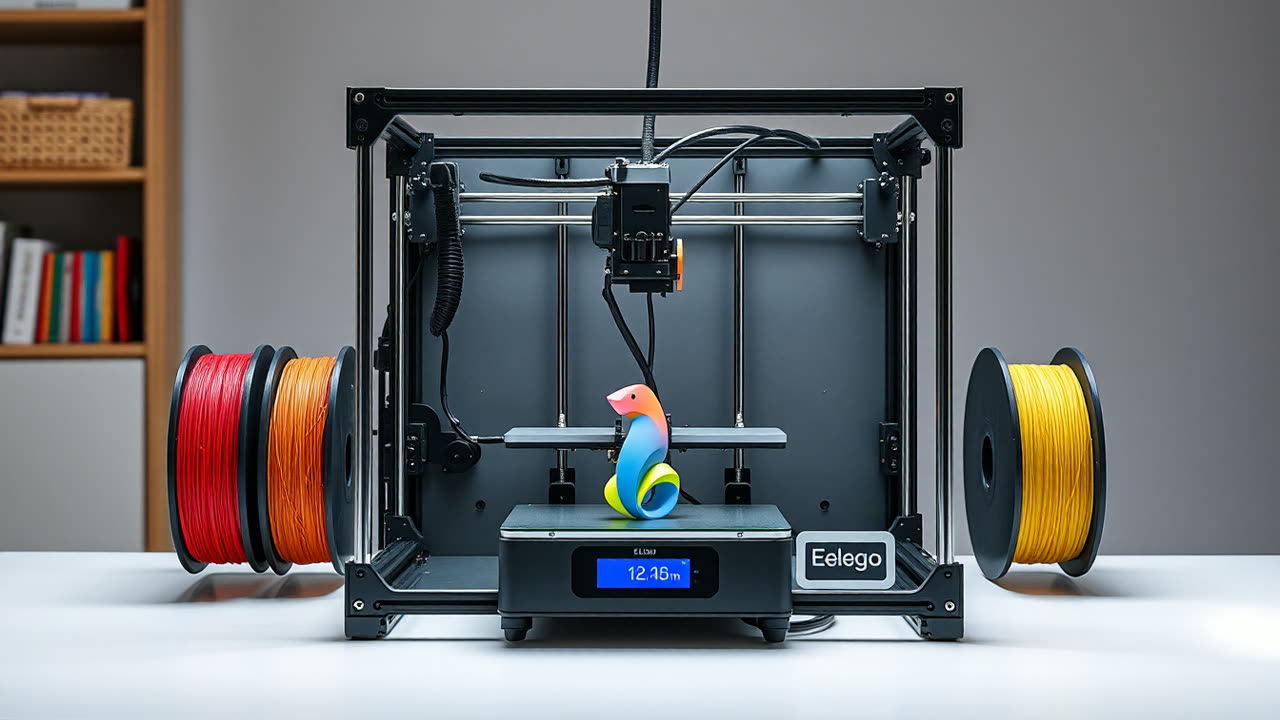
The Elegoo Centauri 2 Combo, priced at a striking $319, has ignited a fresh debate in the 3D printing community regarding the true cost of budget-friendliness. This open-frame CoreXY machine offers four-color printing via Elegoo's CANVAS system, a generous 256 x 256 x 256 mm build volume, and a hot end capable of reaching 350°C with a heated bed up to 110°C, making it technically compatible with a wide array of filaments including PLA, PETG, ABS, ASA, PC, and even some carbon-fiber-reinforced options. However, its most significant differentiator, and potential Achilles' heel, is the deliberate omission of an enclosure—a feature present in its slightly more expensive sibling, the Centauri Carbon 2 Combo, which retails for around $379 to $449. This strategic cost-cutting measure opens the door for accessibility but simultaneously introduces notable compromises for users and the broader industry.
The absence of an enclosure in the Centauri 2 Combo is a double-edged sword that profoundly impacts user experience and material versatility. For casual hobbyists and beginners primarily printing with PLA and PETG, the open design might seem inconsequential. These filaments are generally less sensitive to ambient temperature fluctuations and do not emit significant fumes, making the Centauri 2 Combo an attractive, low-cost entry point into multi-color FDM printing. Its automatic leveling, calibration, and user-friendly 5-inch touchscreen further enhance its appeal to novices. However, the moment users venture into more advanced engineering materials like ABS, ASA, Nylon, or Polycarbonate, the lack of an enclosed and often heated print chamber becomes a critical limitation. These materials are highly susceptible to warping, cracking, and layer delamination due to drafts and inconsistent temperatures, necessitating a stable, warm environment that an open-frame printer simply cannot provide. While the printer's hot end and bed temperatures theoretically support these filaments, achieving successful prints without an enclosure is challenging, leading to higher failure rates and wasted material. Furthermore, printing materials like ABS and ASA can release ultrafine particles and noxious fumes, posing health concerns in an unenclosed setting and making proper ventilation crucial. The Centauri 2 Combo also lacks internal lighting and a camera for remote monitoring, features found in its Carbon counterparts, which detract from convenience for users wanting to oversee prints from afar.
In the competitive landscape of multi-color 3D printing, the Centauri 2 Combo positions itself as an aggressive budget option, but its rivals often offer more comprehensive solutions. The Elegoo Centauri Carbon 2 Combo, for instance, provides an enclosed chamber with smart ventilation, a built-in camera, and internal lighting for an additional $60-$130, significantly broadening its material compatibility and user convenience. Other market contenders like the Bambu Lab A1 Mini, while also open-frame, are known for their integrated ecosystems and ease of use, though comparisons typically pit the A1 Mini against the enclosed Centauri Carbon 2 Combo due to similar price points and feature sets. Prusa's MMU3 system, an add-on for their MK4 printers, offers multi-material capabilities with a focus on open-source flexibility, but often at a higher overall investment and with a different approach to filament management than Elegoo's CANVAS system. The Centauri 2 Combo's CoreXY kinematics allow for fast print speeds up to 500 mm/s and acceleration of 20,000 mm/s², matching or exceeding many competitors in raw speed. However, the actual print speed for multi-color jobs on the Centauri 2 Combo can be hampered by slower color changes and increased purge waste compared to some rivals, as noted by users of the Centauri Carbon 2 Combo. This suggests that while the base hardware is capable, the overall efficiency for multi-color, multi-material prints might still favor more integrated, often enclosed, systems.
Looking ahead, the Centauri 2 Combo's existence underscores a fascinating market trend: the democratization of multi-color 3D printing. Elegoo's strategy of offering a highly capable CoreXY machine with multi-color functionality at such an aggressive price point ($319) is a clear attempt to capture a broader audience, making advanced features accessible to a segment that might have previously found them cost-prohibitive. This move is likely to intensify competition, potentially driving down prices across the board for entry-level multi-color FDM printers. However, the trade-off of the enclosure highlights a persistent tension between affordability and advanced functionality. While some users may opt for DIY enclosures, these often lack the integrated ventilation and temperature control of factory-designed solutions. The industry's trajectory suggests that fully enclosed, actively heated chambers will become increasingly standard, even in mid-range offerings, as manufacturers strive to offer broader material compatibility and a safer user experience for hobbyists and professionals alike. Elegoo may find itself needing to bridge this gap, perhaps by offering an official, affordable enclosure upgrade for the Centauri 2 Combo that integrates seamlessly, or by more clearly segmenting its product line to emphasize the benefits of the enclosed Centauri Carbon 2 Combo. The Centauri 2 Combo serves as a powerful reminder that while initial cost is a significant factor, the long-term value of a 3D printer lies not just in its features, but in its ability to reliably and safely print the materials required for diverse creative and functional applications.