Enthusiast Powers Desktop PC with 192 AA Batteries, Boots Hannah Montana Linux
A desktop PC, powered by an astounding 192 AA alkaline batteries, successfully booted into Hannah Montana Linux, withstood stress testing, and even ran the open-source game FreeDoom, demonstrating an extreme, albeit impractical, proof-of-concept for off-grid computing.
✨ This content was summarized and interpreted by AI; it may contain errors — please verify accuracy with the original sources. Learn more
Listen to this story
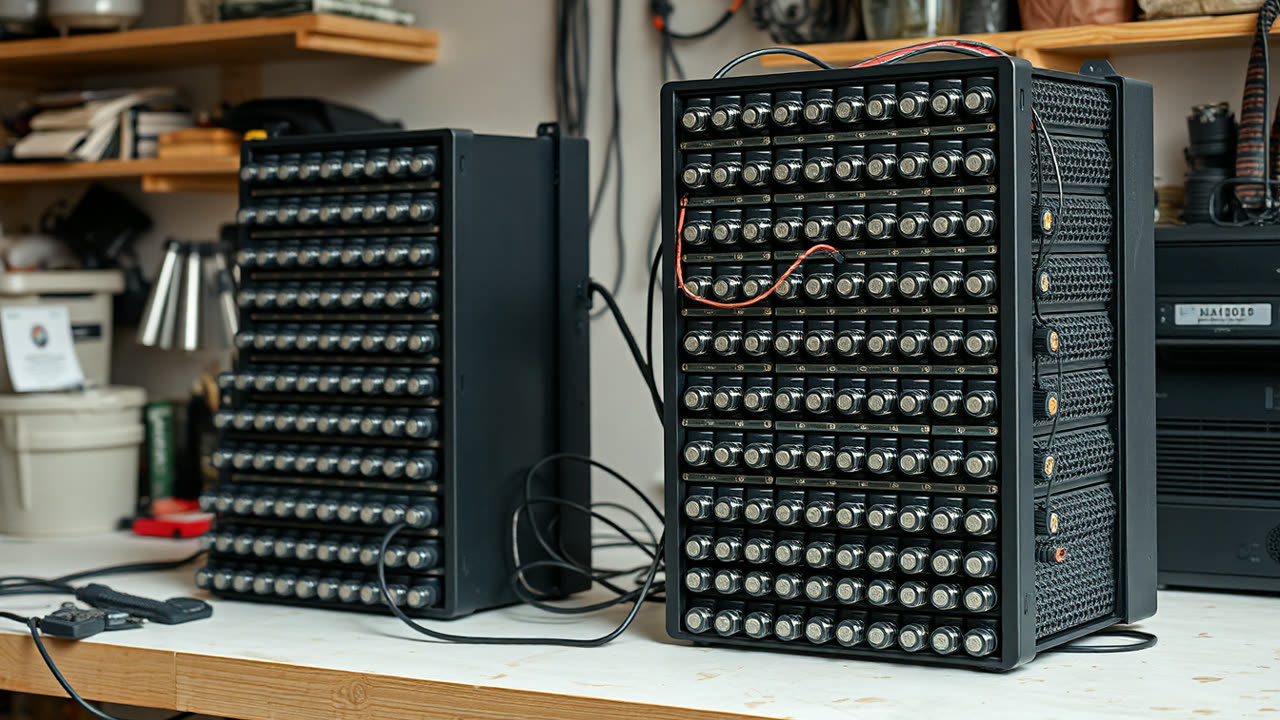
A desktop PC, powered by an astounding 192 AA alkaline batteries, successfully booted into Hannah Montana Linux, withstood stress testing, and even ran the open-source game FreeDoom, demonstrating an extreme, albeit impractical, proof-of-concept for off-grid computing. The creator, known as "Uwoslab," meticulously configured three custom battery banks, each housing 64 AA cells, to deliver the necessary voltage and current to an AM4 system. This audacious experiment pushes the boundaries of unconventional power delivery, highlighting both the robust adaptability of modern PC hardware and the sheer ingenuity of the enthusiast community.
The core news lies in the successful operation of a standard desktop system from such a distributed and low-power-density source. Uwoslab's setup reportedly drew approximately 100W under load, a modest figure for an AM4 platform but still a significant drain on 192 AA batteries. Standard alkaline AA batteries typically provide around 2.5 to 2.8 Wh of energy, meaning the entire array, if perfectly efficient, might offer a theoretical maximum of around 480-537 Wh. This translates to a run-time of roughly 4-5 hours under a 100W load, a duration confirmed by the creator's reports of stable operation during extended stress testing and gameplay. The choice of Hannah Montana Linux, a lightweight and humorously themed distribution, further underscores the project's playful yet technically sound execution, while FreeDoom, a free and open-source re-implementation of the classic Doom engine, provided a real-world, albeit graphically simple, workload.
This feat matters not for its immediate practical application—the cost of 192 AA batteries, even in bulk, far outweighs the utility for sustained operation, and their environmental impact is considerable—but for the fundamental insights it provides into power delivery and system resilience. It underscores the critical role of efficient power regulation within PC components, demonstrating that even a relatively unstable or high-impedance power source can be tamed by modern motherboards and power supply units. For users, it offers a dramatic illustration of what's possible outside the conventional grid, perhaps inspiring thought experiments on emergency backup systems or truly portable, albeit short-lived, computing solutions in extreme scenarios. For the industry, it's a testament to the robust engineering of contemporary PC hardware, capable of drawing power from highly distributed and low-current sources without immediate failure. While obviously not a blueprint for future products, it serves as an extreme stress test of power management circuits and voltage stability under non-ideal conditions.
Compared to traditional PC power solutions, Uwoslab's setup is a stark contrast. A typical 65W AM4 CPU, paired with an integrated GPU or low-power discrete card, would usually draw its power from a highly regulated AC-DC power supply, offering stable voltage and high current delivery. Even portable battery banks designed for laptops use high-capacity lithium-ion cells, providing far greater energy density and reusability than AA alkalines. Previous enthusiast experiments have explored solar power, car batteries, or even manual generators, but few have tackled such a massive array of individual, low-capacity cells. The sheer number of connections and the potential for voltage drops across the array present significant engineering challenges that Uwoslab evidently overcame through meticulous construction and wiring. This experiment highlights the significant power efficiency gains in modern computing, where even a relatively modest desktop system can operate within the power envelope that, just a decade ago, might have exclusively powered a netbook.
Looking ahead, this experiment, while an anomaly, subtly reinforces trends in low-power computing and the increasing demand for adaptable power solutions. While we won't see AA-powered gaming rigs, the drive for greater efficiency in processors and components continues, making smaller, lighter, and more diverse power sources theoretically viable for specialized applications. Innovations in battery technology, particularly solid-state batteries or more energy-dense lithium variants, could one day enable genuinely portable and powerful computing without the need for a grid connection. Uwoslab's project, in its audacious spirit, serves as a reminder that the fundamental principles of electrical engineering and component resilience remain paramount, pushing the boundaries of what is considered "standard" and sparking new ideas for how we might power our digital lives in the most unconventional of ways. The next iteration might involve more efficient battery types, perhaps even a smaller number of higher-capacity cells, or an attempt to power a more demanding system, continually probing the limits of DIY power solutions in a world increasingly reliant on computational access.