External GPUs: The Enduring Flaws of a Niche Gaming Solution
Despite their promise to transform thin-and-light laptops into gaming powerhouses, external GPUs consistently deliver diminished performance and often prove less cost-effective than dedicated basic gaming PCs.
✨ This content was summarized and interpreted by AI; it may contain errors — please verify accuracy with the original sources. Learn more
Listen to this story
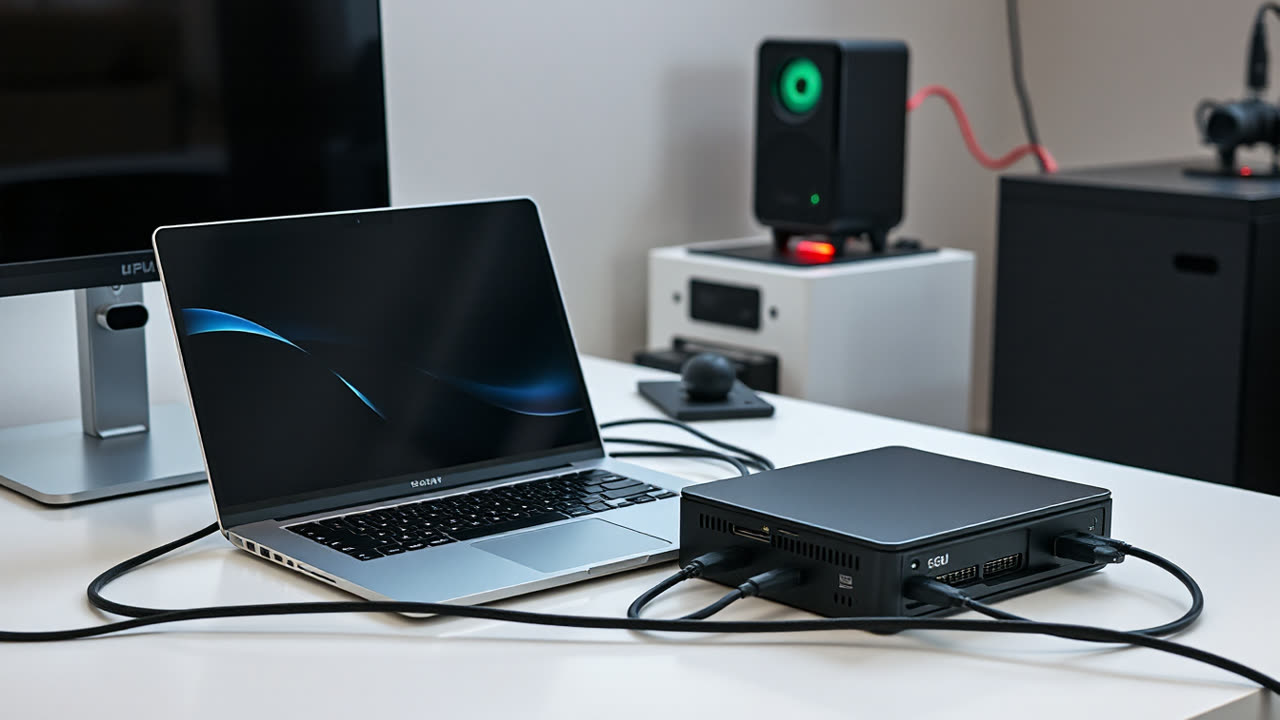
Despite the promise of transforming thin-and-light laptops into gaming powerhouses, external GPUs (eGPUs) consistently deliver a diminished performance experience, often failing to justify their significant cost and complexity, making a dedicated basic gaming PC a more pragmatic investment for most users. This core limitation stems primarily from the inherent bandwidth constraints of Thunderbolt, the prevailing connection standard for eGPUs, which throttles even high-end graphics cards, preventing them from reaching their full potential. While a desktop NVIDIA GeForce RTX 4070 might achieve over 100 frames per second (fps) in a demanding title like Cyberpunk 2077 at 1440p, the same card connected via an eGPU enclosure can see performance dips of 15-30% or more, depending on the game and system configuration, often struggling to maintain stable frame rates. This performance overhead is not merely theoretical; it translates directly into a less fluid gaming experience, characterized by lower average frame rates and more pronounced frame time inconsistencies.
The economic argument against eGPUs is equally compelling. A complete eGPU setup typically involves three main components: a compatible laptop with Thunderbolt 3 or 4, an eGPU enclosure, and a discrete graphics card. Current eGPU enclosures, such as the Razer Core X Chroma or the Sonnet Breakaway Box, range from $300 to $500. Adding a mid-range GPU like an NVIDIA GeForce RTX 4060, which retails for around $300-$350, brings the total eGPU investment to $600-$850, *excluding* the cost of the laptop itself. For comparison, a pre-built entry-level gaming PC featuring an Intel Core i5 or AMD Ryzen 5 processor, an RTX 3050 or RX 6600 GPU, 16GB of RAM, and a 500GB SSD can often be found for $700-$900, sometimes even less during sales events. This dedicated gaming PC not only offers superior, uncompromised performance for its specifications but also provides a full desktop experience, including better cooling, expandability, and a dedicated power supply, all optimized for gaming. The incremental cost to upgrade a laptop with an eGPU often approaches or exceeds the cost of a standalone gaming desktop that would deliver a significantly better return on investment in terms of raw gaming power and user experience.
Beyond the raw performance and cost, eGPUs introduce a layer of operational friction that detracts from their appeal. Setting up an eGPU often involves driver installations, firmware updates, and troubleshooting compatibility issues, particularly with different operating systems or specific laptop models. While plug-and-play functionality has improved, it is far from universal, and users frequently encounter quirks with hot-swapping, external monitor detection, and power delivery. The physical footprint of an eGPU enclosure, often resembling a small form-factor PC, also negates some of the portability advantages of a thin-and-light laptop, tethering the user to a desk setup with multiple cables. This contradicts the very premise of using an eGPU to extend the life or capabilities of a portable machine without sacrificing convenience.
The industry's continued lukewarm embrace of eGPUs speaks volumes. While major GPU manufacturers like NVIDIA and AMD offer drivers that *support* eGPUs, their marketing efforts and product development remain heavily focused on discrete desktop cards and mobile GPUs integrated into gaming laptops. There's no significant push for eGPU-specific optimizations or dedicated hardware solutions that might alleviate Thunderbolt's bottlenecks. This lack of dedicated industry focus suggests that eGPUs remain a niche solution, primarily serving users with specific needs, such as creative professionals who require occasional GPU acceleration for rendering or video editing on a portable workstation, rather than mainstream gamers. For the latter, the performance penalties, coupled with the cost and complexity, simply don't make sense when purpose-built gaming machines offer a superior experience for comparable or even less money.
Looking ahead, the future of eGPUs is tied directly to advancements in high-speed external connectivity. While Thunderbolt 5, announced in late 2023, promises a substantial leap in bandwidth, offering up to 80 Gbps bi-directional bandwidth and 120 Gbps for display-intensive workloads, it will take time for this standard to become ubiquitous in laptops and for eGPU enclosures to adopt it. Even with doubled bandwidth over Thunderbolt 4's 40 Gbps, it still falls short of the PCIe x16 lanes available to internal desktop GPUs, which can offer over 250 Gbps of bandwidth. This suggests that while future eGPUs might see a reduction in performance overhead, a complete parity with internal desktop GPUs is unlikely to be achieved via external interfaces in the near-to-medium term. Therefore, while eGPUs will continue to exist as a viable niche for specific professional workflows, the fundamental trade-offs in performance, cost, and convenience will likely persist, solidifying the position of dedicated gaming PCs as the superior choice for anyone prioritizing an uncompromised gaming experience.
FACTS: eGPUs do work, but they come with some notable limitations — You're probably better off buying a basic gaming PC than messing with an eGPU. (kaynak: Engadget, https://www.engadget.com/2257761/egpu-come-with-limitations/)