Figure AI's Humanoid Robots Self-Destruct in Fiery Decommissioning, Raising IP and E-Waste Alarms
Figure AI's F.02 humanoid robot fleet autonomously self-destructed in a Finnish electric arc furnace, a calculated move to protect proprietary tech and highlight emerging e-waste challenges in advanced robotics.
✨ This content was summarized and interpreted by AI; it may contain errors — please verify accuracy with the original sources. Learn more
Listen to this story
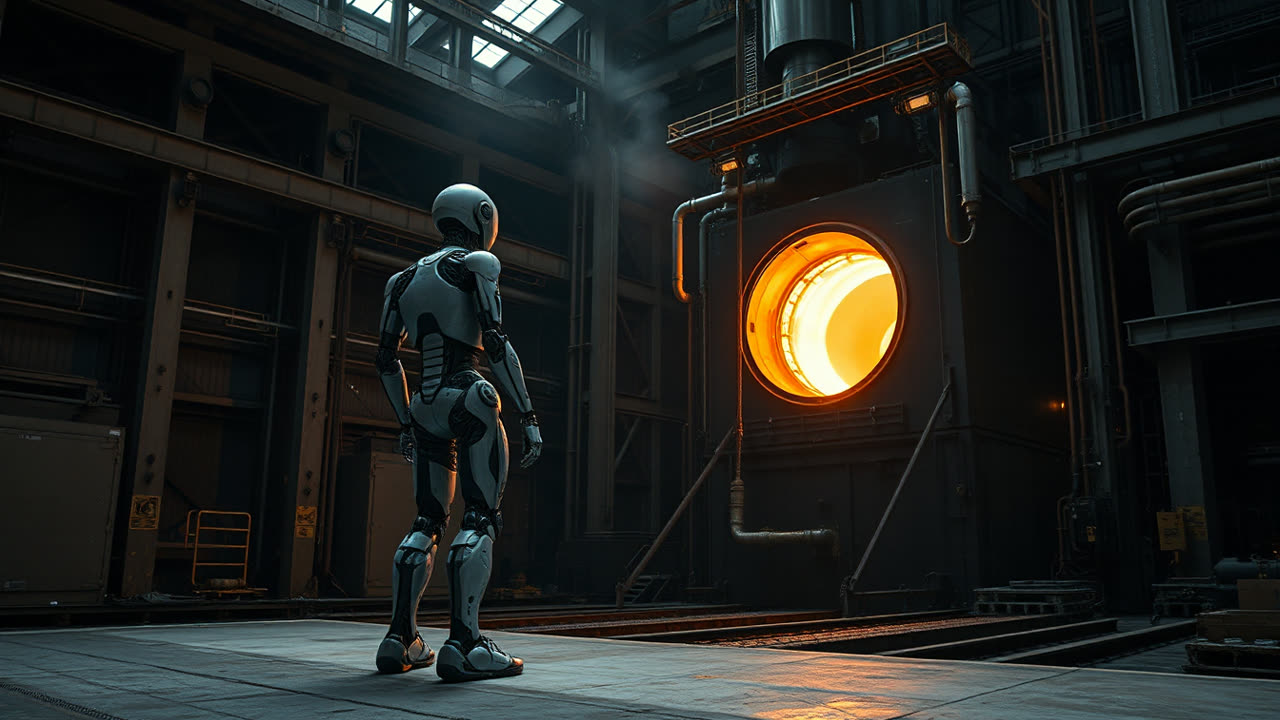
The dramatic decommissioning of Figure AI's F.02 humanoid robot fleet, which saw the machines autonomously leap into a 75-ton electric arc furnace in Imatra, Finland, underscores a pivotal moment in the rapidly accelerating robotics industry. This "T2-style" retirement, famously suggested by actor Arnold Schwarzenegger on X, was not merely a spectacle but a calculated maneuver by Figure AI to safeguard its proprietary hardware, including custom-built actuators and other intellectual property, while simultaneously freeing up engineering resources for its newer F.03 and upcoming F.04 models. The necessity for such extreme measures arose after numerous foundries in the United States and Mexico declined to process robots containing volatile lithium-ion batteries, highlighting an emergent and complex challenge in advanced robotics disposal.
This extraordinary end-of-life protocol for the F.02 fleet, which successfully executed its self-destructive programming despite the foundry's extreme heat and electromagnetic interference, is profoundly significant for both users and the wider industry. Firstly, it sets a stark precedent for intellectual property protection in an era where technological blueprints are arguably as valuable as the physical assets themselves. As humanoid robots become more sophisticated and embed deeper layers of proprietary innovation, companies will face increasing pressure to devise secure, verifiable methods of decommissioning that prevent rivals from reverse-engineering their advancements. This could lead to a future where "design for destruction" becomes a critical, albeit macabre, aspect of product lifecycle management for advanced robotics.
Secondly, the F.02's retirement casts a harsh light on the nascent but critical issue of e-waste in the humanoid robotics sector. Each F.02 robot, weighing approximately 70 kg and capable of carrying a 25 kg payload, contains between 10,000 and 15,000 individual components, including a 2.25 kWh lithium-ion battery and 3.5 to 4 kg of rare-earth neodymium magnets. Traditional recycling methods are ill-equipped to handle such complex, dense assemblies, especially given the risks posed by batteries and the difficulty of recovering rare-earth metals without cross-contamination. The industry currently lacks clear waste stream definitions and robust manufacturer take-back systems, pointing to an urgent need for "design for recycling (DfR)" principles to be integrated from the earliest stages of robot development. Without proactive governance and tailored end-of-life pathways, the projected surge in humanoid robot production could create an unprecedented solid-waste challenge.
The F.02's relatively short 11-month operational life, during which it performed admirably in a pilot program at BMW's Spartanburg plant—working 10-hour shifts, loading over 90,000 sheet-metal parts, logging over 1,250 operating hours, and contributing to the production of more than 30,000 BMW X3 vehicles—demonstrates the incredibly rapid iteration cycle now characteristic of the humanoid robotics market. This rapid obsolescence, driven by continuous advancements, signifies a profound shift from experimental prototypes to commercially viable, if short-lived, industrial tools. The F.02 itself was a significant upgrade from its predecessor, featuring three times the AI inference computing power, a 50% longer battery runtime, and fourth-generation hands with 16 degrees of freedom.
In comparison to its rivals, Figure AI is clearly pushing the envelope on both hardware and the underlying intelligence. The company is making a substantial investment in its Helix AI system, planning an unprecedented supercomputer buildout with up to 100,000 NVIDIA GPUs on the next-generation Vera Rubin platform, a multi-billion-dollar commitment intended to unlock general-purpose capabilities for its robots. This commitment to a proprietary AI stack, as evidenced by Helix's capabilities, positions Figure AI as a serious contender in the "robot race."
Competitors are also making significant strides. Tesla's Optimus, reportedly ramping up production to several hundred units per week with a target of over 1,000 per week by late 2026, aims for commercial sales to businesses by late 2027 and consumer availability shortly thereafter. Optimus leverages a unified AI platform, sharing its core intelligence (AI5 chip, FSD computer-vision, Cortex 2.0 supercomputer) with Tesla's Cybercab, suggesting a highly integrated and scalable approach. Boston Dynamics, a long-standing leader, unveiled its new electric Atlas humanoid in January 2026, with production commencing immediately and initial deployments at Hyundai and Google DeepMind. This new Atlas, designed for industrial tasks, features a sophisticated four-finger hand with 13 degrees of freedom for complex manipulation and an "order of magnitude" reduction in complexity for mass production. Meanwhile, Agility Robotics launched its Digit 5 in September 2026, emphasizing "cooperatively safe" operation alongside humans without traditional safety barriers. With over $300 million in pre-orders, representing approximately 1,000 robots, and a RoboFab factory capable of producing up to 10,000 units annually, Agility is demonstrating a clear path to scaled deployment in logistics and manufacturing.
Looking ahead, the decommissioning of Figure F.02 is a harbinger of several trends. We can anticipate even more accelerated development cycles, with robot generations potentially lasting only months before being superseded. This will necessitate a robust, industry-wide strategy for managing end-of-life robotics, moving beyond ad-hoc solutions to standardized "design for recycling" principles that prioritize both intellectual property security and environmental sustainability. The intense competition among Figure AI, Tesla, Boston Dynamics, and Agility Robotics will undoubtedly drive rapid advancements in both hardware capabilities and, more importantly, AI generalization. The ability of robots to learn from vast datasets and perform complex, unstructured tasks will be the ultimate differentiator. As these humanoid platforms mature, expect to see them transition from industrial pilot programs to widespread commercial deployment, eventually permeating logistics, manufacturing, and even potentially consumer environments, fundamentally reshaping the global workforce and our interaction with autonomous machines.