Firebird AI Launches CIS Region's Largest AI Factory in Armenia
Firebird AI's $500 million initial investment in Hrazdan, Armenia, establishes the CIS region's largest AI factory, poised to deploy over 70,000 NVIDIA Blackwell and Vera Rubin GPUs and become a critical new hub for global AI infrastructure.
✨ This content was summarized and interpreted by AI; it may contain errors — please verify accuracy with the original sources. Learn more
Listen to this story
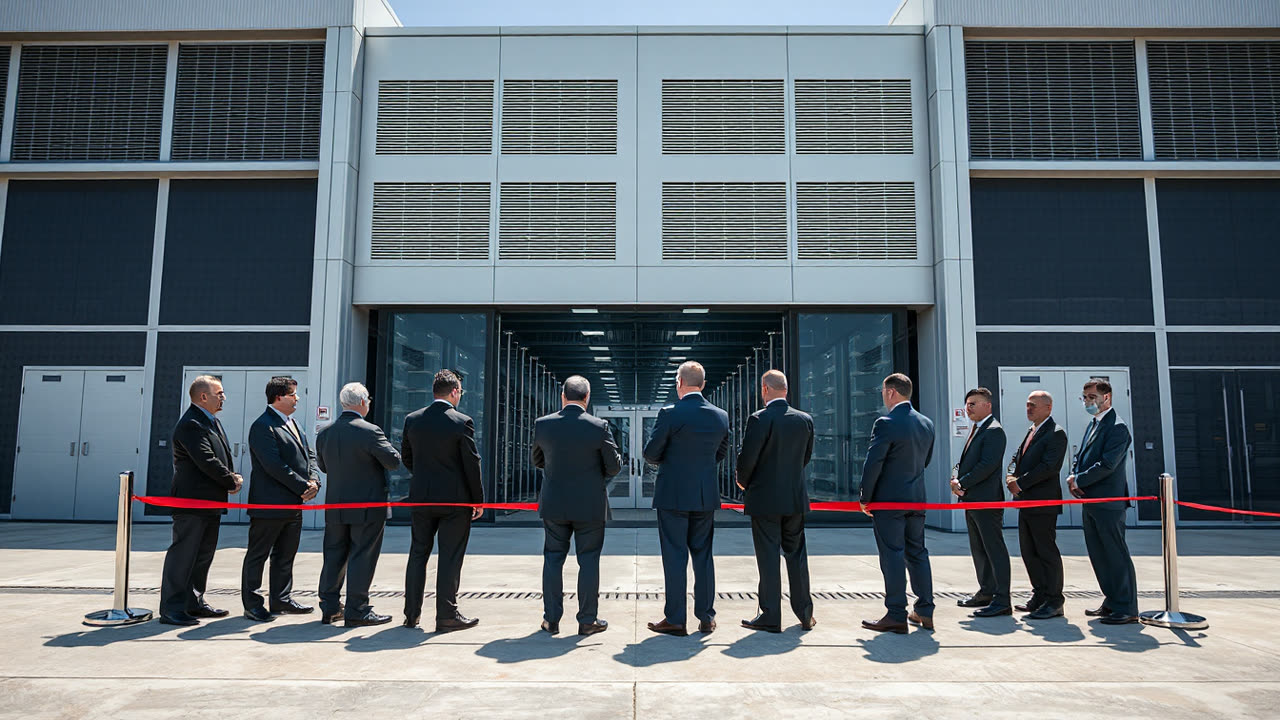
Firebird AI has inaugurated the CIS region's largest artificial intelligence factory in Hrazdan, Armenia, a monumental $500 million initial investment marking a significant shift in the global buildout of AI infrastructure. The facility, which officially opened on August 8, 2026, is poised to become one of Europe's most substantial AI infrastructure projects, with plans to deploy over 70,000 NVIDIA Blackwell and Vera Rubin GPUs by the end of 2027, reaching a total capacity of 300 megawatts. This strategic deployment, powered by NVIDIA's most advanced accelerated computing platforms and Dell Technologies' infrastructure, positions Armenia as a vital new hub for AI computing, with the total project investment expected to reach $5 billion upon completion.
The establishment of such a formidable AI factory in Armenia carries profound implications for both regional development and the broader geopolitical landscape of artificial intelligence. The launch, attended by Armenian Prime Minister Nikol Pashinyan, NVIDIA CEO Jensen Huang, U.S. Chargé d'Affaires David Allen, and Kazakhstan Deputy Prime Minister Zhaslan Madiyev, underscores the strategic national importance now ascribed to domestic computing power. In an era where AI infrastructure is increasingly viewed as critical national infrastructure, comparable to energy grids or communication networks, nations are seeking to host and control their data processing capabilities to safeguard national interests and foster local AI innovation. Firebird, a U.S.- and Armenia-based company, has successfully navigated complex U.S. export licenses and secured host government approvals, demonstrating a new model for deploying advanced AI compute in emerging markets. This initiative directly addresses Armenia's domestic AI compute demand, reserving a portion of the capacity for local startups, universities, and research centers, thereby reducing reliance on foreign AI clouds and cultivating a robust local tech ecosystem. The company has already become a significant taxpayer in Armenia, contributing approximately $2.2 million to the state budget in the first half of 2026.
Technologically, the factory represents the cutting edge of AI compute, leveraging NVIDIA's Blackwell and the newly available Vera Rubin architectures. The Rubin GPU, central to the Vera Rubin platform, boasts 336 billion transistors—1.6 times that of Blackwell's 208 billion—and integrates 288 GB of HBM4 memory, delivering 22 TB/s of memory bandwidth, a 2.8x increase over Blackwell's 8 TB/s. Each Rubin GPU provides up to 50 petaFLOPS of NVFP4 inference performance, significantly surpassing Blackwell's capabilities. The Vera Rubin NVL72 rack, housing 72 Rubin GPUs and 36 Vera CPUs, delivers an astounding 3.6 exaFLOPS of FP4 inference compute and is entirely liquid-cooled, a necessity given the Rubin GPU's substantial power consumption of 1,800 to 2,300W. This architecture is purpose-built for the demands of agentic AI, long-context inference, and trillion-parameter Mixture-of-Experts (MoE) models, offering a claimed 5x rack-level inference performance and 10x lower inference token cost compared to Blackwell. For context, Blackwell, which itself succeeded the Hopper generation (H200), delivered a 15x reduction in cost per million tokens and up to 4x higher per-GPU throughput for dense AI models compared to the H200. The factory's design adheres to NVIDIA's DSX AI Factory reference, which, combined with Spectrum-X Ethernet networking, can fit up to 40% more GPUs within the same megawatt budget by optimizing power management and cooling. The facility also features a closed-loop cooling system for environmental sustainability. Perplexity is already leveraging this advanced infrastructure as one of its first customers for its answer engine and AI-powered digital coworker platform.
Looking ahead, Firebird's ambition extends beyond Armenia, with a global pipeline targeting 2 gigawatts of AI infrastructure by the end of 2028, encompassing expansions into Kazakhstan (where it has secured 125 megawatts of capacity in Data Center Valley) and other frontier markets. This aggressive global strategy, bolstered by an intended investment from NVIDIA following an earlier backing from CoreWeave, signifies NVIDIA's deepening commitment to extending its AI ecosystem through strategic partnerships and equity positions in emerging cloud providers. The company's model of pairing U.S. export licenses with local governmental approvals is critical for navigating complex regulatory environments and unlocking new markets for advanced U.S. technology. This trend of decentralizing AI infrastructure away from traditional hyperscaler dominance is likely to accelerate, driven by both geopolitical considerations and the increasing demand for localized, high-performance computing. However, challenges remain, including securing consistent, high-capacity energy supplies, attracting and retaining specialized talent, and competing with established global AI cloud providers. The successful deployment and scaling of Firebird's AI factory in Armenia, particularly with the deployment of advanced Rubin GPUs, will serve as a crucial benchmark for the viability and impact of sovereign AI initiatives and the future geography of global AI power.