Ford Fathom EV Pickup Challenges Market with Sub-$30,000 Price
Ford's Fathom electric pickup, launching in early 2027 with a starting MSRP of $28,350, is set to redefine the affordable EV truck market.
✨ This content was summarized and interpreted by AI; it may contain errors — please verify accuracy with the original sources. Learn more
Listen to this story
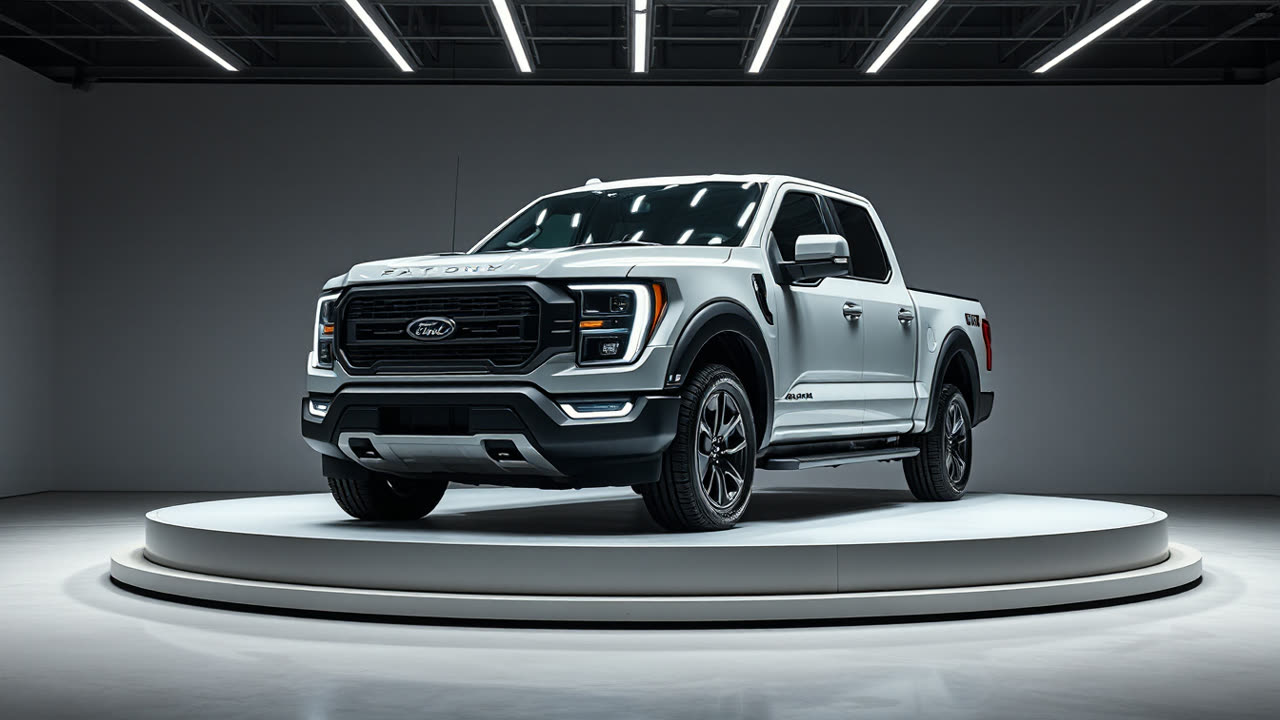
Ford's aggressive entry into the sub-$30,000 electric pickup market with the Fathom, set to launch in early 2027 with a starting MSRP of $28,350, signals a pivotal shift in the automotive industry's electrification strategy. This midsize EV, with a delivered price of $29,945 including a $1,595 destination charge, positions Ford to democratize electric truck ownership, moving beyond the premium segment dominated by early EV adopters. The company's reveal of new footage, showcasing the Fathom "in the wild" during hot weather testing, offers a tantalizing glimpse at a vehicle designed to be accessible and genuinely utilitarian.
The Fathom is not merely a scaled-down version of existing electric trucks; it is the inaugural vehicle built on Ford's new Universal Electric Vehicle (UEV) platform. This platform, which CEO Jim Farley has likened to a "Model T moment" for its focus on affordability and capability, is central to Ford's strategy to produce profitable EVs at a lower price point. Developed by a dedicated "Skunk Works" team, the UEV platform emphasizes manufacturing efficiency, structural simplicity, and cost reduction, utilizing innovations like large single-piece aluminum castings and a structural lithium iron phosphate (LFP) battery pack for the standard range model. This approach aims to reduce parts count and assembly time, with Ford investing $2 billion to transform its Louisville Assembly Plant into an all-EV factory for Fathom production, targeting a 15% increase in assembly speed over previous vehicles built there. Production of prototypes is slated for Q1 2027, with customer deliveries following later that year.
This strategic pivot matters immensely for both consumers and the broader automotive landscape. For users, the Fathom represents a genuine opportunity to access an electric pickup without the prohibitive price tags associated with earlier models. Ford projects the Fathom to offer more passenger volume than a Toyota RAV4, alongside a traditional truck bed and a frunk for additional storage. Key features confirmed for all Fathom models include standard BlueCruise hardware for hands-free highway driving, integrated Apple Maps for navigation with EV routing and battery preconditioning, Pro Power Onboard for bidirectional charging capabilities, and wireless Apple CarPlay and Android Auto. While official EPA range figures, horsepower, and towing capacities are yet to be finalized, Ford has indicated a target of approximately 300 miles of range for an extended-range battery option, with the standard LFP battery likely offering closer to 200-220 miles. The truck is also expected to be as quick as a Mustang EcoBoost, implying a 0-60 mph time around 5 seconds.
The industry impact is profound. Ford's move directly challenges the perception that electric trucks must be expensive, putting significant pressure on rivals. The F-150 Lightning, Ford's earlier electric truck, started at over $49,000 and faced profitability challenges, with Ford reportedly losing $44,000 on every Lightning sold, leading to a $19.5 billion write-down and the cessation of its fully electric model production. The Fathom aims to reverse this, engineered from the ground up for profitability. Compared to competitors, the Fathom's sub-$30,000 price point significantly undercuts models like the Tesla Cybertruck, Chevrolet Silverado EV Work Truck, and Ram 1500 REV, which start at much higher price points. Even compared to the nascent "bare-bones" Slate Truck, which starts at $24,950 but offers fewer features, the Fathom presents a compelling, feature-rich alternative for a slightly higher, yet still highly competitive, price. Its pricing places it squarely in the territory of Ford's own popular Maverick hybrid, which starts at $28,145, potentially creating internal competition but also offering consumers a choice between hybrid and full-electric utility at a similar entry cost.
Looking ahead, the Fathom's success hinges on Ford's ability to achieve its ambitious production targets and maintain profitability at this aggressive price point. The investment in the Universal EV Platform and the retooling of the Louisville Assembly Plant underscore Ford's commitment to a high-volume, low-cost EV strategy. This could serve as a blueprint for future affordable EVs across various segments, not just pickups, potentially accelerating global EV adoption, especially in markets beyond the U.S. where right-hand drive models are also being considered. Challenges remain, including securing sufficient LFP battery supply, expanding charging infrastructure, and managing potential dealer markups that could undermine the Fathom's accessible price. However, if Ford delivers on its promises, the Fathom could solidify its position as a leader in accessible electric vehicles, fundamentally reshaping consumer expectations and pushing the entire industry towards more affordable and practical EV solutions.