Ford's Fathom EV Pickup Faces Production Uncertainty for Ambitious Sub-$30K Launch
Ford's plan to launch its Fathom EV pickup at an aggressive $28,350 price point in early 2027 is clouded by significant production challenges, as CEO Jim Farley admits the effort will be 'a heck of an effort'.
✨ This content was summarized and interpreted by AI; it may contain errors — please verify accuracy with the original sources. Learn more
Listen to this story
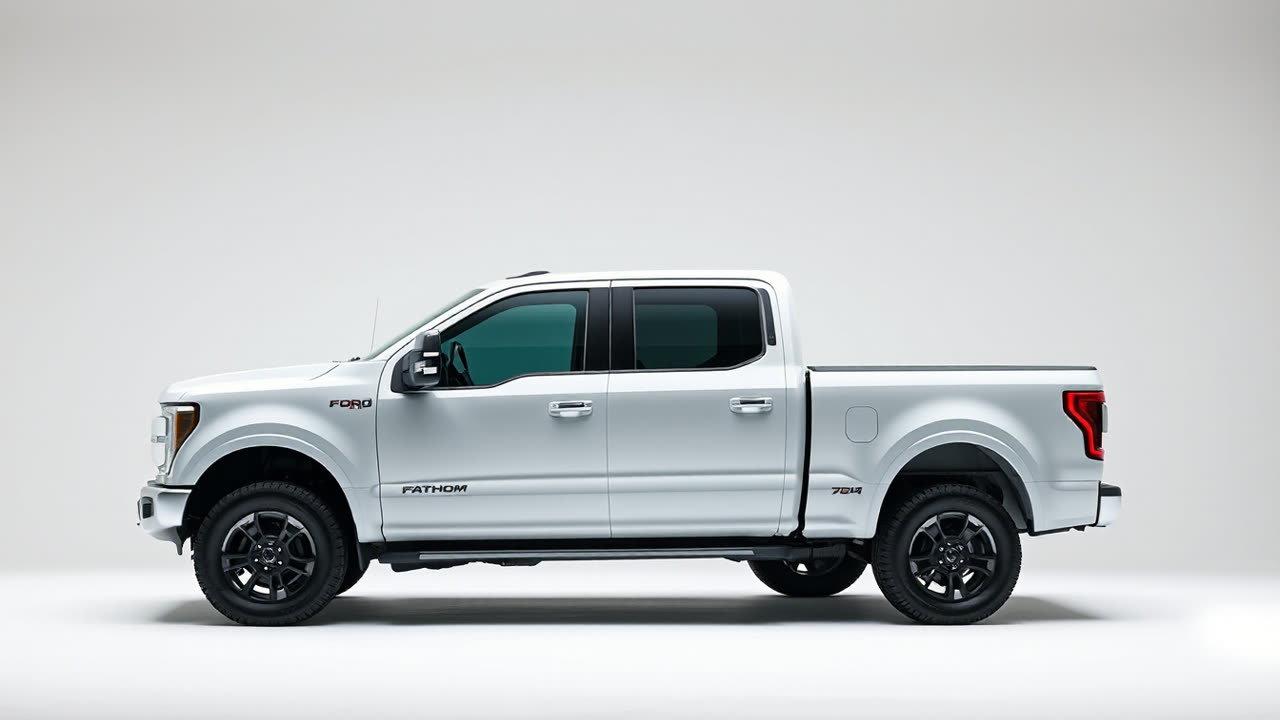
Ford's ambitious plan to launch its Fathom EV pickup in early 2027 with a starting price of $28,350 faces significant production uncertainty, a challenge acknowledged by CEO Jim Farley, who described the effort as "a heck of an effort to launch this at scale, at cost, on time." This candid admission underscores the immense pressures confronting automakers attempting to deliver truly affordable electric vehicles to a mass market.
The Fathom represents a critical pivot for Ford, moving beyond the premium pricing of its F-150 Lightning, which starts at over $50,000 for its Pro trim. Ford's Model e division, established to spearhead its EV transition, reported a $1.3 billion pre-tax loss in the second quarter of 2026, primarily due to investments in next-generation EVs and manufacturing capacity. This financial reality highlights the difficulty of achieving profitability in the nascent EV segment, particularly as the industry pushes towards lower price points. The Fathom's sub-$30,000 target is an aggressive play, aimed at unlocking a vast segment of the truck market currently dominated by internal combustion engine (ICE) vehicles. For users, a $28,350 electric pickup could be a game-changer, potentially making EV ownership accessible to a much broader demographic, especially in regions where pickups are primary vehicles for work and personal use. This affordability could accelerate EV adoption by mitigating the initial cost barrier, which remains a significant deterrent for many prospective buyers.
The challenge, however, lies in the economics of manufacturing. Battery costs, while declining, remain a substantial component of an EV's bill of materials. Industry estimates suggest battery pack costs hover around $90-$100 per kilowatt-hour (kWh) in 2026, meaning even a modest 40 kWh pack for the Fathom would represent a significant portion of its target retail price. Achieving profitability at such a low price point will necessitate unprecedented efficiencies in battery sourcing, manufacturing processes, and supply chain management. Ford has been investing heavily in vertical integration, including battery production facilities like the BlueOval City complex in Tennessee and BlueOval SK battery plants in Kentucky, to gain greater control over costs and supply. Yet, scaling these operations to meet the demand for a mass-market vehicle like the Fathom, while simultaneously driving down unit costs, presents a formidable hurdle.
In the competitive landscape, the Fathom aims to carve out a unique niche. Rivals like the Tesla Cybertruck target a higher-end, niche market with its distinctive design and premium pricing, while the Chevrolet Silverado EV offers a range of trims, with its Work Truck (WT) variant potentially competing on price, albeit likely above the Fathom's entry point. Ram's 1500 REV is also positioned as a full-size, feature-rich offering, likely in a higher price bracket. The Fathom, therefore, isn't just competing with other EVs but directly challenging the value proposition of entry-level ICE pickups like the Ford Maverick or even base-model F-150s. This direct confrontation with established, profitable ICE segments underscores the Fathom's strategic importance as a volume driver for Ford's EV ambitions. Success would validate the strategy of targeting the heart of the pickup market with an affordable electric option, proving that EVs can compete on upfront cost, not just total cost of ownership.
Looking ahead, the Fathom's launch will serve as a bellwether for the entire automotive industry's ability to democratize electric mobility. If Ford can indeed deliver the Fathom at scale, on time, and at its target price point, it could force other manufacturers to accelerate their own plans for affordable EVs, potentially sparking a new wave of competition in the sub-$35,000 segment. Conversely, significant delays or price increases for the Fathom would signal the persistent difficulties in achieving EV profitability at lower price points, potentially causing other automakers to reconsider or postpone their own mass-market EV initiatives. Ford's ongoing development of next-generation EV platforms, designed for greater manufacturing simplicity and cost efficiency, will be crucial to the Fathom's success. The company's ability to leverage these new architectures, alongside aggressive cost-cutting measures and robust supply chain resilience, will determine whether the Fathom becomes a landmark in affordable EV adoption or a testament to the challenges of the transition. The industry is watching to see if Ford can truly build an electric truck for the masses, or if the economic realities of EV production will continue to confine true innovation to premium segments.