Frore's LiquidJet Promises 10°C Cooler Nvidia Rubin GPUs, 15% AI Performance Boost
Frore's LiquidJet coldplate technology is set to dramatically improve thermal management for next-generation AI accelerators, promising a 10°C temperature reduction for Nvidia Rubin GPUs and a 15% boost in AI workload performance, a critical advancement for hyperscalers exploring delidded GPUs.
✨ This content was summarized and interpreted by AI; it may contain errors — please verify accuracy with the original sources. Learn more
Listen to this story
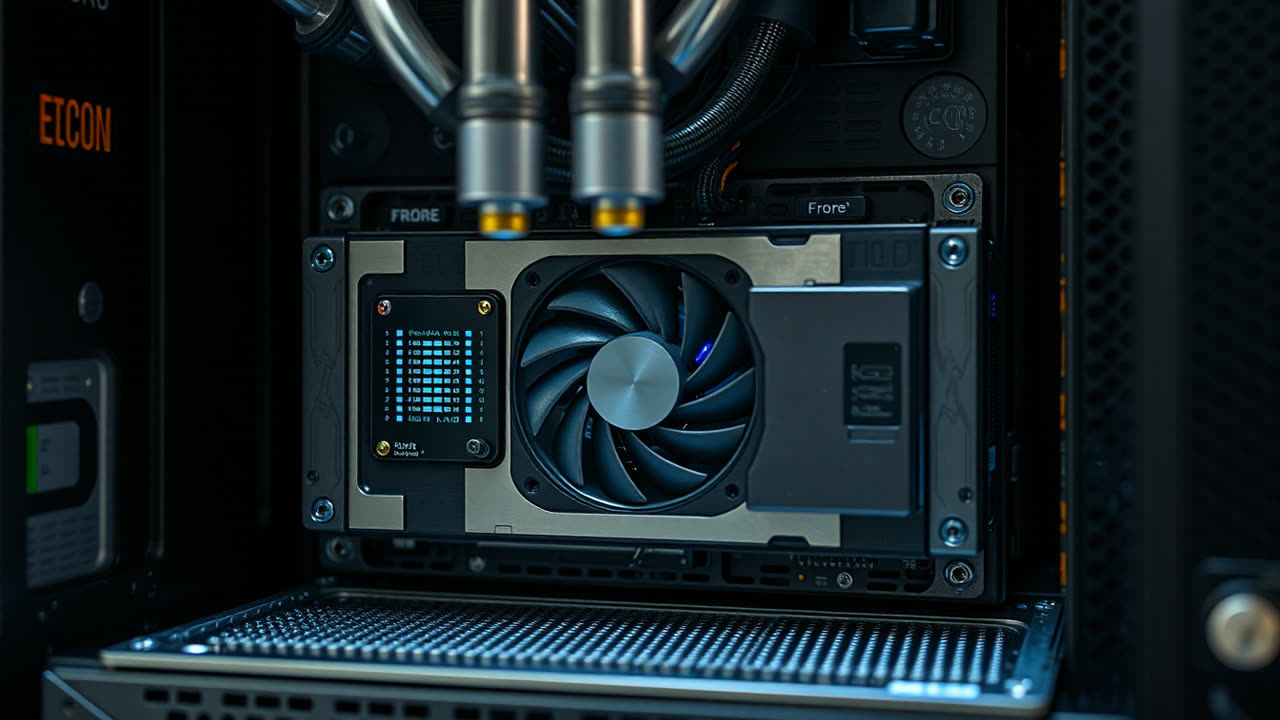
Frore's LiquidJet coldplate technology is poised to redefine thermal management for next-generation AI accelerators, promising a significant 10°C reduction in Nvidia Rubin GPU temperatures and a corresponding 15% performance uplift, a critical advancement as hyperscalers increasingly explore delidded GPUs in production environments. This efficiency extends directly to operational metrics, with Frore claiming a 15% increase in token generation efficiency for AI workloads, directly impacting the economic viability of burgeoning AI data centers. Such claims underscore a pivotal shift in the AI hardware landscape, where cooling solutions are no longer an ancillary consideration but a fundamental driver of computational throughput and operational expenditure.
The core innovation behind LiquidJet lies in its ability to deliver ultra-efficient, localized cooling directly to the GPU die, a necessity given the escalating thermal design power (TDP) of advanced AI chips like the upcoming Nvidia Rubin. While specific details on Rubin's architecture remain under wraps, its predecessor, Blackwell, already pushes thermal boundaries, and Rubin is expected to further intensify heat generation with increased core counts and higher clock speeds, demanding more sophisticated cooling than traditional air-cooling or even conventional coldplate solutions can offer. Frore's approach, utilizing a system that actively pumps and jets dielectric fluid across the hot spots of the GPU, offers a distinct advantage over passive or less dynamic liquid cooling methods. This active, directed flow maximizes heat transfer efficiency at the chip level, which is particularly beneficial for delidded GPUs where the direct-to-die contact eliminates thermal resistance layers inherent in integrated heat spreaders (IHS). For hyperscalers, delidding GPUs, despite the inherent risks to warranty and handling, presents an opportunity to shave precious degrees off operating temperatures and unlock additional performance headroom, making Frore's solution a synergistic complement to this high-risk, high-reward strategy.
The economic implications of such cooling advancements are profound for AI data centers, which are grappling with unprecedented energy consumption and operational costs. The energy required to cool a modern AI server rack can rival, or even exceed, the power consumed by the compute hardware itself. By reducing GPU temperatures by 10°C, LiquidJet not only prevents thermal throttling, allowing GPUs to sustain peak performance for longer durations, but also potentially extends the lifespan of expensive hardware by operating within more optimal temperature ranges. The claimed 15% boost in token generation efficiency directly translates to a significant reduction in the cost per token, a key metric for large language models (LLMs) and other generative AI applications. This means more AI output for the same energy input, or the same output with less energy, directly improving the return on investment for massive AI infrastructure deployments. Current industry benchmarks indicate that cooling can account for 30-50% of a data center's total energy consumption, highlighting the transformative potential of technologies that can drastically improve thermal efficiency. Traditional liquid cooling systems, while superior to air, often involve complex plumbing and larger footprints. Frore’s compact, targeted solution aims to integrate seamlessly, offering a more granular and efficient approach to direct-to-chip cooling.
Looking ahead, the success of Frore's LiquidJet will hinge on its scalability, reliability, and ease of integration into existing and future data center architectures. While the performance claims are compelling, widespread adoption will require rigorous independent validation and a robust supply chain to meet the demands of hyperscale deployments. Competitors in the advanced cooling space, such as those developing two-phase immersion cooling or other direct-to-chip liquid cooling plates, are also vying for market share, but Frore’s focus on an active jetting mechanism offers a differentiated approach. As Nvidia continues its rapid iteration cycle with chips like Rubin, and with subsequent generations like the expected "X" series, thermal management will only grow in complexity and importance. The industry is moving towards a future where cooling is not an afterthought but an integral part of chip design and system architecture, potentially leading to co-designed cooling solutions alongside future GPU generations. The ability to unlock latent performance and significantly cut operational costs through superior cooling will be a decisive factor in the competitive landscape of AI infrastructure, making innovations like LiquidJet critical enablers for the next wave of AI development.