Fruit Fly Brain Fails to Boost LLM Performance, Challenging Neuro-Inspired AI Dogma
A groundbreaking experiment wiring the complete *Drosophila melanogaster* connectome into a 1.2-billion-parameter large language model not only failed to enhance performance but actively demonstrated the limitations of direct neuro-biological emulation in current AI paradigms.
✨ This content was summarized and interpreted by AI; it may contain errors — please verify accuracy with the original sources. Learn more
Listen to this story
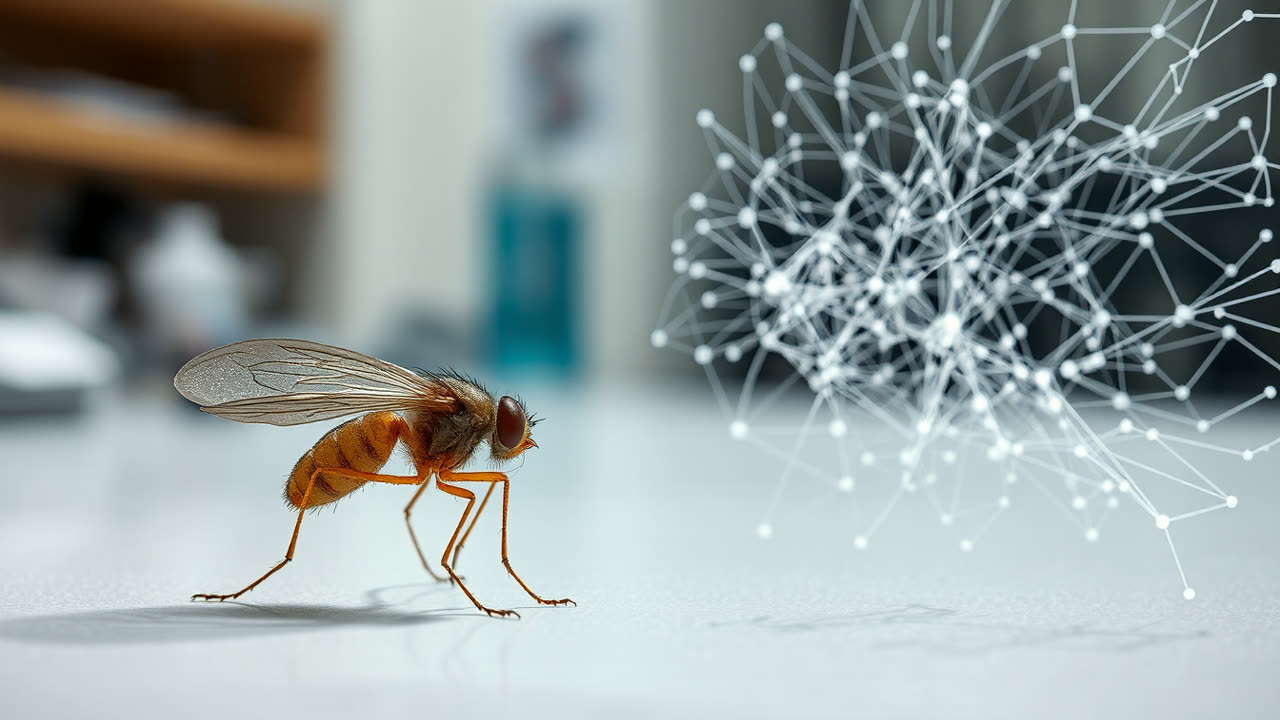
The Fly Language Model (FLM) project, a groundbreaking endeavor to imbue a large language model with the intricate architecture of a biological brain, has delivered a paradoxical finding: wiring the complete male *Drosophila melanogaster* connectome into a frozen 1.2-billion-parameter LLM not only failed to enhance performance but actively demonstrated the limitations of direct neuro-biological emulation in current AI paradigms. This audacious experiment saw the FLM drive all 166,700 retained neurons and 25.6 million edges of the fruit fly’s central nervous system, mapping these biological connections onto token embeddings of a frozen LFM2.5-1.2B-Instruct backbone. The researchers then added a small learned correction layer, comprising only 278,528 parameters, to adapt the LLM to this novel architecture. The subsequent control tests, however, starkly revealed that this elaborate biological scaffolding provided no discernible benefit to the model's capabilities, challenging a long-held intuition in AI research that biological inspiration, particularly at the level of connectomics, would inherently lead to more efficient or capable artificial intelligence.
This outcome carries profound implications for the trajectory of AI development, particularly for those championing neuro-inspired architectures. For years, the quest to understand and replicate the brain's computational prowess has fueled significant research, with many believing that deciphering and mimicking biological neural networks would unlock new frontiers in AI. The FLM's results suggest that a direct, one-to-one translation of biological wiring, even from a relatively simple organism like the fruit fly, may not be the silver bullet for enhancing large language models. The 1.2-billion-parameter LFM2.5-Instruct model, a sophisticated LLM developed through extensive training on vast datasets, already possesses emergent capabilities far exceeding the known cognitive scope of a fruit fly. Introducing the fly's connectome, while biologically faithful, appears to impose structural constraints that are either irrelevant or actively detrimental to the LLM's learned representations and computational processes, which are optimized for linguistic tasks rather than navigating a three-dimensional environment or executing motor commands. This indicates a potential mismatch between the functional optimization of biological brains for survival in complex physical environments and the abstract, statistical optimization of LLMs for language processing.
The experiment also highlights a fundamental divergence in how biological and artificial neural networks achieve intelligence. Biological brains, shaped by millions of years of evolution, operate under severe energy and resource constraints, leading to highly optimized, sparse, and specialized architectures. The fruit fly connectome, for instance, is a testament to efficient processing for specific tasks like navigation, olfaction, and mating. In contrast, modern LLMs leverage dense, highly interconnected layers and massive computational power to learn statistical correlations from enormous datasets, often without explicit structural constraints beyond general architectural patterns like transformers. The FLM's findings suggest that simply porting biological "blueprints" into an LLM might not transfer the underlying computational advantages unless the *function* these biological structures enable is also relevant to the LLM's objective function. It raises questions about whether the "intelligence" of a connectome lies purely in its static wiring diagram or in the dynamic, activity-dependent learning rules and synaptic plasticity that govern its operation, elements not directly replicated by merely mapping edges to token embeddings.
Comparing FLM's approach to other biologically inspired AI efforts reveals a critical distinction. While some projects seek to emulate neuron-level spiking dynamics or integrate principles like sparsity and recurrent connections, the FLM focused on the precise anatomical wiring diagram. Previous attempts to build "neuromorphic" chips and models, such as IBM's TrueNorth or Intel's Loihi, have shown promise in energy efficiency and specific pattern recognition tasks by mimicking spiking neural networks, but they rarely attempt to replicate an entire connectome directly into a pre-existing, non-spiking LLM architecture. The FLM's unique contribution is its direct test of connectomic transfer, and its negative result compels a re-evaluation of the "brain-as-blueprint" paradigm. It suggests that the path to more advanced AI might lie not in literal biological replication, but in abstracting higher-level computational principles from neuroscience, or perhaps in developing entirely novel architectures that are merely *inspired* by, rather than bound to, biological structures.
Looking ahead, the FLM's outcome will likely catalyze a shift in neuro-inspired AI research. Instead of direct connectome mapping, future efforts may concentrate on identifying and integrating specific, functional motifs from biological brains that confer demonstrable advantages to AI models for particular tasks. This could involve exploring how specific brain regions handle memory, attention, or reasoning, and abstracting those mechanisms into modular AI components, rather than attempting a wholesale structural transplant. Furthermore, the focus might shift towards understanding the *developmental* processes that build biological brains and how these processes could inform the creation of more robust and adaptive AI systems. The FLM project, despite its counter-intuitive conclusion, has provided invaluable data, demonstrating that while the fruit fly connectome is a marvel of natural engineering, its direct integration into current LLM architectures does not automatically translate to enhanced artificial intelligence. This forces researchers to confront the nuanced relationship between biological inspiration and practical AI progress, pushing the field towards more sophisticated and perhaps less literal interpretations of how nature's intelligence can inform our own creations.