Galaxy Z Fold 8 Unlocks Hidden DeX Desktop Mode on Inner Screen
An unofficial workaround has enabled Samsung's Galaxy Z Fold 8 to run its full DeX desktop environment directly on its expansive inner display, transforming the foldable into a self-contained PC-like workstation.
✨ This content was summarized and interpreted by AI; it may contain errors — please verify accuracy with the original sources. Learn more
Listen to this story
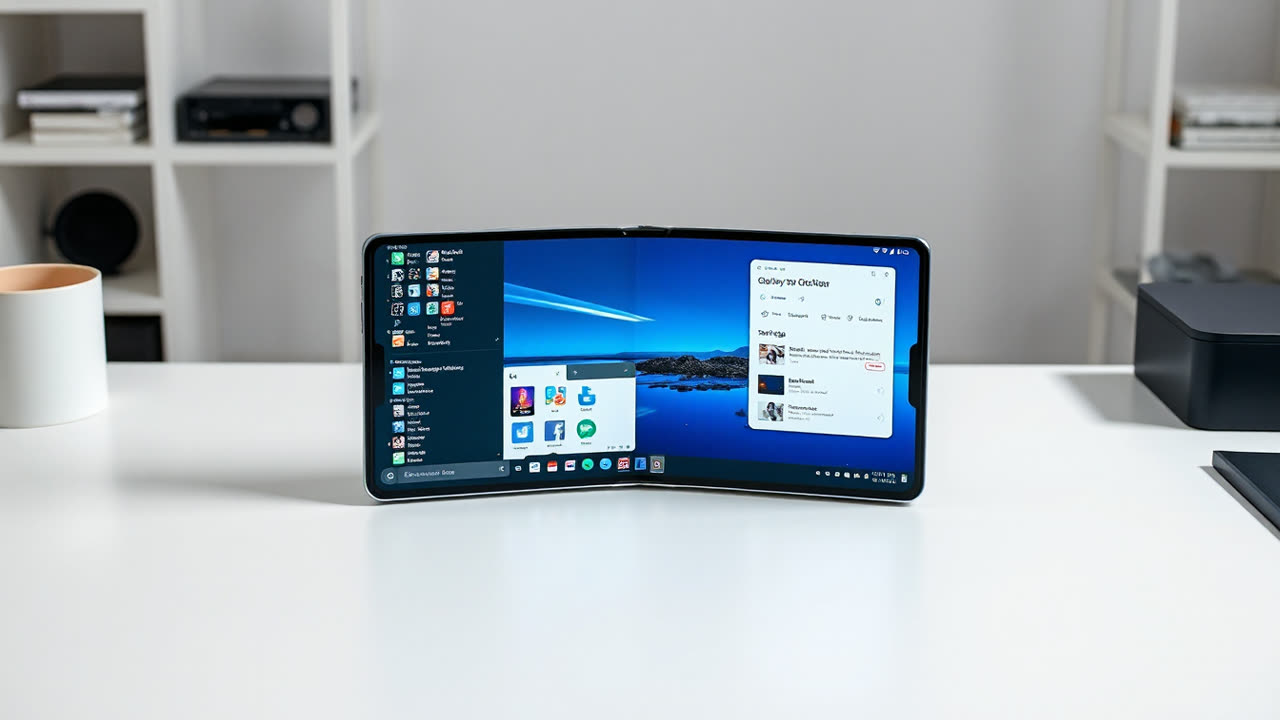
The Galaxy Z Fold 8, released in August 2026, has revealed a latent capability through an unofficial workaround, enabling users to launch Samsung's DeX desktop environment directly on its expansive inner display, fundamentally transforming the device into a self-contained, PC-like workstation. This discovery bypasses Samsung's traditional restriction, which typically reserves DeX for external monitors or the smaller cover screen, unlocking unprecedented on-device productivity for a foldable. The trick, which involves specific developer options or third-party launchers, forces DeX to render its full desktop interface, complete with a taskbar, resizable windows, and a cursor-driven experience, across the Z Fold 8's 7.6-inch Dynamic AMOLED 2X internal panel. This is a significant leap from the standard Android tablet mode, which often struggles with multi-window management and application scaling, and it represents a profound shift in how users can interact with their primary mobile device.
The immediate impact on users is a dramatic increase in the Z Fold 8's utility, effectively blurring the lines between smartphone, tablet, and ultraportable laptop. Professionals on the go, students, or anyone needing robust multitasking capabilities without carrying multiple devices will find this feature invaluable. Imagine editing documents, managing complex spreadsheets, or conducting video conferences with multiple applications open simultaneously, all within a familiar desktop paradigm, directly on the device itself. This capability, while unofficial, addresses a long-standing user desire for true convergence, allowing the Z Fold 8's formidable Snapdragon 8 Gen 4 processor and up to 16GB of RAM to be fully leveraged for demanding tasks that previously required an external display. The ability to use the inner screen for DeX also enhances the device's value proposition against traditional tablets, offering superior portability and the added functionality of a full-fledged smartphone.
Historically, Samsung DeX has evolved from a simple docking station accessory in 2017 with the Galaxy S8 to a wireless casting solution and, more recently, a limited on-device mode for the cover screens of foldable devices. However, the full DeX experience, designed for larger displays, has always been tethered to an external monitor. This "trick" on the Z Fold 8 represents a logical, albeit unsanctioned, progression, showcasing the hardware's inherent readiness for more advanced on-device computing. Competitors in the foldable space, such as Google's Pixel Fold 3 or OnePlus Open 2 (expected in late 2026), offer robust tablet modes within Android but lack a dedicated, full-fledged desktop environment directly on their inner screens. While Android 15 and 16 have introduced improvements in desktop mode for external displays, Samsung DeX remains the most refined and feature-rich solution for a PC-like experience, giving the Z Fold line a unique, if currently hidden, advantage. The Z Fold 8's larger, more immersive display, compared to prior generations like the Z Fold 7, further amplifies the benefits of this DeX implementation, making the desktop environment feel genuinely usable rather than cramped.
Looking ahead, this unofficial capability puts significant pressure on Samsung to officially integrate and optimize DeX for the inner screens of future Galaxy Z Fold devices. The current workaround, while functional, may suffer from minor compatibility issues or lack the seamless integration of an officially supported feature. Samsung has an opportunity to solidify its leadership in the foldable market by embracing and refining this on-device DeX experience, potentially introducing dedicated software features, improved peripheral support (like enhanced keyboard and mouse integration), and cloud-based application streaming to further elevate the mobile workstation concept. This move could redefine the foldable category, positioning these devices not just as sophisticated smartphones, but as primary computing devices capable of handling a vast array of productivity tasks. The ultimate vision is a single device that seamlessly transitions between a pocketable smartphone, a versatile tablet, and a powerful desktop computer, a future the Z Fold 8, through this clever trick, has inadvertently brought closer to reality.