Geely Unveils AI-Powered Fast Charging System That 'Heals' EV Batteries
Geely has unveiled an AI-powered fast charging system capable of extending electric vehicle battery cycle life by up to 20% through a novel micro-pulse current technology designed to actively reverse some of the damage typically incurred during rapid charging.
✨ This content was summarized and interpreted by AI; it may contain errors — please verify accuracy with the original sources. Learn more
Listen to this story
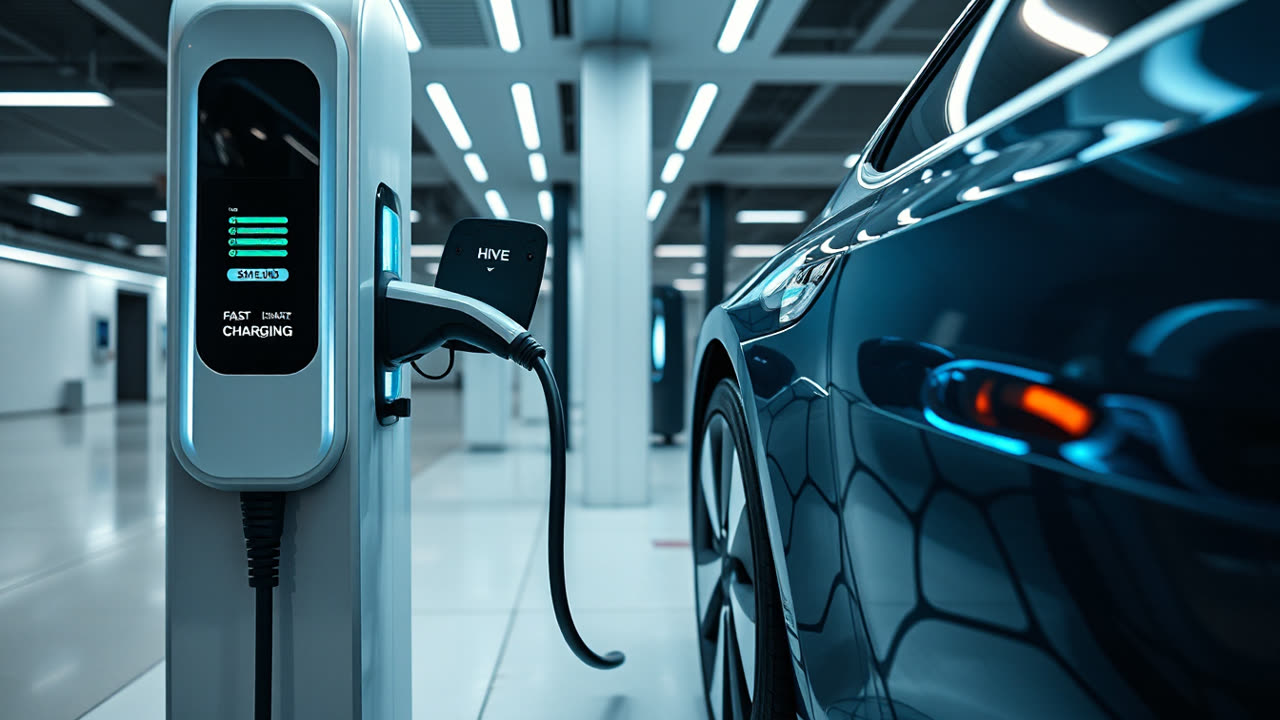
Geely has unveiled an AI-powered fast charging system capable of extending electric vehicle battery cycle life by up to 20% through a novel micro-pulse current technology designed to actively reverse some of the damage typically incurred during rapid charging. This breakthrough, announced on September 25, 2026, directly confronts one of the most significant trade-offs in EV adoption: the desire for ultra-fast charging versus the long-term degradation of expensive battery packs.
The core innovation lies in the system's ability to "heal" batteries. Traditional fast charging, while convenient, subjects lithium-ion cells to high currents and temperatures, accelerating the formation of dendrites and solid electrolyte interphase (SEI) layers, which reduce capacity and power over time. Geely's AI system reportedly monitors battery health in real-time and, during charging, applies precisely controlled micro-pulse currents. These pulses are engineered to break down resistive layers and potentially mitigate the growth of deleterious structures, effectively rejuvenating the battery at a microscopic level. The 20% increase in cycle life translates directly into thousands more charging cycles, significantly extending the operational lifespan of an EV and deferring the inevitable, costly battery replacement. For a typical EV battery rated for 1,000 to 1,500 cycles before significant degradation, this could mean an additional 200 to 300 cycles, pushing the effective lifespan well beyond current industry averages of 8-10 years or 100,000-150,000 miles.
This development holds profound implications for both consumers and the broader automotive industry. For users, the immediate benefit is a substantial reduction in the total cost of ownership. Battery packs represent the single most expensive component of an EV, often accounting for 30-40% of the vehicle's manufacturing cost. Extending their life by a fifth effectively amortizes this cost over a longer period, making EVs more economically viable and competitive with internal combustion engine vehicles, particularly in the used car market where battery health is a major concern. Furthermore, it addresses range anxiety not just from a charging speed perspective, but from a longevity standpoint, assuring owners that their vehicle's performance will remain robust for years longer. For fleet operators, where vehicle uptime and predictable maintenance schedules are paramount, this technology could unlock new levels of efficiency and profitability.
Industrially, Geely's announcement sets a new benchmark in battery management systems (BMS) and charging infrastructure. While many manufacturers focus on increasing charging speeds, often at the expense of long-term battery health, Geely's approach tackles the degradation issue head-on. Rivals like Tesla, Porsche, and Hyundai have pushed 800V architectures to enable charging rates of 250 kW to 350 kW, achieving 10-80% charge in under 20 minutes. However, these systems still contend with the inherent chemical stresses on batteries. Companies like StoreDot are developing extreme fast charging (XFC) capabilities, aiming for 100 miles of range in five minutes, but their primary focus remains on speed rather than active degradation reversal. Geely's solution complements these efforts, suggesting that future EV charging could be both lightning-fast *and* battery-preserving. Prior generations of charging technology largely ignored active repair, relying instead on passive cooling and sophisticated algorithms to *slow* degradation, rather than *reverse* it.
The background to this innovation stems from extensive research into battery electrochemistry and the application of artificial intelligence to optimize complex charging profiles. AI algorithms can analyze myriad data points—temperature, voltage, current, internal resistance, and historical usage patterns—to precisely determine the optimal micro-pulse sequence needed for various battery states and chemistries. This level of dynamic, adaptive charging is far beyond what static charging protocols can achieve. While specific deployment timelines and the first Geely models to feature this technology were not immediately detailed, the company's broad portfolio, including brands like Volvo, Polestar, and Zeekr, suggests a wide potential rollout.
Looking ahead, Geely's "healing" fast charging heralds a new era for EV battery technology. It is reasonable to expect that this capability will become a critical differentiator in the fiercely competitive EV market. Other manufacturers will undoubtedly accelerate their own research into active battery regeneration, potentially leading to a race for even greater cycle life extensions. This could also pave the way for more resilient battery chemistries that are inherently more amenable to such restorative processes. Furthermore, the concept of "battery-as-a-service" or subscription models for battery health could emerge, where manufacturers guarantee a certain level of performance over the vehicle's lifetime, underpinned by technologies like Geely's. Challenges remain in scaling this technology across diverse battery chemistries and ensuring its long-term efficacy under real-world conditions. However, the fundamental shift from merely slowing degradation to actively reversing it represents a paradigm change, promising a future where EV batteries are not just powerful and fast-charging, but also remarkably durable and sustainable.