Generalist AI Unveils GEN-1.5: Robots Learn Complex Tasks from Single, Brief Demonstration
Generalist AI's groundbreaking GEN-1.5 robot foundation model enables robots to instantaneously learn complex physical tasks from a mere 3-12 second single demonstration, dramatically reducing deployment time and expertise.
✨ This content was summarized and interpreted by AI; it may contain errors — please verify accuracy with the original sources. Learn more
Listen to this story
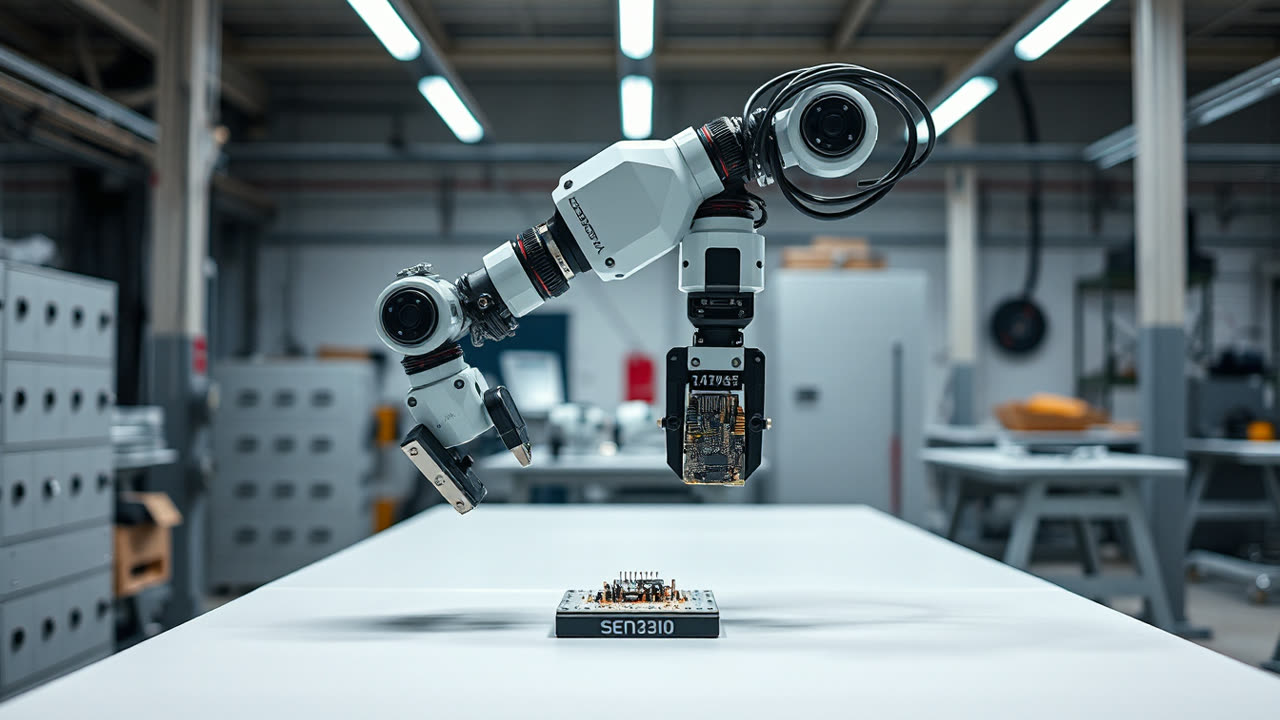
Generalist AI has unveiled GEN-1.5, a groundbreaking robot foundation model capable of learning complex physical tasks from a mere 3-12 second single demonstration, marking a significant leap toward truly adaptable robotic systems. This new paradigm allows for the instantaneous assimilation of new skills without the arduous process of gradient-based training, requiring only a brief sensorimotor data input into its 30-second context window. The immediate implication is a dramatic reduction in the time and expertise traditionally required to deploy robots in new, unstructured environments, moving beyond the often-rigid programming or extensive fine-tuning that has historically constrained robotic applications.
The core innovation of GEN-1.5 lies in its ability to generalize from minimal data, something previous robot learning models have struggled with. Traditional approaches often rely on large datasets and iterative training, where a robot might perform hundreds or thousands of repetitions to refine a single task. In contrast, GEN-1.5's "no gradient" learning suggests a novel architectural design, likely leveraging pre-trained world models or highly sophisticated latent space representations that can rapidly map a new demonstration to existing knowledge and extrapolate the necessary motor commands. This instant learning capability fundamentally redefines the bottleneck in robotic deployment from data acquisition and model training to simply providing a concise, real-world example. For industries like manufacturing, logistics, and even domestic robotics, this translates directly into unprecedented flexibility, allowing robots to adapt on the fly to new product variations, changing warehouse layouts, or novel household chores without requiring a team of AI engineers for each new scenario.
Comparing GEN-1.5 to its predecessors and current rivals reveals its transformative potential. Prior generations of robot learning, such as reinforcement learning models, have shown promise but often demand millions of simulated or real-world interactions, making them impractical for rapid, on-demand task acquisition in dynamic environments. Even advanced imitation learning techniques typically necessitate multiple demonstrations and significant data augmentation to achieve robust performance. While companies like Google DeepMind and OpenAI have made strides with models like RT-2 and Gato, which integrate vision-language models with robotic control, GEN-1.5's stated ability to learn from a *single, brief* demonstration without gradient updates pushes the frontier further, suggesting a more efficient and less computationally intensive learning mechanism for physical tasks. The emphasis on sensorimotor data as the primary input also highlights a departure from purely visual or linguistic instructions, grounding the learning directly in the robot's physical experience. This direct learning from demonstration, without the need for extensive data curation or label generation, dramatically lowers the barrier to entry for robotic automation, particularly for small and medium-sized enterprises that lack the resources for complex AI development.
The impact on the industry will be profound. For businesses, GEN-1.5 promises faster deployment cycles and greater agility in automating tasks previously considered too variable or niche for cost-effective robotic solutions. Consider a factory floor where new assembly steps are introduced weekly, or a warehouse where product packaging changes frequently; a robot powered by GEN-1.5 could learn these new operations in seconds, minimizing downtime and maximizing productivity. This could accelerate the adoption of robotics in sectors where adaptability is paramount, such as healthcare (assisting with novel surgical procedures), hospitality (learning new service protocols), and even agriculture (adapting to specific crop handling techniques). The "no gradient" aspect also hints at lower computational requirements during the learning phase, potentially reducing the energy footprint and hardware costs associated with advanced AI robotics. Moreover, it could democratize robot programming, allowing non-specialists to "teach" robots new skills simply by showing them, much like one would teach a human apprentice.
Looking ahead, the development of GEN-1.5 suggests a future where robots are not just tools performing pre-defined functions, but truly generalist agents capable of continuous, rapid learning from human interaction. The immediate next steps will likely involve rigorous testing across a wider array of real-world scenarios to validate its robustness and generalization capabilities beyond laboratory conditions. Further research will undoubtedly focus on expanding the complexity of tasks it can learn, extending the context window, and integrating multi-modal inputs beyond just sensorimotor data, potentially combining brief visual demonstrations with natural language instructions. The long-term trajectory points towards a future where foundation models like GEN-1.5 become the operating system for a new generation of highly intelligent and adaptable robots, capable of seamlessly integrating into diverse human environments and performing an ever-expanding repertoire of tasks with minimal human intervention. This shift could usher in an era where robots are as easy to teach new skills as they are to power on, fundamentally altering the landscape of labor, automation, and human-robot collaboration.