GMKtec Unveils Evo-X5 Pro: A $7,099 Mini-PC with 192GB RAM for Offline AI
GMKtec's new Evo-X5 Pro, powered by AMD's Ryzen AI Max+ PRO 495 and featuring an unprecedented 192GB of LPDDR5X memory, sets a new benchmark for compact local AI inference, capable of running 320-billion-parameter LLMs offline.
✨ This content was summarized and interpreted by AI; it may contain errors — please verify accuracy with the original sources. Learn more
Listen to this story
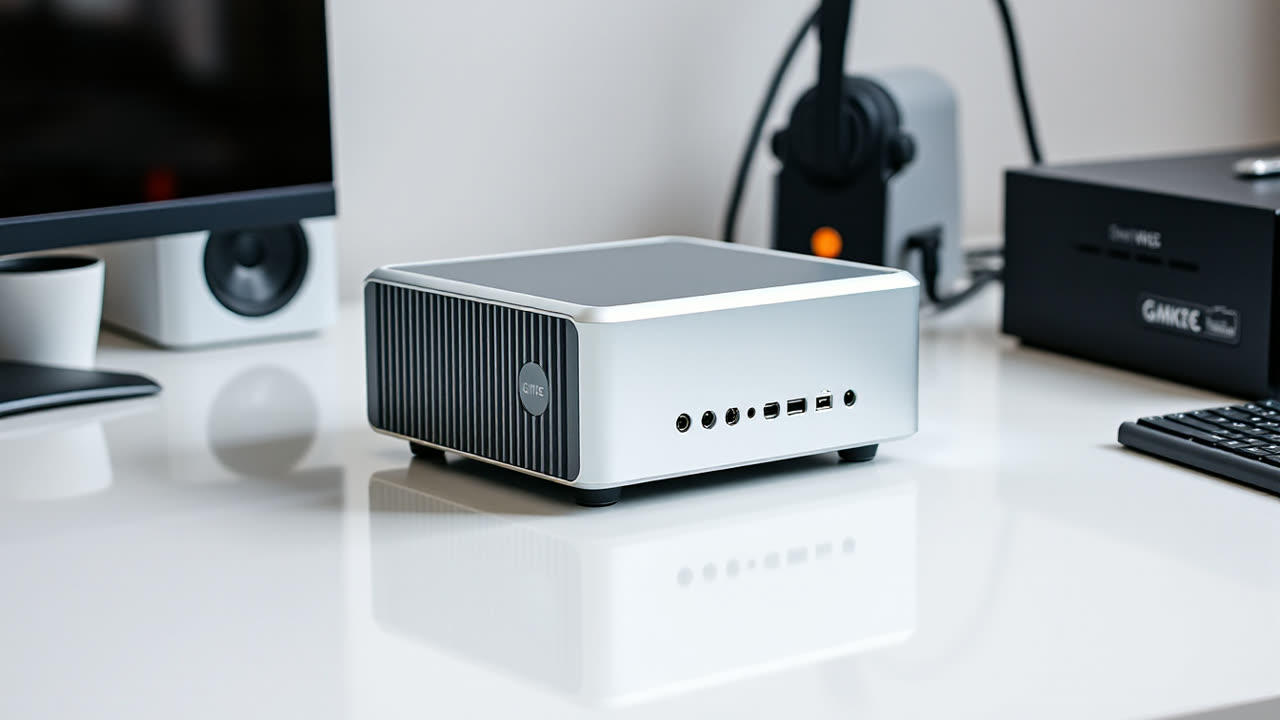
An eye-watering $7,099 price tag accompanies GMKtec's new Evo-X5 Pro, a compact AI mini-PC packing 192GB of LPDDR5X-8533 unified memory and AMD's formidable Ryzen AI Max+ PRO 495 processor. Launched at IFA 2026, this machine, leveraging the "Gorgon Halo" codenamed APU, is explicitly designed to run large language models (LLMs) with up to 320 billion parameters entirely offline, marking a significant, albeit expensive, stride towards the "agentic PC" era.
This substantial investment signifies a pivotal moment for on-device AI. The Evo-X5 Pro isn't merely a powerful mini-PC; it's a dedicated workstation engineered for the burgeoning field of local AI inference. Its sheer memory capacity, dynamically configurable with up to 160GB allocated as VRAM, directly addresses one of the most critical bottlenecks in running complex AI models on consumer-grade hardware: the ability to load entire large models into memory. This capability is crucial for developers, researchers, and professionals in privacy-sensitive sectors like healthcare, finance, and legal, who require the benefits of AI without the inherent security and compliance risks of transmitting proprietary data to cloud-based services. The ability to process data on-premise offers enhanced privacy and reduced latency, fostering a more controlled and secure AI environment.
At the heart of the Evo-X5 Pro is the AMD Ryzen AI Max+ PRO 495, featuring 16 Zen 5 CPU cores, 32 threads, and boost clocks up to 5.2 GHz. Crucially for AI workloads, it integrates an AMD XDNA 2 NPU delivering up to 55 TOPS (Trillions of Operations Per Second) and an AMD Radeon 8065S GPU with 40 compute units, contributing to an impressive overall AI performance of up to 131 TOPS (combining CPU, GPU, and NPU). This "Gorgon Halo" processor, fabricated on a 4nm process, represents a refresh of the "Strix Halo" (Ryzen AI Max 300 series), distinguishing itself by exclusively utilizing full-size Zen 5 cores, unlike the hybrid Zen 5 and Zen 5c approach of the "Gorgon Point" (Ryzen AI 400 series). The inclusion of dual 10GbE LAN ports, multiple USB4 V2 (80Gbps) and USB4 (40Gbps) ports, AMD DASH remote management, and dTPM 2.0 security further underscores its enterprise-ready design, even supporting rack clustering for scalable deployments.
Comparing this to rivals reveals AMD's aggressive push in the high-end local AI space. Intel's Lunar Lake processors (Core Ultra 200V Series), launched in September 2024, offer an NPU with up to 48 TOPS and a total AI performance of up to 120 TOPS, but are currently limited to a maximum of 32GB LPDDR5X memory. Apple's M4 chip, debuted in May 2024, boasts a 16-core Neural Engine achieving 38 TOPS. While Apple Silicon is renowned for its unified memory architecture, current Mac Mini M4 Pro configurations typically cap at 64GB of unified memory, significantly less than the Evo-X5 Pro's 192GB. Qualcomm's Snapdragon X Elite chips, expected in laptops, promise 45 TOPS from their NPU and 75 TOPS total. While these competitors meet or exceed Microsoft's 40 TOPS requirement for Copilot+ PCs, none currently match the Evo-X5 Pro's combination of raw NPU power and expansive unified memory in a mini-PC form factor. Other AMD Ryzen AI Max+ 395 mini-PCs from manufacturers like Minisforum, Beelink, and other GMKtec models offer up to 128GB of unified memory with 50 TOPS NPUs, typically priced between $1,200 and $2,500, positioning the Evo-X5 Pro in a distinct, ultra-premium segment.
The significance of the Evo-X5 Pro extends beyond raw specifications. It addresses the growing demand for "agentic PCs," a market projected to surge from USD 12.84 billion in 2026 to USD 337.63 billion by 2035, exhibiting a compound annual growth rate (CAGR) of 43.8%. The fastest-growing segment within this is edge and on-device agentic AI, with a projected CAGR of 51.2% through 2035. This trend underscores a shift from simple generative AI tools to autonomous, goal-directed AI agents capable of executing complex, multi-step workflows locally. For businesses, running LLMs locally can translate into substantial long-term cost savings compared to cloud APIs, especially for high-volume usage, potentially saving 30-50% over three years despite high upfront hardware costs.
Looking ahead, the Evo-X5 Pro sets a new benchmark for compact, high-performance local AI computing. AMD's roadmap indicates an annual cadence for AI product releases, with Zen 6-based EPYC CPUs (Venice) and Instinct MI400 series AI accelerators slated for 2026, followed by the MI500 series in 2027 and MI600 series in 2028. Further into the future, Zen 7 (Florence, Ferrara, Fidenza) is expected in 2028, and Zen 8 (Ravenna) in 2030, suggesting continuous innovation in AI processing power and memory integration. This trajectory implies increasing competition and miniaturization of AI hardware, pushing the boundaries of what's possible on the desktop. The Evo-X5 Pro, while currently a niche, high-cost solution, foreshadows a future where robust, private, and powerful AI capabilities are increasingly accessible on the edge, fundamentally reshaping how individuals and enterprises interact with artificial intelligence.